


There is too much content and I am too lazy to read it all. Why not get a summary?
Fear, Hesitation, and Doubt (FUD): Spreading fear and uncertainty to gain a competitive advantage.
Fear of missing out (FOMO): The mentality of buying blindly due to fear of missing out.
Hold Long Term (HODL): Buy and hold for the long term!
BUIDL: Keep your head down and work hard to build the next financial system.
Safe Asset Fund for Users (SAFU): Funds are absolutely safe!
Return on Investment (ROI): Money earned (or lost).
All Time High (ATH): The highest price ever!
All-time Low (ATL): The lowest price in history.
Do your own research (DYOR): don’t trust anything, verify carefully.
Due Diligence (DD): Reasonable people make decisions based on facts.
Anti-Money Laundering (AML): Regulations that prevent criminals from hiding money.
Identity verification (KYC): The trading platform’s rules for verifying user identity.
Introduction
Whether it’s the stock market, day trading, forex, or emerging cryptocurrencies, unfamiliar trading terminology is everywhere. What do FOMO, ROI, ATH, and HODL stand for? Trading and investing have their own terminology, and learning new terms can always be daunting. However, if you want to keep up with financial market trends, learning these terms is very useful.
This article has compiled some of the important terms you need to know when trading cryptocurrencies.
1. Fear, Hesitation and Doubt (FUD)

Fear, hesitation and doubt (FUD) is not an exclusive trading term, but is commonly used in financial markets. Fear, hesitation, and doubt (FUD) is a tactic used to discredit a specific company, product, or project by spreading negative information with the goal of creating fear to gain a competitive advantage. This advantage may be a competitive advantage or a tactical advantage, or it may be the opportunity to profit from a drop in stock prices due to potentially negative news.
It turns out that fear, hesitation, and doubt (FUD) is all too common in the cryptocurrency space. In many cases, investors take a short position in an asset and then publish potentially harmful or misleading news, and then make huge profits by selling short or buying put options. Investors also arrange over-the-counter (OTC) transactions in advance.
Most of the time, these stories tend to be false, or at least misleading, but there are some cases where they turn out to be true. It is worth advocating to consider the controversy in its entirety. It’s helpful to think about people’s motivations for sharing their exact opinions publicly.
2. Fear of missing out (FOMO)
Fear of missing out (FOMO) refers to the mentality of investors who rush to buy assets because they are afraid of missing out on profit opportunities. A large number of users have a fear of missing out (FOMO) mentality, and this violent fluctuation of emotions leads to parabolic price trends. Investors' "FOMO-ing" from waiting and watching to seizing asset investment opportunities usually indicates that they have entered the late stage of the bull market.
If you read our article on common mistakes in technical analysis (TA), you will know that extreme market conditions can change market practices. Once emotions get out of hand, many investors may open positions out of fear of missing out (FOMO), which may lead to two-way action, and many traders who try to make reverse trades may be trapped.
Fear of missing out (FOMO) is also widely used in social media app design. Have we ever wondered why social media posts are not displayed in strict chronological order? This also goes hand in hand with the fear of missing out (FOMO). If the user can still see all posts from the last time they logged in, they will assume they are done with the latest content.
Social media platforms deliberately disrupt the timeline of new and old posts to instill fear of missing out (FOMO) among users. As a result, users will refresh their browsing frequently for fear of missing important information.
3. Long-term holding (HODL)
Hold for the Long Term (HODL) comes from a misspelling of “hold” and is basically equivalent to the buy and hold strategy for cryptocurrencies. "HODL" first appeared in a well-known post on the BitcoinTalk forum in 2013, originating from the misspelling of the post title "I AM HODLING".
"HODLing" means continuing to hold on to a stock despite falling prices. This term is often used to describe investors who admit that they are not good at short-term trading, but want to understand the price of cryptocurrency ("long-term holders"), or some investors who have a high degree of trust in a specific currency and intend to invest for the long term. .
The long-term holding strategy is similar to the traditional market buy-and-hold investment strategy. Investors buy and hold undervalued assets for the long term. Many investors use this strategy to invest in Bitcoin.
If you've read our article on dollar-cost averaging (DCA), you'll know that this is a great strategy for making high returns investing in Bitcoin. If you had bought just $10 in Bitcoin every week over the past 5 years, your investment income would have been more than 7 times your principal!
4. BUIDL
BUIDL is a derivative term from HODL, which usually describes cryptocurrency industry players who insist on building infrastructure despite price fluctuations. The main logic of this concept is that no matter how brutal the bear market is, loyal fans will continue to build the ecosystem of the cryptocurrency industry. In this sense, “BUIDLers” truly embrace blockchain and cryptocurrency development and continue to actively contribute to achieving this goal.
BUIDL is a mindset that provides insight into how cryptocurrencies are not just a speculation, but a new technology worth promoting to the masses. This concept always reminds us to keep a low profile and continue to build the infrastructure of cryptocurrency to better provide services to billions of users in the future. In addition, BUIDLer believes that teams with a long-term vision can go further.
5. Security Asset Fund for Users (SAFU)

The Safe Asset Fund for Users (SAFU) originated from a meme uploaded by Bizonacci. In the video, Binance CEO Changpeng Zhao (CZ) said that "funds are safe and worry-free" even during unplanned platform maintenance.
The video quickly went viral in cryptocurrency circles. In response, Binance established the Safe Asset Fund for Users (SAFU), charging 10% of transaction fees as an emergency insurance fund. These funds are stored in separate cold wallets. The idea behind its creation is that in the event of extreme circumstances, the Safe Asset Fund for Users (SAFU) can make up for users' capital losses and provide additional protection for Binance users. This is why we often hear “funds are protected by SAFU”.
6. Return on investment (ROI)
Return on investment (ROI) is a way of measuring the return on investment. Return on investment (ROI) measures return on investment based on principal and is a convenient way to compare returns from different investments.
Here's how to calculate return on investment (ROI): Subtract the principal invested from the current value of the investment and divide by the principal.
Return on investment = (current value - principal) / principal
Suppose you buy Bitcoin for $6,000 and the current price of Bitcoin is $8,000.
ROI = (8000 - 6000) / 6000
ROI = 0.33
In other words, the current price has increased by 33% from the principal amount. For more accurate results, you also need to take into account the fees (or interest rates) paid.
After all, rough numbers don’t tell the whole story. There are other factors to consider when comparing investment projects. What are the risks? How long is the time span? How liquid are the assets? Does sliding spread affect buying price? Return on investment (ROI) is not the ultimate metric in itself, but a tool to effectively measure investment returns.
Calculating position size is critical when considering investment returns. For a simple formula for effective risk management, read How to Calculate Position Size in Trading.
7. All-time high (ATH)
This concept shouldn’t require much explanation, right? An all-time high is the highest recorded price for an asset. For example, during the 2017 bull market, the trading volume of Bitcoin in the Binance BTC/USDT trading pair was 19,798.86 USDT, a record high. That said, this is the highest price Bitcoin has ever traded at in this market pair.
The most gratifying thing is that as long as the asset reaches a new all-time high, almost all users who buy can make a profit. If an asset is in a long-term bear market, many losing traders will want to exit the position when it reaches breakeven.
However, traders who had hoped to exit the market at breakeven will not leave once the asset breaks out to a new all-time high (ATH). This is why some call the all-time high (ATH) a "blue sky breakout" because there may not be a resistance zone above.
Breakouts to new all-time highs (ATH) are also typically accompanied by a surge in volume. why? Because day traders will also seize the opportunity to buy market orders and sell them at a higher price to make a quick profit.
Does breaking out of the all-time high (ATH) mean there will be no limit to price gains? of course not. Traders and investors seek to profit at certain points and place limit orders at certain price levels. Especially when previous all-time highs are continually being breached.
Many investors rush out of the market once they realize the uptrend is coming to an end. Therefore, parabolic moves often end in sharp price declines. Please look at Bitcoin’s plunge after rising to $20,000 in December 2017, showing a parabolic trend.
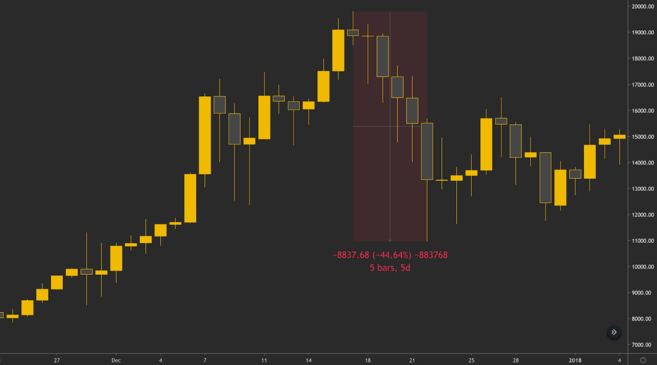
The price of Bitcoin fell from $20,000 to $11,000 in just five days.
After reaching an all-time high (ATH) of $19,798.86, Bitcoin dropped nearly 45% in just a few days. Therefore traders should manage their risk and always use stop loss orders.
8. Historical Low (ATL)
In contrast to the all-time high (ATH), the all-time low (ATL) is the lowest price of an asset. For example, in the BNB/USDT market pairing, BNB’s historical lowest price on the first trading day was 0.5 USDT.
A breakout of an asset's price from an all-time low can lead to similar results as a breakout from a new all-time high, but in the opposite direction. When an asset's price breaks past its previous all-time low, many take-profit and stop-loss orders can be triggered, causing the price to plummet.
Since prices are at historic lows, the market value will continue to fall, with no lower limit. Since there is no logical lower limit, buying during this period is extremely risky.
Many traders wait for a significant trend to emerge, confirmed by moving averages or other indicators, before considering entering a long position. Otherwise, you may be stuck for a long time and trapped in a situation of falling prices.
Want to start your cryptocurrency journey? Welcome to buy Bitcoin on Binance!
9. Do your own research (DYOR)

In the financial markets, the term "Do Your Own Research (DYOR)" is closely related to fundamental analysis (FA), which means that investors should conduct independent research on their investments and should not rely on others. In the cryptocurrency market, there is another sentence that is often used to express a similar meaning, that is, "Don't trust easily, verify carefully."
The most successful investors do their own research and draw their own conclusions. If you want to succeed in the financial market, you must have your own unique trading strategy. This can lead to disagreements between different investors, but is perfectly normal for investing and trading. Some investors are bullish, and others are bearish.
Different perspectives can accommodate different strategies, and successful traders and investors may adopt very different trading strategies. The key is that they all did their own research, came to their own conclusions, and made investment decisions based on those conclusions.
10. Due Diligence (DD)
There is a certain connection between due diligence (DD) and doing your own research (DYOR), which refers to the investigation and attention that a reasonable person or company would conduct before reaching an agreement with the other party.
If reasonable business entities reach an agreement, it means they have completed due diligence on each other. Why? Because rational investors want to ensure that a trade does not raise potential red flags, how else can they compare potential risks with expected returns?
The same goes for investing. When investors are looking for potential investment opportunities, they need to conduct due diligence on the project to ensure that all risks are fully considered. Otherwise, they will not be able to make confident investment decisions and may end up making wrong choices.
11. Anti-Money Laundering (AML)
Anti-money laundering (AML) refers to a series of regulations, laws and procedures designed to prevent criminals from converting their illegal income into legal income. Anti-money laundering (AML) procedures make it difficult for criminals to "launder" money by hiding or pretending to be legitimate.
Criminals will find ways to hide the true source of funds. Due to the complexity of financial markets, operating methods can also be varied. Derivatives, which are made up of derivatives, and other complex market instruments make it difficult, but not impossible, to trace the true source of funds.
Anti-money laundering (AML) regulations require financial institutions such as banks to monitor customer transactions and report suspicious behavior. Therefore, criminals who use money laundering to convert illegal gains will eventually be unable to escape the law.
12. Identity verification (KYC)
Stock exchanges and trading platforms must adhere to national and international norms. For example, the New York Stock Exchange (NYSE) and Nasdaq (NASDAQ) must comply with regulations set by the U.S. government.
Know Your Customer (KYC) guidelines ensure institutions verify customer identities using financial transaction instruments. Why is this important? This is mainly because it minimizes the risk of money laundering.
In addition, not only financial industry players must adhere to identity verification (KYC) guidelines, but many other industry segments must also adhere to these guidelines. Generally speaking, identity verification (KYC) guidelines are a broader anti-money laundering (AML) strategy.
Summarize
Cryptocurrency trading terminology may seem confusing at first, but now that you have a general understanding, you will feel more SAFU protected when you see these acronyms. Make sure to do your own research (DYOR) on fear, hesitation and doubt (FUD), and do not blindly buy currencies that have broken through all-time highs (ATH) with a fear of missing out opportunity (FOMO). Please continue to hold them for the long term ( HODLing) and continue to build infrastructure (BUIDLing)!
Want to learn more cryptocurrency trading terms? Please visit our Q&A platform Ask Academy, where members of the Binance community will patiently answer your questions.