


Introduction
When you think of safe-haven assets, you probably first think of precious metals like gold or silver. Many individual investors have turned to such investments as a hedge against traditional market turbulence.
The debate continues over whether Bitcoin will follow in the footsteps of these assets. In this article, we will focus on some of the main arguments for and against Bitcoin as a store of value.
What is a store of value?
Stores of value are assets that retain value over time. If you purchase an item today that serves as a store of value, you have reasonable confidence that its value will not depreciate over time. In the future, you would expect the asset to be worth the same as it is today (perhaps even more).
When you think of this “safe haven” asset, gold or silver are probably the first things that come to mind. These items have traditionally held value for a number of reasons, which we’ll get to shortly.
Find out the latest price of Bitcoin (BTC) now.
What is a store of value?
To understand what an ideal store of value is, let’s first explore what a bad store of value is. If we want something to last a long time, it should be durable.
Take food, for example. Apples and bananas have intrinsic value because humans need nutrients to survive. In times of food scarcity, these commodities will undoubtedly be worth a fortune. But that doesn’t make them a good store of value. If you leave them in a safe for a few years, their value will drop significantly because they will obviously go bad.
What about items that have intrinsic value and are durable? For example, dried pasta? This is a better option in the long run, but there is still no guarantee that it will maintain its value. Pasta is produced cheaply using readily available resources. Anyone can put more pasta on the market, and the pasta in circulation will lose value due to oversupply. Therefore, for something to maintain its value, it must also be scarce.
Some people believe that fiat currencies (USD, EUR, JPY) are a good way to store wealth because they retain their value over the long term. But they are actually poor stores of value because as the number of units increases, their purchasing power decreases significantly (just like pasta). You can take out your life savings and hide them under your mattress for 20 years, but when you finally decide to spend the money, it may not have as much purchasing power as it once did.
$100,000 could buy far more in 2000 than it does today. This is mainly due to inflation, which is the rise in the prices of goods and services. In many cases, inflation is caused by an oversupply of fiat currency as governments print more money.
For example, let's say you hold 25% of the total supply of $100 billion, which is $25 billion. Over time, the government decides to print an additional $800 billion to stimulate the economy. Your share is suddenly down to about 3%. There is more money in circulation, so obviously your share has less purchasing power than before.
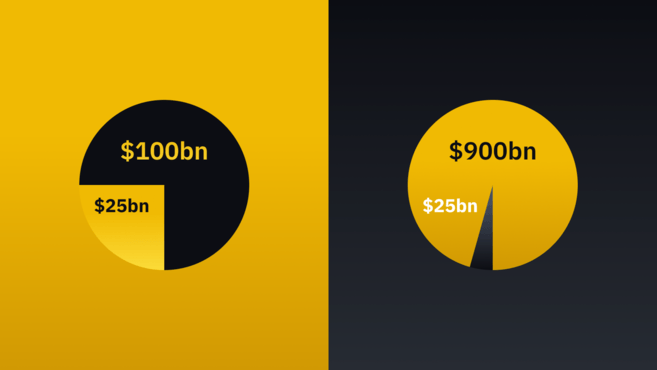
Purchasing power is lost over time.
Like pasta, dollars are cheap to make. This can happen in just a few days. With a good store of value, it's not that easy to flood the market with new units. In other words, if your share is diluted, it should be diluted very slowly.
Take gold, for example. We all know that it is in limited supply. We also know that it is extremely difficult to mine. So even if demand for gold suddenly increased, people couldn't just run a printer to create more gold. Instead, it would have to be mined from the ground as usual. Despite the massive increase in demand, the supply couldn't materially increase to meet that demand.
Bitcoin as a Store of Value
Since the early days of Bitcoin, supporters have argued that the cryptocurrency is more akin to “digital gold” than a simple digital currency, a view that has been shared by many Bitcoin enthusiasts in recent years.
The store of value theory of Bitcoin holds that it is one of the most reliable assets known to mankind. Proponents of this theory believe that Bitcoin is the best way to store wealth so that it does not depreciate over time.
Bitcoin is known for its extreme volatility. Many people think that if an asset can lose 20% of its value in a single day, it sounds unbelievable to use it as a store of value. But even taking into account its many declines, it is still the best performing asset class to date.
So why is Bitcoin hailed as a store of value?
Scarcity
Perhaps one of the most compelling arguments for the store of value theory is that the supply of Bitcoin is limited. If you’ve read our article What is Bitcoin, you may remember that there will never be more than 21 million Bitcoins. The protocol uses hard-coded rules to ensure this.
The only way to create new coins is through a process called mining, which is similar to how gold is mined. But instead of drilling underground, Bitcoin miners must use computing power to crack a cryptographic puzzle. In doing so, they win new coins.
Over time, the reward is reduced by events called halvings. If you guessed that this would cut the reward in half, you'd be right. In the early days of Bitcoin, the system rewarded 50 Bitcoins to any miner who produced a valid block. During the first halving, that number was reduced to 25 Bitcoins. A subsequent halving reduced it to 12.5 Bitcoins, and the next halving cut miners' rewards to 6.25 Bitcoins per block. This process will continue for more than 100 years until the last of the tokens enter circulation.
Let’s model this process in a similar way to the fiat currency example mentioned earlier. Let’s say you bought 25% of the Bitcoin supply (i.e. 5.25 million tokens) many years ago. When you acquired these tokens, you knew that your percentage would remain the same because no entity could add more tokens to the system. There is no government here, well, not in the traditional sense (more on that later). So if you bought (and held on to) 25% of the maximum supply in 2010, you still own 25% today.
Decentralization
You might be thinking, it's open source software, I can just copy the code and mint an additional 100 million tokens myself.
You can. Let's say you cloned the software, made your changes, and ran a node. Everything seems to be working fine. There's just one problem: there are no other nodes to connect to. As soon as you change the parameters of the software, members of the Bitcoin network start to ignore you. You've forked, and you're no longer running the program that is recognized by the world as Bitcoin.
What you have done is the functional equivalent of taking a picture of the Mona Lisa and claiming that there are now two Mona Lisas. You can convince yourself that this is true, but it is not so easy to convince others.
We said that there is a kind of "government" in the Bitcoin space. The government is made up of every user who runs the software. The only way to change the protocol is if a majority of users agree to the change.
Convincing a majority to add tokens is no easy feat — after all, you’re asking them to reduce their holdings. As is the case today, even seemingly trivial features can take years to gain consensus on the network.
As the scale continues to increase, it will only become more difficult to implement changes. Therefore, holders have reason to believe that the supply will not increase significantly. Although the software is man-made, the decentralization of the network means that Bitcoin is more like a natural resource than a code that can be changed at will.
Characteristics of “good money”
Store of value believers also point to some of the properties that make Bitcoin “good money.” Not only is it a scarce digital resource, but it also has the same characteristics that money has had for centuries.
Gold has been used as money in multiple civilizations since its creation. There are many reasons for this. We have already discussed durability and scarcity. These characteristics make for a good asset, but not necessarily a good currency. Add to that fungibility, portability, and divisibility.
Substitutability
Fungibility means that the units are indistinguishable. In the case of gold, any two ounces of gold are worth the same. The same is true for stocks and cash. No matter which specific unit you hold, it is worth the same as any other unit of the same kind.
Bitcoin fungibility is a tricky issue. It doesn't matter which coin you hold. In most cases, 1 BTC = 1 BTC. It gets complicated when you consider that each unit can be linked to previous transactions. In some cases, companies will blacklist funds they believe were involved in criminal activity, even if the holder receives the funds later.
Does it really matter? It's hard to see why. When you buy something with a dollar bill, neither you nor the merchant knows where it was used three transactions ago. There is no concept of transaction history here - a new bill is not worth more than an old one.
However, in a worst-case scenario, older Bitcoins (with more history) could sell for less than new Bitcoins. Depending on who you ask, this scenario could be a significant threat to Bitcoin, or it could be something not to worry about too much. Regardless, for now, Bitcoin is functionally fungible. Blocking of coins due to questionable history is just an isolated incident.
Portability
Portability refers to the ease with which an asset can be transported. $10,000 in $100 bills? Easy to carry around. $10,000 worth of oil? Not so easy.
The ideal currency must be small. It must be portable so that people can pay each other for goods and services.
Gold has always been great at this. At the time of writing, a standard gold coin is worth nearly $1,500. You are unlikely to buy an ounce worth of gold, so smaller denominations take up less space.
Bitcoin is actually superior to precious metals in terms of transportability. It doesn’t even have a physical form. You can store trillions of dollars worth of wealth on a hardware device that fits in the palm of your hand.
Moving $1 billion worth of gold (over 20 tons at current values) requires a huge human and financial effort. Even in cash, you would need to carry several pallets of $100 bills. With Bitcoin, you can send the same amount anywhere in the world for less than a dollar.
Severability
Another important property of money is divisibility—the ability to break it up into smaller units. With gold, you can cut a one-ounce coin in half to get two half-ounce units. You may incur an additional cost by damaging the eagle or buffalo on the coin, but the overall value of the gold remains the same. You can cut your half-ounce coin as many times as you like to get smaller denominations.
Divisibility is another advantage of Bitcoin. There are only 21 million Bitcoins in the world, but each one is made up of 100 million small units (satoshis). This gives users a great deal of control over their transactions, as they can specify an amount to send up to eight decimal places. Bitcoin's divisibility also makes it easier for small investors to buy parts of Bitcoin.
Store of value, medium of exchange, and unit of account
There are varying opinions on the role that Bitcoin currently plays. Many people believe that Bitcoin is simply a currency - a tool for moving money from point A to point B. We will discuss this in the next section, but this view is diametrically opposed to the view defended by many proponents of the store of value theory.
Proponents of the store of value theory believe that Bitcoin must go through several stages before becoming the ultimate currency. It started out as a collectible (arguably the stage we are currently in): it has proven its functionality and security, but has only been adopted by a small number of people. Its core audience is mainly hobbyists and speculators.
Only when there is more knowledge, a stronger institutional infrastructure, and greater confidence in its ability to retain value can it move to the next stage: store of value. Some believe Bitcoin has already entered this stage.
At this time, Bitcoin is not widely used because Gresham's law states that bad money drives out good money. This means that when faced with two currencies, individuals are more likely to spend bad money and hoard good money. Bitcoin users prefer to spend fiat currencies because they have little confidence in the long-term survival of these currencies. They will hold (or hold for a long time) Bitcoin because they believe that Bitcoin can maintain its value.
If the Bitcoin network continues to grow, more users will adopt Bitcoin, liquidity will increase, and the price will become more stable. With greater stability, people will have less incentive to hold Bitcoin in the hope of higher returns in the future. Therefore, we can expect Bitcoin to be used more in commerce and everyday payments as a strong medium of exchange.
Increased usage further stabilizes the price. In the final stage, Bitcoin will become a unit of account, and it will be used to price other assets. You might price a gallon of gas at $4, and similarly, in a world where Bitcoin is the dominant currency, you would use Bitcoin to measure the value of oil.
If all three of these monetary milestones are achieved, supporters believe that in the future Bitcoin will become the new standard that replaces currently used currencies.
Bitcoin as a Store of Value
The arguments presented in the previous section may sound perfectly logical to some, and completely outlandish to others. There are several criticisms of the idea of Bitcoin as “digital gold” from both Bitcoiners and cryptocurrency skeptics.
Bitcoin as digital cash
When disagreements arise on this issue, many people quickly turn to the Bitcoin white paper. To them, it is clear that Satoshi intended Bitcoin to be used for consumption from the beginning. In fact, this is evident from the title of the paper, “Bitcoin: A Peer-to-Peer Electronic Cash System.”
This view holds that Bitcoin is only valuable if users consume the token. Hoarding Bitcoin for a long time is not helping its adoption, but hurting it. If Bitcoin is not widely accepted as a digital currency, then it is not utility that drives its core proposition, but speculation.
These ideological differences led to a major fork in 2017. A minority of Bitcoiners wanted a system with larger blocks, which meant lower transaction fees. As the original network grew in usage, transaction costs could rise dramatically, and many users abandoned lower-value transactions. If the average fee was $10, then it made no sense to spend $3 on a token.
The forked network is now known as Bitcoin Cash. Meanwhile, the original network rolled out its own upgrade, called SegWit. SegWit nominally increased block capacity, but that wasn’t its primary goal. It also laid the foundation for the Lightning Network, which seeks to facilitate low-fee transactions by pushing them off-chain.
In practice, however, the Lightning Network is far from perfect. While regular Bitcoin transactions are fairly easy to understand, managing Lightning Network channels and capacity requires a steep learning curve. It remains to be seen whether the network can be simplified, or whether the design of the solution is fundamentally too complex to be abstracted.
Due to the increasing demand for block space, on-chain transactions during busy periods are no longer cheap. As such, one could make the argument that not increasing the block size would hurt Bitcoin’s usability as a currency.
No intrinsic value
For many people, comparing Bitcoin to gold is absurd. The history of gold is essentially the history of civilization. This precious metal has been an important part of society for thousands of years. It is undeniable that gold has indeed lost some of its dominance since the abolition of the gold standard, but it still remains the quintessential safe-haven asset.
Indeed, it seems far-fetched to compare the network effects of the “king of assets” to an 11-year-old protocol. For thousands of years, gold has been revered as a symbol of social status and an important industrial metal.
In contrast, Bitcoin is useless outside of its network. It cannot function as a conductor for electronics, nor can it be crafted into a giant, sparkly necklace when you decide to start a hip-hop career. It may mimic gold (mining, limited supply, etc.), but that doesn't change the fact that it is a digital asset.
In some ways, all money is a shared belief - the dollar is valuable because the government says it is and society accepts it. Gold is valuable because everyone thinks it is valuable. Bitcoin is no different, but those who assign value to it are still a small minority of a much larger population. In your real life, you probably often need to explain what Bitcoin is in the middle of a conversation because the vast majority of people are unaware of its existence.
Volatility and Correlation
Those who got in early on the Bitcoin market have certainly enjoyed an order of magnitude increase in wealth. For them, Bitcoin is indeed a store of value - and more. But those who bought the first tokens at the all-time high price did not enjoy this pleasure. Many people sold at any time afterwards and suffered huge losses.
Bitcoin is incredibly volatile and its market is completely unpredictable. In comparison, metals like gold and silver have very little volatility. You could argue that it’s too early and that the price of Bitcoin will eventually stabilize. But that in itself could be a sign that Bitcoin is not currently a store of value.
You also need to consider Bitcoin's relationship to traditional markets. Bitcoin has been on a steady upward trend since its inception. If all other asset classes are doing well, cryptocurrencies don't really pass the test as a safe haven asset. Bitcoin enthusiasts may say it's "uncorrelated" to other assets, but we won't know that unless other assets suffer and Bitcoin remains stable.
Tulip Fever and Beanie Babies
If we compare Bitcoin to tulip mania and Beanie Babies, we can get a proper critique of Bitcoin’s store of value properties. These aren’t great analogies at best, but they illustrate the dangers of a bubble bursting.
In both cases, investors flocked to buy items they believed to be rare, hoping to resell them for a profit. The items themselves weren’t that valuable because they were relatively easy to produce. When investors realized they had overvalued their investments, the bubble burst and the tulip and Beanie Baby markets subsequently collapsed.
Again, this is not a very good analogy. Bitcoin’s value does come from the belief that users have in it, but unlike tulips, people can’t farm more Bitcoins to meet demand. That is, there is nothing to guarantee that investors won’t decide that Bitcoin is overvalued in the future, causing its bubble to burst.
Summarize
Indeed, Bitcoin has most of the characteristics of a store of value like gold. It has a finite number of units, a decentralized network that ensures security for holders, and it can be used to hold and transfer value.
Ultimately, it will also have to prove its worth as a safe-haven asset — and it’s too early to tell. It could go both ways — the whole world could flock to Bitcoin in times of economic turmoil, or it could continue to be used by a select few.
Time will prove everything.