


chapter
Introduction to Bitcoin
Where does Bitcoin come from?
Get started with Bitcoin
Bitcoin Halving
Common Misconceptions
Bitcoin’s scalability
Participating in the Bitcoin Network
Chapter 1: Introduction to Bitcoin
Contents
What is Bitcoin?
What is Bitcoin used for?
What is the value of Bitcoin?
How does the Bitcoin system work?
What is blockchain?
Is Bitcoin legal?
A brief history of Bitcoin
Who invented Bitcoin?
Did Satoshi Nakamoto invent blockchain technology?
Digital currencies before Bitcoin
What is Bitcoin?
Bitcoin is a form of digital cash. Unlike common fiat currencies, Bitcoin is not controlled by any central bank; the financial system it belongs to is run by thousands of computers around the world, and anyone who wants to participate only needs to download open source software.
As the first digital currency, the concept of Bitcoin was proposed in 2008 (issued in 2009). It gives users the ability to send and receive digital currency (abbreviated as "BTC" in English), but Bitcoin's more notable features are: anti-censorship, funds cannot be used twice, and transactions can be conducted anytime and anywhere.
What is Bitcoin used for?
Everyone uses Bitcoin for different reasons. Many people like its permissionless nature, meaning anyone with an Internet connection can send and receive it. In terms of its unrestricted use, Bitcoin is a bit like cash; but its digital form means it can be transferred across borders.
What is the value of Bitcoin?
Bitcoin is decentralized, censorship-resistant, secure, and borderless.
Based on the above characteristics, Bitcoin's advantageous use cases include international remittances and payments, which effectively protect personal identity privacy (using debit or credit cards can easily expose personal identity information).
Many people do not spend Bitcoin, but choose to hold it for a long time (ie HODL). The number of Bitcoin is limited, hence the name "digital gold". Some investors regard Bitcoin as a "store of value" that is as scarce and difficult to "mine" as precious metals such as gold and silver.
Coupled with the global use and high liquidity of Bitcoin, long-term holders believe that Bitcoin is an ideal medium for long-term storage of wealth and will increase in value over time.
How does the Bitcoin system work?
In the Bitcoin system, the way funds are sent is not the digital transfer of cash that most people imagine. If Alice transfers money to Bob, the process is more like Alice recording that she transferred $1 to Bob in a ledger that everyone can see. If Carol wants to collect $1 from Bob, she can see from the same ledger that Bob does have $1.
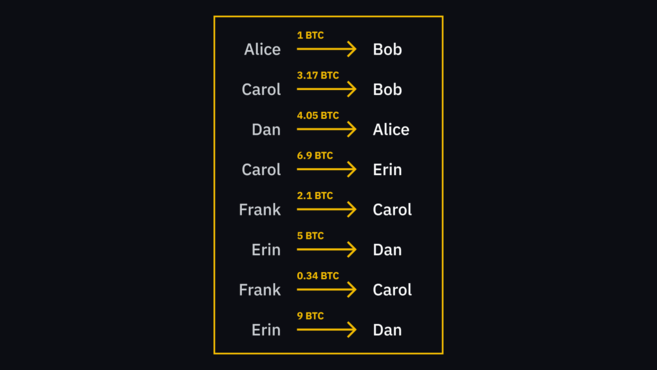
The ledger here is the so-called "blockchain" database. All participants share the same copy of the data; this copy is stored in the participants' devices, and data updates are synchronized in all connected devices.
When a payment occurs, the relevant information is broadcast directly to the peer-to-peer network; there is no central bank or institution involved in the payment process. The Bitcoin blockchain uses a unique "mining" mechanism to add new information, such as connecting new blocks with transaction information to the chain.
What is blockchain?
The blockchain is an append-only ledger, which only accepts data additions. Once information is added to the blockchain, it is difficult to modify or delete. To ensure this, the blockchain imposes a pointer in each block that points to the next connected block.
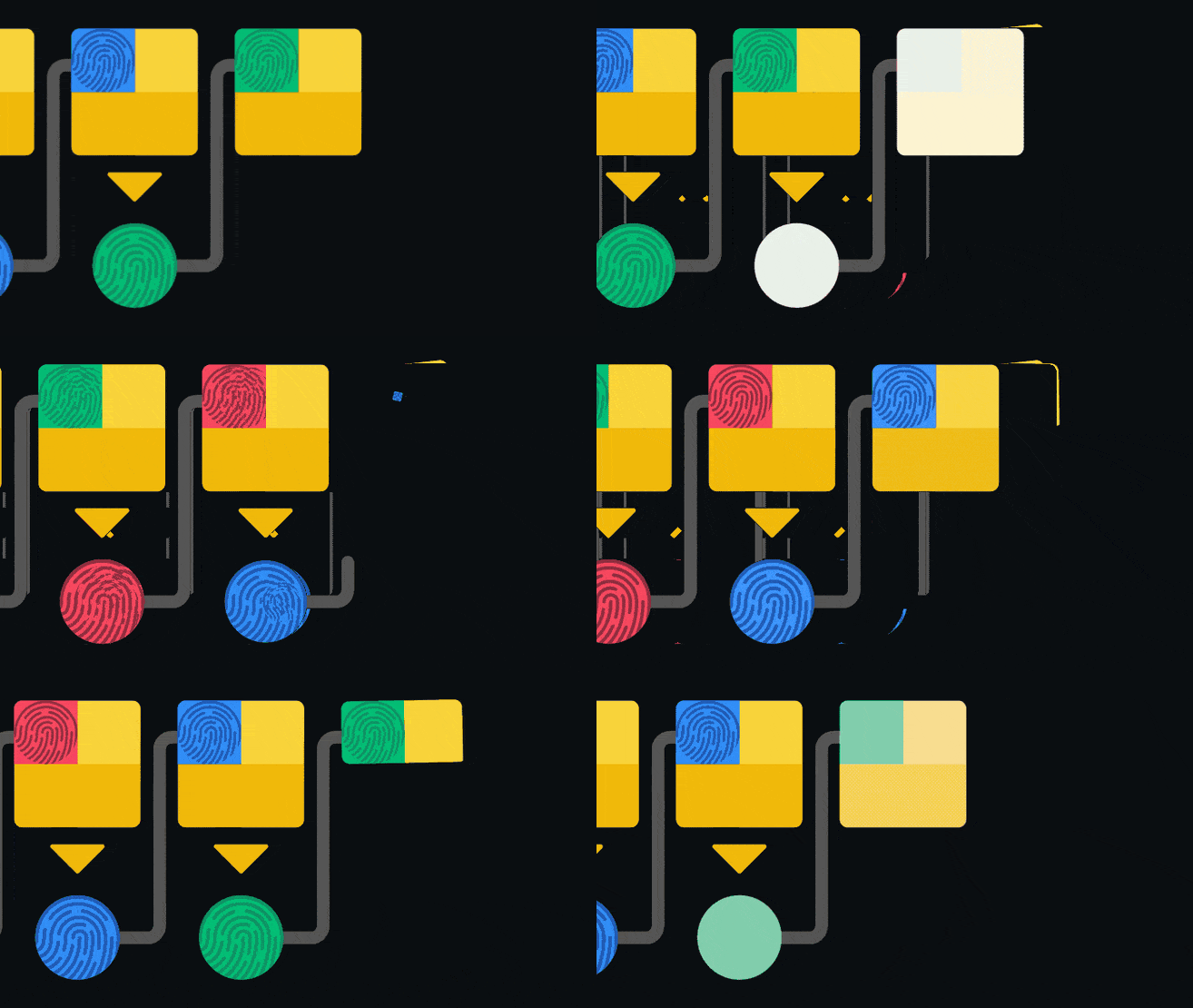
The pointer is actually the hash value of the previous block. Hashing (also known as "hash") is to input data into a set of one-way functions to obtain a corresponding special "fingerprint". Even a slight change in the input value will result in a completely different fingerprint. Since the blocks are connected like a chain, any change to any block will inevitably invalidate all subsequent blocks. This architecture is one of the security guarantees of the blockchain.
If you want to learn more about blockchain, please refer to the "Introduction to Blockchain Technology".
Is Bitcoin legal?
Bitcoin is completely legal in most countries with only a few exceptions, but it is important to understand the laws in your jurisdiction before investing.
In regions where Bitcoin is legal, government agencies have different tax and regulation practices. Overall, regulation in this area is still underdeveloped and is likely to change significantly in the future.
A brief history of Bitcoin
Who invented Bitcoin?
No one knows! The inventor of Bitcoin, "Satoshi Nakamoto", is actually a pseudonym, and his true identity remains a secret. Satoshi Nakamoto could be a person or a group of developers, and could be from anywhere in the world. Although "Satoshi Nakamoto" is a Japanese name, his strong English skills have led many people to conclude that she/he/they are from an English-speaking country.
Satoshi Nakamoto published the Bitcoin white paper and software, but mysteriously disappeared in 2010.
Did Satoshi Nakamoto invent blockchain technology?
In fact, many of the technologies involved in Bitcoin have been around for some time. The concept of blockchain was not born with Bitcoin, and the immutable data architecture can be traced back to the early 1990s. At that time, Stuart Haber and W. Scott Stornetta conceived a system for adding timestamps to files. It relied on encryption technology to ensure data security and prevent tampering, which is very similar to today's blockchain.
Interestingly, Satoshi Nakamoto’s white paper does not mention the word “blockchain”.
You may want to check out "The History of Blockchain".
Digital currencies before Bitcoin
Bitcoin is not the first digital currency, but it is definitely the most successful. Past attempts laid the foundation for Satoshi Nakamoto's invention.
DigiCash
In the late 1980s, DigiCash was founded by cryptographer and computer scientist David Chaum to offer a privacy-centric solution for online transactions based on a paper written by David Chaum (see here for details).
DigiCash’s model was a centralized system, but it was not an interesting experiment. The company later went bankrupt, and David Chaum attributed the reason to the fact that e-commerce had not yet developed at the time.
B-money
The concept of B-money first appeared in a proposal by computer engineer Dai Wei in the 1990s. The proposal was subsequently referenced in the Bitcoin white paper for obvious reasons.
The B-money proposal involves a “proof of work” system (used in bitcoin mining) and a distributed database for signing transactions. The second version of B-money also describes a concept similar to the collateral mechanism used by other digital currencies.
Although B-money ultimately ended up in the drafting stage, it is not difficult to see its impact on Bitcoin.
Bit Gold
Bit Gold is so similar to Bitcoin that some people believe that the former's founder, computer scientist Nick Szabo, is Satoshi Nakamoto. At its core, Bit Gold is a ledger that records strings of data calculated by proof of work.
Like B-money, Bit Gold was not developed. However, Bit Gold shares many similarities with Bitcoin that solidify its status as a pioneer.
Chapter 2: Where does Bitcoin come from?
Contents
How are Bitcoins generated?
What is the total amount of Bitcoin?
How does Bitcoin mining work?
How long does it take to create a block?
How are Bitcoins generated?
Bitcoin has a limited supply, but only a portion of it enters circulation. The only way to generate new coins is through "mining," a unique mechanism for adding data to the blockchain.
What is the total amount of Bitcoin?
The Bitcoin protocol sets the maximum supply of Bitcoin at 21 million. As of 2020, nearly 90% of Bitcoin has been mined, but the remaining part will take 100 years to be fully mined. The reason is the periodic "halving" event, which gradually reduces the mining bonus.
How does Bitcoin mining work?
Mining is how new blocks are added to the blockchain. Participants must devote computing power to solving cryptographic puzzles. To attract miners, anyone who proposes a valid block is rewarded.
Although the cost of creating a block is high, the cost of checking a block is low. If someone attempts to cheat and submits an unqualified block, the request will be immediately rejected by the network and the miner will not be able to recover the mining cost.
The bonus from mining is generally called "block reward", which consists of two parts: transaction fees and mining bonus. Mining bonus is the only source of new Bitcoin. Every time a block is generated, the total supply of Bitcoin will increase by a fixed amount.
How long does it take to create a block?
The Bitcoin protocol will adjust the mining difficulty dynamically to control the block generation time to about 10 minutes. The interval between the creation of two consecutive blocks is not necessarily exactly 10 minutes, but fluctuates around this value.
Chapter 3: Getting Started with Bitcoin
Contents
How to buy Bitcoin?
How to buy Bitcoin with a credit/debit card
How to Buy Bitcoin on a Peer-to-Peer Marketplace
What can Bitcoin be used to buy?
Where can Bitcoin be spent?
What to do if you lose your Bitcoin?
Can Bitcoin transactions be reversed?
Can Bitcoin be used to make money?
How to store Bitcoin?
Store on Binance
Store in Bitcoin wallet
Hot Wallet
Cold wallet
How to buy Bitcoin?
How to buy Bitcoin with a credit/debit card
With Binance, you can seamlessly buy Bitcoin on your web browser. Here’s how:
Log in to the digital currency trading portal.
Select the purchase currency and payment currency.
Log in to your Binance account. If you don’t have an account, you need to register first.
Select Payment Method.
Enter your bank card information as prompted and complete identity verification.
Done! The corresponding Bitcoins will be recorded in your Binance account.
How to Buy Bitcoin on a Peer-to-Peer Marketplace
You can also buy and sell Bitcoin on the peer-to-peer market. With the Binance mobile app, you can buy Bitcoin directly from other users. Here’s how:
Open the app and log in or register an account.
Select "One-click Coin Exchange" and then click "Buy" in the upper left corner of the interface.
Select a transaction type from the pop-up window and click “Buy”.
You can pay with other digital currencies (click "Digital Currency Payment") or use fiat currency (click "Fiat Currency Payment").
Next, you will be asked to specify a payment method.
Select “Buy BTC”.
At this point, you will need to make the payment. Once you have completed it, click "Mark as Paid" and confirm.
Once the seller sends you the BTC, the transaction is complete.
Want to start investing in digital currency? Buy Bitcoin on Binance!
What can Bitcoin be used to buy?
Bitcoin can be used to buy many things. It is difficult to find brick-and-mortar stores that accept Bitcoin (although it is not impossible). You can search online to find some websites that accept Bitcoin payments; some will allow customers to buy gift cards with Bitcoin first, and then use the gift cards to pay for services.
Here are a few examples of items that can be purchased with Bitcoin:
Airline Tickets
hotel room
real estate
food and drinks
clothing
gift card
Online Subscription
Where can Bitcoin be spent?
There are more and more places to spend Bitcoin! Let’s take a look at some examples.
TravelbyBit
Don’t want to worry about huge credit card fees when traveling around the world? Why not use digital currencies such as Bitcoin to book flights and hotels on TravelbyBit. Register and use digital currencies to enjoy a 10% discount.
He will spend
The search engine Spendabit can help you find "bitcoin-friendly" products. You just need to enter what you want to buy, and the system will find a list of merchants that accept bitcoin payments.
Coinmap
Coinmap can locate digital currency merchants and ATMs in your area. If you're eager to find a place to spend Bitcoin, this platform is for you.
Bitrefill
You can use Bitcoin and other digital currencies to buy a wide variety of service gift cards or top up your phone bills. The program is simple and easy to use, and you can also use the Lightning Network to pay.

Heatmap of retailers accepting digital currency payments. Source: https://coinmap.org/
What to do if you lose your Bitcoin?
Since the Bitcoin network has no banks, users are responsible for the security of their own assets. Some people hold their assets in exchanges, while others choose various types of wallets. Wallet users must write down their mnemonics to facilitate retrieval of wallet information when needed.
Can Bitcoin transactions be reversed?
Once data is added to the blockchain, it is difficult (almost impossible, in fact) to erase, which means that transactions made cannot be reversed. Before transferring money, remember to double-check that the receiving address is correct.
To learn about the theoretical method of reversing transactions, please refer to "What is a 51% attack?"
Can Bitcoin be used to make money?
Bitcoin can be used to make money or lose money. Generally speaking, long-term investors believe that Bitcoin will appreciate in value in the future, so they buy and hold the currency for a long time. Some people choose to actively trade between Bitcoin and other digital currencies to obtain short- to medium-term profits. Both strategies have risks, but the rewards are often more generous than low-risk investments.
Some investors adopt a combination of strategies: holding Bitcoin as a long-term investment while opening a separate portfolio for short-term trading. Because investors have different risk preferences and goals, there is no right or wrong way to allocate assets in a portfolio.
As a way to earn passive income, lending is becoming more and more popular. Coin holders can earn interest income by lending their funds to others. Platforms such as Binance Lending allow users to borrow and lend using digital currencies such as Bitcoin.
How to store Bitcoin?
There are many ways to store Bitcoin, each with its own advantages and disadvantages.
Store on Binance
Custody means that users give their digital currency to a third party for safekeeping. They need to log in and send their assets to a third-party platform. Exchanges such as Binance often adopt this model, which greatly increases transaction efficiency.
By hosting Bitcoin on Binance, users can easily perform transactions and loans.
Store in Bitcoin wallet
In contrast to custodial solutions, non-custodial solutions represent users who control their own funds and require the use of a "wallet". The wallet does not store the funds themselves, but the key that unlocks the funds on the blockchain. There are two main types of wallets:
Hot Wallet
Hot wallets are software that can connect to the Internet, usually in the form of mobile or desktop applications, which make it easy for users to send and receive funds. For example, Trust Wallet is an easy-to-use mobile wallet that supports a wide range of currencies. Because hot wallets can be connected to the Internet, they are often convenient for payments, but they are also more vulnerable to attacks.
Cold wallet
Wallets that cannot connect to the Internet are called "cold wallets." Because there is no online attack path, cold wallets are relatively safer, but the user experience is generally poor. Cold wallet types include hardware wallets and paper wallets.
If you want to learn more about wallet types, don’t miss the article “Several Common Digital Currency Wallets”.
Chapter 4: Bitcoin Halving
Contents
What is the Bitcoin halving?
How does the Bitcoin halving work?
Why does Bitcoin halving occur?
What is the impact of Bitcoin halving?
When is the next Bitcoin halving?
What is the Bitcoin halving?
Bitcoin halving is actually a reduction in block rewards. After the halving occurs, the new block verification bonus received by miners will be half of what it was before, but transaction fees will not be affected.
How does the Bitcoin halving work?
When Bitcoin was first launched, miners received a bonus of 50 BTC for each valid block they found.
The first halving occurred on November 28, 2012. At that time, the protocol compressed the block reward from 50 BTC to 25 BTC. The second halving occurred on July 9, 2016, and the block reward dropped from 25 BTC to 12.5 BTC. The next halving is expected to occur in May 2020, and the block reward will drop to 6.25 BTC.
Perhaps you have also noticed that halvings seem to occur every 4 years, with a few months' error. This is a result of the protocol architecture design. The protocol does not set a specific date for halvings, but rather a corresponding block height: halvings occur every 210,000 blocks. Therefore, it can be estimated that halvings occur every 2,100,000 minutes (block generation time is about 10 minutes).

The chart above shows how the relationship between the block reward and total supply changes over time. At first glance, it looks like the block reward has dropped to zero and the maximum supply has all entered circulation - this is actually an illusion. The curve is indeed very close to the extreme, but the block reward is not expected to reach zero until 2140.
Why does Bitcoin halving occur?
This is one of the main selling points of Bitcoin, but Satoshi Nakamoto never fully explained why the total supply was limited to 21 million. Some people speculate that the 21 million comes from a simple calculation of the 50 BTC initial block reward and the 210,000 block halving cycle.
A fixed supply means that the currency is less susceptible to long-term devaluation. Fiat currencies are the exact opposite: as more fiat currencies enter circulation, their purchasing power decreases.
The mining speed limit is also reasonable. After all, 50% of the total Bitcoin supply was mined before block 210,000 (i.e. before 2012). If the block reward remains the same, all Bitcoins will enter circulation before 2016.
The halving mechanism ensures that the mining time can be extended to more than 100 years, allowing the system enough time to attract users so that the transaction fee market can grow smoothly.
Want to start investing in digital currency? Buy Bitcoin on Binance!
What is the impact of Bitcoin halving?
The group most affected by the halving is miners, as the block reward is the bulk of their profits. A halving of the block reward means a halving of revenue. Although transaction fees are not affected, they have not been able to match the block reward so far.
Therefore, the block reward after the halving may no longer be cost-effective for some miners. No one knows how the entire industry will be affected by this. The reduction in block rewards may cause the network to become more centralized, or it may promote the efficiency of mining technology.
If Bitcoin continues to rely on the proof-of-work algorithm, fees will have to rise to a level that is profitable for miners. This is entirely possible. Since a block can only contain a limited number of transactions, if there are too many pending transactions, those with higher fees will be prioritized.
As far as past records are concerned, the price of Bitcoin will skyrocket after the halving occurs. Of course, the reference data is very limited because the halving has only occurred twice. Many people attribute this price trend to the scarcity of Bitcoin, which has led to a higher market valuation, which is a phenomenon caused by the halving. Supporters of this theory believe that after May 2020, the value of Bitcoin will soar again.
Opponents argue that the market has already factored in the halving (see the Efficient Market Hypothesis). The argument is that the halving did not occur out of the blue; participants knew for more than a decade that it would occur in May 2020. Another argument is that the industry was still in its early stages of development when the first two halvings occurred; now it has scale, mature trading tools exist, and can accommodate more investors.
When is the next Bitcoin halving?
The next halving is expected to occur in May 2020, and the block reward will drop to 6.25 BTC accordingly. Please stay tuned to Binance Academy’s “Bitcoin Halving Countdown” section.
Chapter 5: Common Misconceptions
Contents
Are Bitcoin users anonymous?
Is Bitcoin a Scam?
Is Bitcoin a bubble?
Does Bitcoin use encryption?
Are Bitcoin users anonymous?
Not really. On the surface, Bitcoin users can be anonymous. In reality, the Bitcoin blockchain is public and anyone can see transactions. User identities are not tied to wallet addresses on the blockchain, but it is possible for an observer with the right resources to link the two. It is more accurate to say that Bitcoin is pseudonymous, with wallet addresses visible to everyone and user names kept private.
Despite this, the privacy of the Bitcoin system is relatively high. If you want to make it more difficult for observers to match numbers, there are ways to do so. Existing free technology can create a viable privacy barrier by disconnecting address links. In addition, future technology updates will also improve privacy protections - see the examples in "Introduction to Confidential Transactions" for details.
Is Bitcoin a Scam?
No. Just like fiat currencies, Bitcoin can be used for illegal activities, but that doesn’t mean Bitcoin itself is a scam.
Bitcoin is a digital currency that is not controlled by anyone. Critics have labeled it a "pyramid scheme." In fact, Bitcoin does not meet the relevant definition. Whether it is worth $20 or $20,000, Bitcoin's function as a digital currency is not affected. It has been around for more than 10 years and the technology has been proven to be safe and reliable.
However, Bitcoin is subject to many scams, and users should be careful. These include phishing and social engineering scams such as fake portals and airdrops. The general principle of prevention is: If it sounds too good to be true, it is probably a scam. Never tell your private key or mnemonic phrase to others, and beware of low-risk, high-return projects. Once funds are sent to scammers or fake portals, they can never be recovered.
Is Bitcoin a bubble?
Bitcoin prices fluctuate so volatilely that it’s no wonder some call it an “investment bubble.” Many economists compare Bitcoin to the tulip mania or the Internet bubble.
Because Bitcoin is a decentralized digital commodity, its price is entirely determined by free market speculation. Although Bitcoin prices are affected by many factors, these factors ultimately drive price trends in the form of market supply and demand. Due to the limited number and strict issuance schedule, the long-term demand for Bitcoin will exceed the supply.
Compared with traditional markets, the digital currency market is relatively small, which means that digital assets such as Bitcoin are more volatile and prone to short-term market supply and demand imbalances.
In other words, Bitcoin prices fluctuate from time to time. However, financial markets are inherently volatile; the total market volume and circulation capacity of digital currencies are still relatively low, making fluctuations even more pronounced.
Does Bitcoin use encryption?
No. Many people do think so, but the Bitcoin blockchain does not use cryptography; transactions need to be visible to every node in the network for them to be valid. However, the Bitcoin system uses digital signatures and hash functions. Although some digital signature algorithms involve encryption, Bitcoin does not.
It is worth noting that many applications and digital currency wallets use encryption and passwords to protect account security; however, encryption and blockchain are not related, but many projects integrate the two together.
Chapter 6: Bitcoin Scalability
Contents
What is expansion capability?
Why does Bitcoin need to scale?
How many transactions can the Bitcoin network process?
What is the Lightning Network?
What is a fork?
Soft Fork
Hard Fork
What is expansion capability?
Capacity is a measure of whether the system can keep up with demand growth. If the network is overloaded with requests, you can add servers. If you want your computer to run more intensive applications, you can upgrade the computer's hardware.
In the context of digital currency, “scalability” describes whether a blockchain can be easily upgraded to handle more transactions.
Why does Bitcoin need to scale?
To handle everyday payments, the Bitcoin system must be fast enough. So far, the Bitcoin network’s throughput is relatively low, meaning that the number of transactions that can be processed in each block is quite limited.
As mentioned earlier, miners who submit valid blocks can earn transaction fees. This fee is paid by users and is intended to incentivize miners to include transactions in blocks.
Miners need to get a return on their investment in hardware and electricity, so they prioritize transactions with higher fees. If the network has a backlog of many pending transactions (memory pool), the fees will surge because users need to offer high prices to attract miners. In extreme cases, the average fee has exceeded $50.
How many transactions can the Bitcoin network process?
Based on the average number of block transactions, the Bitcoin network can currently process about 5 transactions per second (TPS). This speed is much lower than centralized payment methods and is also one of the costs of using decentralized currency.
The Bitcoin system is not managed by a data center, and upgrades cannot be arbitrarily decided by a single organization, so the Bitcoin block size must be limited. Blocks can indeed accommodate 10,000 transactions per second, but such a setting will reduce the decentralization of the network. Full nodes need to download information about new blocks every 10 minutes; if this process is too troublesome, the node may choose to quit.
Bitcoin enthusiasts believe that if the system is to be used for payments, effective expansion must be achieved through other means.
What is the Lightning Network?
The Lightning Network is a Bitcoin expansion proposal. Also known as the "second layer" solution, it separates transactions from the blockchain; all transactions are recorded at the bottom layer and processed by the bottom layer protocol.
The Lightning Network enables near-instant fund transfers for free and with unlimited throughput (as long as users have the ability to send and receive funds). To use the Bitcoin Lightning Network, two participants lock a certain amount of Bitcoin in a special address; the address has a property that the funds will only be unlocked with the consent of both parties.
At this point, both parties share a private ledger; the ledger can allocate balances on its own without notifying the main chain. After the transaction is completed, the main chain can be notified, and the main chain protocol will update the balances of both parties. In this process, the two parties do not need to trust each other. If either party attempts to cheat, the protocol will automatically detect it and impose penalties.
Such a payment channel only requires users to make two on-chain transactions in total: the first to top up the address, and the second to distribute the funds. As a result, thousands of transfers can be made between the two transactions. With future development and optimization, the second layer technology may become a key component of a large blockchain system.
For more details on scaling and potential solutions, see Blockchain Scalability - Sidechain Technology and Payment Channels.
What is a fork?
Because the Bitcoin system is open source, anyone can edit it, such as adding new rules or deleting old rules according to different needs. However, not all edits are "created equal"; some updates will make nodes incompatible with the network, while others will cause backward compatibility.
Soft Fork
A soft fork means that after the rules are changed, nodes that have deployed the new rules can still interact with nodes that have not deployed the new rules. Take block capacity as an example: suppose the original block capacity is 2MB; from now on, half of the network nodes will implement a new block capacity limit of 1MB, and blocks that are too large will be considered invalid.
Old version nodes can still receive or broadcast blocks. In this case, the new network can cover all nodes regardless of the rule version.
As you can see from the animation below, the new smaller blocks are accepted by both old and new nodes. However, new nodes will not recognize the 2MB blocks because they need to follow the new rules.

Bitcoin's Segregated Witness (also known as "SegWit") is an example of a soft fork. This fork cleverly introduces a new format for blocks and transactions. Nodes that have not updated can continue to receive block information, but will not participate in the verification of new transactions.
Hard Fork
The hard fork situation is more troublesome. Suppose now half of the network nodes want to increase the block size from 2MB to 3MB. If the 3MB block is sent to the old version of the node, the block will be rejected; because the rules of the old version of the node clearly state that 2MB is the upper limit of the valid block. At this point, the old and new versions of the network are no longer compatible, and the blockchain has two branches.

The black chain in the above image represents the original blockchain, and the second block is where the hard fork occurred. From then on, the new version of the node began to create blocks with larger capacity (green blocks). The old version of the node did not recognize these blocks, so it developed in a different direction. The blockchain became two, and the common history ended at the second block.
At this point, there are two network protocols, each using a different currency. The balances of all accounts are cloned from the original records to the new chain; if a user has 20 BTC before the fork, he will have an account on each of the two forks, with a balance of 20 BTC and 20 new BTC respectively.
In 2017, the Bitcoin network had a controversial hard fork, similar to the above situation. A small number of users wanted to increase the block capacity, thereby increasing throughput and reducing transaction fees. Other users believed that the expansion strategy was inappropriate. In the end, the hard fork resulted in Bitcoin Cash (BCH), which was independent from the Bitcoin network and formed its own community and development path.
For more details on forks, see Hard Forks and Soft Forks.
Chapter 7: Participating in the Bitcoin Network
Contents
What is a Bitcoin Node?
How do Bitcoin nodes work?
Full Node
Light Node
Mining Node
How to run a Bitcoin full node?
How to mine Bitcoin?
How long does mining take?
Who can contribute code to the Bitcoin system?
What is a Bitcoin Node?
The term "Bitcoin node" is used to describe a class of programs that interact with the Bitcoin network in a specific way. A node can be a mobile phone running a Bitcoin wallet or a dedicated computer that stores a complete record of the Bitcoin blockchain.
There are different types of nodes, each performing a specific function. All of these nodes are communication points for the network, communicating transactions and block information within the network to each other.
How do Bitcoin nodes work?
Full Node
Full nodes are responsible for verifying that transactions and blocks meet certain requirements (i.e., that they are valid). Most full nodes run "Bitcoin Core" software - the reference implementation of the Bitcoin protocol.
Bitcoin Core is a program released by Satoshi Nakamoto in 2009. At the time, the program was simply named "Bitcoin". To avoid confusion, it was later renamed "Bitcoin Core". Full nodes can also run other implementations, provided that the implementation is compatible with Bitcoin Core.
Full nodes are the key to Bitcoin's decentralization. They are responsible for downloading and verifying blocks and transactions, broadcasting relevant information to the entire network. Since each full node independently verifies the authenticity of information, users do not need to rely on a third party to do anything within the network.
Full nodes that store the complete record of the blockchain are called "full archive nodes." Some users will discard old blocks to save storage space - the Bitcoin blockchain contains more than 200GB of transaction data.

Global distribution of Bitcoin full nodes. Image source: bitnodes.earn.com
Light Node
Light nodes are not as powerful as full nodes, but their resource requirements are relatively low. Users can access the network through light nodes without running all the functions of a full node.
Full nodes need to download all blocks and verify them one by one, while light nodes only need to download part of each block (also known as the "block header"). Although the block header has a small capacity, it contains enough information to allow users to view the specific block where the transaction is located.
Light nodes are ideal for devices that are limited by bandwidth or storage space. As a result, light nodes are common in desktop computers and mobile wallets. Since they cannot be verified, light nodes can only rely on full nodes.
Mining Node
Mining nodes perform another task in addition to full nodes: creating blocks. As mentioned above, mining requires specialized equipment and software to add new data to the blockchain.
The mining node will collect the pending transactions and other information for hashing to obtain a value. If the value is lower than the target threshold set by the protocol, the block is considered valid and can be broadcast to other full nodes.
If you want to mine independently, miners must first run the full node function. Otherwise, miners will not be able to know the transaction information in the block.
Participants who want to mine but cannot run a full node can connect to the server and obtain the required information. For example, a mining pool (i.e., collaboration with other nodes) only requires one of the nodes to run a full node.
For a breakdown of node types, see What is a Node?
How to run a Bitcoin full node
Full nodes are beneficial to developers, merchants, and end users. Running the Bitcoin Core client on your own hardware provides greater privacy and security for users, making the Bitcoin network more stable. Users who use full nodes do not need to rely on anyone to participate in network interactions.
Some Bitcoin-oriented companies offer “plug-and-play” nodes, where pre-built hardware is sent directly to the user. The user simply plugs the hardware in and starts downloading the blockchain. This approach may be more suitable for less technical users, but it costs much more than assembling the hardware yourself.
In most cases, an old desktop or laptop will suffice. However, it is not advisable to run a full node on an everyday computer, as this would severely limit the speed of the operation. As the blockchain continues to grow, users must ensure that their devices have enough space to accommodate the entire blockchain record.
A 1TB hard drive should be sufficient for years of data, assuming block sizes don’t change significantly. Other hardware requirements include 2GB of RAM (most computers come with more) and plenty of bandwidth.
After the hardware is ready, you can refer to bitcoin.org’s “Full Node Operation Guide” for specific setup steps.
How to mine Bitcoin?
When Bitcoin was in its infancy, laptops were sufficient to create blocks. At the time, Bitcoin was unknown and mining competition was almost non-existent. Since the network was not yet active, the protocol naturally set a low mining difficulty.
As the network’s hash rate increases, miners must upgrade their equipment to remain competitive. After several rounds of hardware transformation, the mining industry finally entered the era of so-called “Application-Specific Integrated Circuits (ASICs)”.
As the name suggests, these devices are made for a specific purpose. They are very efficient, but can only perform a single task. Therefore, mining ASICs can be said to be computers that can only be used for mining. In addition to mining Bitcoin, Bitcoin ASICs can also mine digital currencies with different algorithms.
Today, Bitcoin mining requires a huge investment, both in hardware and energy. As of this writing, a good mining rig is capable of performing 10 trillion operations per second. With high efficiency comes high energy consumption. Unless you have multiple mining machines and cheap electricity, it is difficult for the average miner to make a profit from Bitcoin mining.
However, with the right equipment, setting up a mining operation is fairly straightforward - many ASIC devices come with their own software. A common approach is to join a mining machine to a mining pool and work with others to mine. If the mining pool successfully creates a block, the block reward is distributed among the miners in proportion to their hash rate.
Miners can also choose to mine alone; the success rate of creating a block will be very low, but the miner can monopolize the block reward.
How long does mining take?
There is no definitive answer to this question, as mining time is affected by a variety of factors, such as the amount of electricity and hash rate available to the miner. In addition, the actual cost of operating the mining equipment must also be taken into account.
To get a rough idea of how profitable Bitcoin mining is, use a mining calculator to estimate the costs.
Who can contribute code to the Bitcoin system?
The Bitcoin Core software is open source, meaning anyone can contribute code. Users can propose new features, which are reviewed and added to the more than 70,000 lines of code; they can also report bugs, translate documents, or improve them.
Software changes are subject to rigorous review. After all, the system handles hundreds of billions of dollars and must be free of loopholes.
If you are interested in contributing to Bitcoin code, you may wish to check out developer Jimmy Song's blog or the official website of "Bitcoin Core".