


Introduction
Market trends are one of the most fundamental aspects of financial markets. We can define market trends as the general direction of an asset or market. Therefore, both technical and fundamental analysts pay close attention to market trends.
Bull markets tend to be relatively simple to trade, as they offer some of the simplest trading and investing strategies. Even inexperienced traders can perform well in a very favorable bull market environment. That being said, it is also important to understand how markets move in cycles.
So, what should you know about bull markets? And how can traders make the most of them? We answer these questions in this article.
What is a bull market?
A bull market (also known as a long market) refers to a state of financial markets where prices are moving higher. The term "bull market" is often used in relation to the stock market. But it can also be applied to any financial market - including forex, bonds, commodities, real estate, and cryptocurrencies. In addition, a bull market may also refer to a specific asset, such as Bitcoin, Ethereum, or BNB. It can even refer to a sector, such as utility tokens, privacy coins, or biotech stocks.
You may have heard Wall Street traders use the terms “bullish” and “bearish.” If a trader says they are bullish on a market, it means they expect prices to rise. If they are bearish on a market, it means they expect prices to fall.
Bullish usually means they are also long that market, although this is not necessarily the case. Bullish does not necessarily mean there is a long trading opportunity right now, it just means that prices are rising or expected to rise.
It is also worth noting that a bull market does not mean that prices will not fall or fluctuate. Therefore, it is wiser to consider bull markets over a longer time frame. In this sense, a bull market will contain periods of decline or consolidation without breaking the main market trend. Let's look at the Bitcoin chart below. Although there have been periods of decline and some violent market crashes, it has mainly been in an uptrend since its inception.
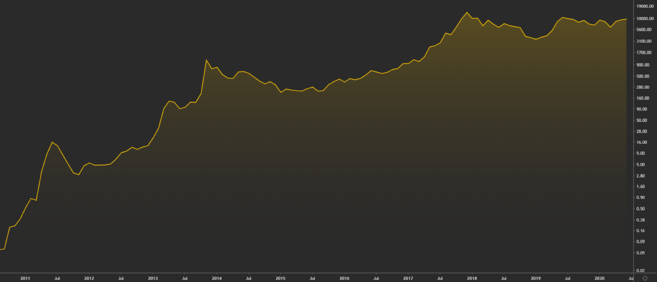
Bitcoin price chart (2010-2020).
So in this sense, the definition of a bull market depends on the time frame we are talking about. Generally speaking, when we use the term bull market, we are referring to a time frame of several months or years. As with other market analysis techniques, longer time frame trends are more effective than shorter time frame trends.
Therefore, there can be prolonged declines during bull markets on longer time frames. These counter-trend price moves are notorious for being particularly volatile, but this can vary widely.
Bull Market Example
Some of the most well-known examples of bull markets have occurred in the stock market. These are periods of sustained growth in stock prices and market indices, such as the Nasdaq 100.
The global economy swings back and forth between bull and bear markets. These economic cycles can last for years, even decades. Some say the bull run from after the 2008 financial crisis until the COVID-19 pandemic is the "longest bull run in history." This statement is a matter of opinion, and as we mentioned, the longer time frame bull run may be based on your perspective.
Even so, let's look at the long-term performance of the Dow Jones Industrial Average (DJIA). We can see that it has basically experienced a century-long bull market. Of course, there have been recessions that lasted for several years, such as January 1929 or February 2008, but the overall trend is still upward.

DJIA performance since 1915.
Some believe that a similar trend will occur with Bitcoin. However, there is no way to know if and when Bitcoin will experience a multi-year bear market. It is also worth noting that most other cryptocurrencies (i.e. altcoins) may never experience similar price appreciation, so you need to be extremely cautious when investing.
What is the difference between a bear market and a bull market?
These are two opposite concepts, so the difference between them is not hard to guess. In a bull market, prices continue to rise, and in a bear market, prices continue to fall.
This also leads to differences in the best trading methods. In a bull market, traders and investors usually want to go long. In a bear market, they either want to go short or hold cash.
In some cases, holding cash (or stablecoins) can also mean shorting the market because we expect prices to fall. The main difference is that holding cash is more about preserving capital, while shorting is about profiting from a fall in the price of an asset. But if you sell an asset with the hope of buying it back at a lower price, you are essentially in a short position - even if you don't profit directly from the fall.
Another thing to consider is fees. Holding stablecoins may not incur any fees as there are typically no custody costs. However, many short positions will require funding fees or interest rates to maintain the position. Because of this, quarterly contracts may be ideal for long-term short positions as there are no funding fees associated with them.
➟ Want to start your digital currency journey? Buy Bitcoin on Binance now!
How Traders Can Take Advantage of the Bull Market
The main idea behind a bull market is relatively simple. Prices are rising, so going long and buying the dips are usually sound strategies. Therefore, buy-and-hold strategies and dollar-cost averaging are usually well suited to long-term bull markets.
There’s a saying that goes, “The trend is your friend, until it’s no longer a trend.” This simply means that it’s smart to trade in the direction the market is trending. Again, no trend lasts forever, and the same strategy may not perform well during other parts of the market cycle. The only certainty is that markets can and will change. As we’ve seen with the coronavirus pandemic, multi-year bull markets can evaporate in a matter of weeks.
Of course, most investors will be bullish during a bull market. This makes sense because prices are rising, so the overall market sentiment should also be bullish. However, even during a bull market, some investors will be bearish. If their trading strategy is executed well, they may even be able to profit from short-term bearish trades, such as shorting.
Therefore, some traders will try to short the recent highs in a bull market. But these are advanced strategies and are usually more suitable for professional traders. For less experienced traders, trading with the trend is usually a wiser choice. Many investors will get stuck trying to short a bull market. After all, standing in front of a raging bull or a roaring locomotive is a dangerous thing to do.
Summarize
We have discussed what a bull market is and how traders can trade in a bull market environment. In any market trend, the most straightforward trading strategy is usually to follow the direction of the overall trend.
Therefore, bull markets can present good trading opportunities, even for new or first-time investors. However, it is always important to manage your risk appropriately and keep learning to avoid mistakes as much as possible.