



Summary
The circulation supply system of elastic supply tokens is constantly changing. The core idea is to adjust the token supply through rebasing rather than relying on price fluctuations.
Imagine if the Bitcoin protocol reaches a target price by adjusting the number of Bitcoins in a user's wallet. So, let's say you own 1 BTC today. When you wake up tomorrow, you might have 2 BTC, but each is worth only half of what it was yesterday. This is how the rebase mechanism works.
Introduction
Decentralized finance (DeFi) has driven explosive growth in new financial products in the blockchain space. We have previously covered liquidity mining, tokenized Bitcoin in Ethereum, Uniswap, and flash loans. Another hot topic in the cryptocurrency space is elastic supply tokens, also known as “rebase tokens.”
The unique mechanisms behind them can support a lot of experimentation. Let’s take a closer look at how these tokens work.
What are elastic supply tokens?
Elastic supply (or rebasing) tokens work in roughly the following way: the circulating supply of a token increases or decreases as the price goes up or down. This increase or decrease in supply is accomplished through a mechanism called “rebasing.” After a rebase is performed, the supply of each token is algorithmically increased or decreased based on the current price.
In some ways, elastic supply tokens are similar to stablecoins. The goal of both is to stabilize a target price, and the rebase mechanism helps achieve that goal. However, the main difference between the two is that rebase tokens achieve this through changes in supply (elasticity).
You might ask, isn't the supply of many cryptocurrencies changing? That's right. Currently, 6.25 new coins are mined for each Bitcoin block. After the halving in 2024, this number will drop to 3.125 coins/block. This ratio is predictable, and we can estimate the number of Bitcoins in the market next year or after the next halving.
Elastic supply tokens work differently. As mentioned above, rebasing adjusts the circulating supply of a token periodically. Let's say an elastic supply token wants to achieve a stable price of $1. If the price is above $1, the supply will be increased through rebasing, reducing the value of a single token. Conversely, if the current price is below $1, the supply will be reduced, increasing the value of each token.
What does this mean in practice? If you rebase, the number of tokens in your wallet changes. Let's say we have rebased USD (rUSD), a hypothetical token with a target price of $1. You deposit 100 rUSD in your hardware wallet. Let's say the price drops below $1. After the rebase, you only have 96 rUSD in your wallet. At the same time, the value of each account increases accordingly.
The core principle of this token is that the amount of tokens held by users remains at a certain ratio to the total supply, which does not change due to rebasing. Let's say you hold 1% of the total supply of tokens before rebasing. Even if the number of tokens in your wallet changes after rebasing, you still own 1% of the total supply. Essentially, your share of the tokens held in the network does not change regardless of price changes.
Token rebase example
Ampleforth
Ampleforth is one of the first elastic supply tokens. It aims to be a non-collateralized synthetic commodity where 1 AMPL has a target price of 1 USD. Rebases are performed every 24 hours.
The project had relatively little traction before the launch of a liquidity mining program called "Geyser." What is particularly interesting about this program is its duration. It will continue to distribute tokens to participants over a period of 10 years. Geyser is a classic example of how liquidity incentives can create huge traction for DeFi projects.
A stablecoin from a technical perspective, the AMPL price chart showcases the volatility of an elastic supply token.

AMPL has a price target of $1, but the price could also fluctuate wildly.
Note that this price chart only shows the price per AMPL token and does not take into account supply changes. Even so, given the huge volatility, Ampleforth is likely to be a high-risk token.
It may make more sense to evaluate elastic supply tokens from a market cap perspective. Since the price per token is irrelevant, market cap can be a barometer of network growth and appeal.
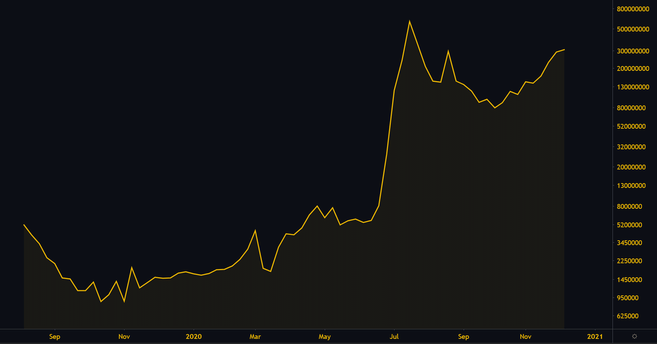
AMPL’s exponential market cap.
Yam Finance
Yam Finance is another elastic supply token project that has attracted widespread attention. The overall design of the Yam protocol is somewhat similar to the combination of Ampleforth's elastic supply, Synthetix's staking system, and Yearn.finance's fair launch. YAM also aims to stabilize the price at $1.
YAM is a completely community-run experiment, with all tokens distributed through liquidity mining. There is no pre-mine or founder allocation - even everyone can enjoy the dividends of token creation through the liquidity mining program.
As a new and unknown project, YAM locked $600 million in value into the staking pool in less than two days. The reason for the high liquidity value is that the YAM mining pool is tailored for holders of some popular DeFi tokens. These tokens include COMP, LEND, LINK, MKR, SNX, ETH, YFI and ETH-AMPL Uniswap LP tokens.
However, there may be loopholes in the rebase mechanism, which may lead to an increase in the supply of token mining. With the joint efforts of the community, the project used funds to complete the audit and finally restarted and migrated to a new token contract. Now, the future of YAM is completely in the hands of YAM holders.
Risks of Elastic Supply Tokens
Elastic supply tokens are very dangerous investments and carry a high risk. Make sure you understand what is going on before committing your money. Please note that looking at the price chart will not help as your token holdings will change after a rebase.
Of course, gains can be magnified or reduced, anything is possible. If a rebase occurs when the price of the coin is falling, in addition to the loss from the decline, each rebase will reduce the tokens in your hands!
Their mechanics are difficult to understand, so investing in rebase tokens is likely to result in losses for most traders. Only invest in elastic supply tokens if you fully understand the mechanics behind them. Otherwise, you will not be able to fully control your investment and make informed decisions.
➟ Want to start your digital currency journey? Go to Binance to buy Bitcoin now!
Summarize
Elastic supply tokens are one of the innovations worth noting in the DeFi space. As we have seen, these are currencies and tokens that can algorithmically adjust their supply to try to reach a target price.
Will elastic supply tokens just be an interesting experiment or will they be able to create significant traction and carve out a niche? It remains to be seen, but there are certainly new DeFi protocols being developed that are moving towards this goal.