


Essentially, forward and futures contracts are agreements that allow traders, investors and commodity producers to speculate on the future price of an asset. These contracts act as a commitment between two parties to trade an instrument at a future date (expiration date) at the price agreed upon when the contract was created.
The underlying financial instrument of a forward or futures contract can be any asset, such as equity, commodities, currencies, interest payments or even bonds.
However, unlike forward contracts, futures contracts are standardized contracts from a contractual perspective (as a legal agreement) and are traded on a specific venue (the futures contract trading platform). Therefore, futures contracts are subject to a specific set of rules, which may include, for example, contract size and daily interest rates. In many cases, futures contracts are executed under the guarantee of a clearing house, which allows the parties to trade with lower counterparty risk.
Although primitive forms of futures markets were established in 17th century Europe, the Dojima Rice Exchange (Japan) is considered to be the first established futures exchange. In early 18th century Japan, most payments were made in rice, so futures contracts began to be used to hedge against the risk of unstable rice prices.
With the advent of electronic trading systems, futures contracts have become commonplace across the financial industry, along with a host of use cases.
Functions of Futures Contracts
Futures contracts in the context of the financial industry usually have the following functions:
Hedging and risk management: Futures contracts can be used to mitigate specific risks. For example, a farmer can sell futures contracts on his product to ensure that he can sell it at a certain price in the future, despite adverse events and market volatility. Or, a Japanese investor holding U.S. Treasuries can buy a yen-dollar futures contract equal to the quarterly coupon payment (interest rate) to lock in the yen value of the coupon at a predetermined rate, thereby hedging his dollar exposure.
Leverage: Futures contracts allow investors to take leveraged positions. Since contracts are settled on the expiration date, investors can use leverage to take positions. For example, a trader using 3:1 leverage can open a position up to three times the balance in their trading account.
Short Exposure: Futures contracts allow investors to gain short exposure to an asset. When an investor decides to sell a futures contract without owning the underlying asset, this is often referred to as a "naked position."
Asset Diversification: Investors are able to gain exposure to assets that are difficult to trade physically. Commodities such as oil are often expensive to deliver, involving high storage fees, but by using futures contracts, investors and traders can speculate on a wider range of asset classes without having to physically trade them.
Price discovery: Futures markets are one-stop shops for buyers and sellers (i.e., where suppliers and demanders meet) and can trade a wide range of asset classes, such as commodities. For example, the price of oil may be determined by real-time demand in the futures market rather than by local interactions at a gas station.
Settlement mechanism
The expiration date of a futures contract is the last day of trading activity for that particular contract. After the expiration date, trading stops and the contract is settled. There are two main settlement mechanisms for futures contracts:
Physical Settlement: The underlying asset is exchanged between two parties to a contract at a predetermined price. The party that is short (sell) is obliged to deliver the asset to the party that is long (buy).
Cash settled: The underlying asset is not traded directly. Instead, one party pays the other party an amount that reflects the current value of the asset. Oil futures contracts are a typical example of cash settled futures contracts, where cash is exchanged instead of barrels of oil, as trading thousands of barrels of oil is quite complex.
Cash-settled futures contracts are more convenient than physically settled contracts, even for liquid financial securities or fixed-income instruments where ownership can be transferred fairly quickly (at least compared to physical assets such as barrels of oil), and are therefore more popular.
However, cash-settled futures contracts can lead to manipulation of the underlying asset price. This type of market manipulation is often referred to as “rigging the close,” a term that describes unusual trading activity that intentionally disrupts the order book as a futures contract approaches expiration.
Exit strategies for futures contracts
After holding a futures contract position, futures traders can perform three main operations:
Closing: The act of closing a futures contract by creating an opposite trade of equal value. So if a trader is short 50 futures contracts, a long position of the same size can be opened to offset their initial position. Offsetting strategies can allow traders to realize profits or incur losses before the settlement date.
Rollover: A rollover occurs when a trader decides to open a new futures contract position after offsetting their initial contract position, essentially extending the expiration date. For example, if a trader is long 30 futures contracts expiring the first week of January, but wants to extend the position for 6 months, they can offset the initial position and open a new position of the same size with an expiration date set to the first week of July.
Settlement: If futures traders do not close or roll over their positions, the contract will settle on the expiration date. This is when the parties involved are legally obligated to trade assets (or cash) based on their positions.

Price Patterns of Futures Contracts: Contango and Backwardation
From the moment a futures contract is created until it is settled, the market price of the contract will continue to change as buying and selling power changes.
The relationship between the expiration date and price changes of futures contracts creates different price patterns, often referred to as contango (1) and backwardation (3). These price patterns are directly related to the expected spot price (2) of the asset on the expiration date (4), as shown in the figure below.
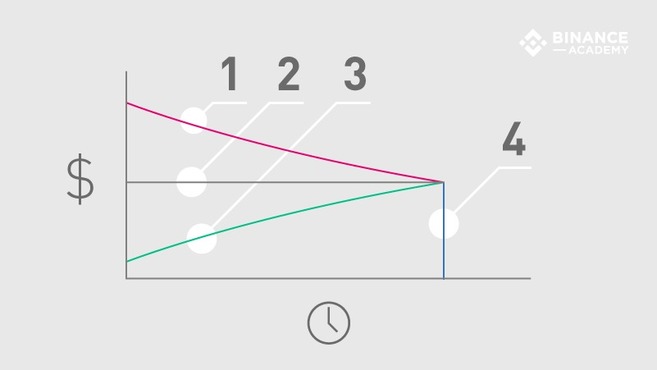
Contango (1): A market condition in which the price of a futures contract is higher than the expected future spot price.
Expected Spot Price (2): The expected asset price at settlement (expiration date). Note that the expected spot price is not always constant, i.e. it may change as market supply and demand change.
Backwardation (3): A market condition in which the price of a futures contract is lower than the expected future spot price.
Expiration Date (4): The last day on which trading activity may occur on a particular futures contract before settlement.
While contango market conditions tend to be more favorable to sellers (short positions) than to buyers (long positions), backwardation markets are generally more favorable to buyers.
As the expiration date approaches, the futures contract price is expected to gradually converge to the spot price until the two are ultimately worth the same. If the futures contract price and the spot price do not agree on the expiration date, traders can take advantage of arbitrage opportunities to make a quick profit.
Contango occurs when futures contracts trade at a premium to the expected spot price, usually for greater convenience. For example, futures traders may decide to pay a premium for a physical commodity that will be delivered at a future date so they don’t have to worry about paying for things like storage and insurance (gold is a classic example). Additionally, companies can use futures contracts to lock in their future expenses at a predictable value, buying commodities that are essential to providing their services (such as a bread producer buying wheat futures contracts).
On the other hand, a backwardation market occurs when futures contracts are trading at a discount to the expected spot price. Speculators who buy futures contracts hope to profit if the price rises as expected. For example, if the expected spot price for a barrel of oil is $45 next year, a futures trader might buy a barrel of oil contract today for $30 per barrel.
Summarize
As a standardized forward contract, futures contracts are one of the most commonly used tools in the financial industry, with versatility and suitability for a wide range of use cases. But before investing your money, it’s important to understand the basic mechanics of futures contracts and their specific markets in detail.
While "locking in" a future asset price can be useful in some situations, it is not always safe, especially when trading contracts on margin. Therefore, risk management strategies are often needed to mitigate the inevitable risks associated with trading futures contracts. Some speculators also use technical analysis indicators as well as fundamental analysis methods to understand the price behavior of the futures market.