


Summary
MakerDAO is a decentralized finance (DeFi) project that uses cryptocurrencies as collateral, and the stablecoin DAI is pegged to the US dollar. Its community manages tokens through a decentralized autonomous organization (DAO). Users lock cryptocurrencies in the Maker profit pool at a certain forced liquidation ratio to generate DAI. For example, a 125% forced liquidation ratio requires that every $1 of DAI is backed by a pledge of $1.25 worth of cryptocurrencies.
To cope with the volatile price of cryptocurrencies, stablecoins are overcollateralized and a stability fee is charged. If the value of the collateral falls below the liquidation ratio, your cryptocurrencies will be liquidated to cover any losses.
DAI remains stable because the DAO controls the stability fee and the DAI savings rate. The stability fee affects the supply of DAI by changing the cost of minting DAI. The DAI savings rate can affect the market demand for the token and change the returns investors can receive for staking DAI. When DAI becomes out of sync with the pegged currency, the DAO will use these two mechanisms to bring the price back on track.
The advantages of DAI are similar to other stablecoins and crypto assets. It can be easily transferred around the world, used for payments, or to lock in profits and losses. You can also use DAI as leverage and earn interest by investing in the DAI Savings Rate smart contract.
To participate in governance polls and executive votes, users purchase MKR tokens, which grant them voting rights that can be used to adjust stability fees, DAI savings fees, teams, smart contracts, and other topics.
Introduction
Stablecoins are very popular cryptocurrencies that provide a middle ground between traditional finance and digital assets. These blockchain-based tokens are similar to fiat currencies but operate like cryptocurrencies, making them attractive for "locking in" profits and losses.
To date, the largest stablecoins are pegged to fiat currencies, with reserves to back the stablecoin. However, stablecoins backed by cryptocurrencies are also gaining popularity. In this article, we will look at a well-known example, MakerDAO, and see how it maintains a 1:1 peg to the US dollar while using a volatile currency as collateral.

What is MakerDAO?
MakerDAO is an Ethereum (ETH) project launched by Rune Christensen in December 2017. It focuses on the creation of DAI, a stablecoin backed by cryptocurrency and pegged to the US dollar. The MakerDAO ecosystem is not run by a group of developers or a single organization, but instead uses the governance token MKR for project proposals and decision-making. This governance model is called a DAO (Decentralized Autonomous Organization).
Users access MakerDAO through the Oasis DApp. Here, they can apply for collateralized loans, participate in governance, and manage their existing Maker yield pools. These interactions rely on smart contracts and game theory to keep DAI’s value relatively stable. DAI also works with stablecoins backed by fiat currencies and has the same advantages.
What is DAI?
DAI is MakerDAO’s stablecoin, pegged to the US dollar, and is one of the largest stablecoins and cryptocurrencies by market capitalization. As long as users continue to provide collateral to generate more DAI, the supply of this ERC-20 token will be endless.
MakerDAO uses cryptocurrency collateral to maintain its peg ratio, rather than using fiat reserves. This may seem puzzling, how can a cryptocurrency known for its volatility back a stablecoin? Simply put, the cryptocurrency that users deposit to create DAI is worth much more than the stablecoin they receive. This provides redundancy in the event of price declines in the cryptocurrency collateral.
Similar to other stablecoins, DAI has the following advantages when used:
1. More suitable for spending with stable demand. Retailers and retail investors are not always willing to pay for cryptocurrencies whose value fluctuates wildly.
2. DAI benefits from the advantages of blockchain. Stablecoins can be transferred globally without a bank account. If stored correctly, they are also extremely safe and reliable.
3. You can use it to lock in profits and losses and hedge risks. DAI will offset the overall risk of some portfolios and help enter or exit positions without off-chain operations.
How does crypto collateral work?
Collateral is a common concept in traditional finance that you may have heard of before. When taking out a loan, you’ll need to put up something of value as collateral. This will be used to pay off the loan if you can’t repay it.
Physical Collateral vs. Fiat Collateral
Let's use a pawn shop as an example. You pledge your jewelry (collateral) to the pawn shop in exchange for a cash loan. You can then repay the loan plus interest and redeem the collateral, or allow the pawn shop to keep the collateral and cover its losses. The collateral acts as a safety net, and the same concept applies to mortgages and car financing. In these examples, the goods (property or car) serve as collateral.
Fiat-backed stablecoins like BUSD have fiat as collateral. Users pledge funds (collateral) in exchange for tokens. If they wish, they can return the tokens to the issuer, but if they don't, the issuer still owns the funds. This mechanism allows for arbitrage, which keeps the stablecoin peg intact. For more information, see What are Stablecoins?
Cryptocurrency Collateral
Crypto-collateralized stablecoins like DAI accept cryptocurrencies as collateral, not fiat. Smart contracts manage these funds according to the rules: for Y amount of Ethereum deposited, issue X amount of stablecoin tokens. When X amount of stablecoin is withdrawn, return Z amount of Ethereum. The exact amount of collateral required depends on the project issuing the token. The ratio will mainly depend on the volatility and risk of the collateral asset.
What is overcollateralization?
Fiat currencies, precious metals, and low-risk assets with stable prices, such as real estate, are common collateral. As we mentioned, using cryptocurrency as collateral is riskier for lenders because of its greater price volatility. Imagine a project requiring $400 in Ethereum as collateral in exchange for 400 tokens pegged to the dollar.
If the price of Ethereum suddenly drops, the lender’s collateral will not be able to cover the loan they issued. Overcollateralization is the solution: the lender requires $600 of Ethereum for every $400 of stablecoin tokens they lend.
What is a Collateralized Debt Position (CDP)?
MakerDAO has been using over-collateralization to maintain a reasonable and reliable peg ratio for many years. Since the DAI generation process is controlled by smart contracts, it can operate efficiently and away from human interference. When you want to borrow DAI stablecoins, your cryptocurrency will be locked in the CDP smart contract. The CDP will set a forced liquidation ratio, for example, 1.5x, which means you need to provide $150 of Ethereum in exchange for $100 of DAI. If users wish, they can add more collateral and reduce their risk. If the collateral amount is less than 150% (1.5x), there will be a penalty. Ultimately, if users fail to repay the DAI at the attached interest rate (stability fee), they will face the risk of forced liquidation.
What is the Maker Yield Pool?
The Maker yield pool is where users place collateral and generate DAI. This allows you to use multiple different cryptocurrencies as collateral at the same time. As long as the user returns the DAI, the Maker yield pool will destroy it. The process is as follows:
1. Deposit supported cryptocurrencies into the Maker Protocol.
2. The deposit will open a Maker Yield Pool position.
3. You can withdraw DAI based on the collateral amount. You also need to pay a stability fee.
4. To redeem your crypto collateral, repay the DAI you withdrew.
You can generate or return DAI, and add or redeem collateral at any time. However, you must maintain the forced liquidation ratio shown in the yield pool. If it falls below this ratio, the yield pool will force liquidate your collateral.
How does the value of DAI remain stable?
In addition to reducing MakerDAO's risk as a lender, the CDP mechanism helps keep DAI pegged to the dollar. MakerDAO can also vote to change the stability fee and the DAI savings rate (the interest paid to stakers in the DAi savings rate smart contract) to control the supply and demand of DAI. Together, these three tools maintain DAI's 1:1 peg to the dollar. Let's take a look at what's going on:
1. When DAI falls below the peg ratio, the system will attract users to repay debts, recover collateral, and destroy DAI. This can be achieved by increasing the stability fee, making borrowing more expensive. DAO can also increase the DAI savings rate and expand the demand for token investment.
2. When DAI is above its peg ratio, the opposite is true. If the stability fee is reduced, DAO will incentivize the generation of DAI. This creates new DAI, increases the total supply, and reduces the price. MakerDAO can also reduce the demand for DAI by reducing the DAI Savings Rate, which means investors will find other ways to earn interest.
Use cases for DAI
As mentioned above, DAI’s usage is similar to other stablecoins, and its advantages are similar. You don’t even need to generate DAI yourself, you can buy it on the cryptocurrency market, such as Binance Market. DAI also has several unique use cases:
1. Leverage - Let's say you have $1,000 in Ethereum and you estimate that the price will go up. However, you currently don't have the extra funds to buy Ethereum. At this time, you can use Ethereum as collateral to generate DAI, and then use it to buy more Ethereum. If the price of Ethereum goes up and you want to cash out, you can sell some Ethereum in exchange for DAI tokens to redeem your collateral.
2.DAI Savings Rate - Deposit DAI into the DAI Savings Rate smart contract to earn interest. This rate changes as the DAO controls the price of DAI.
Where to buy DAI?
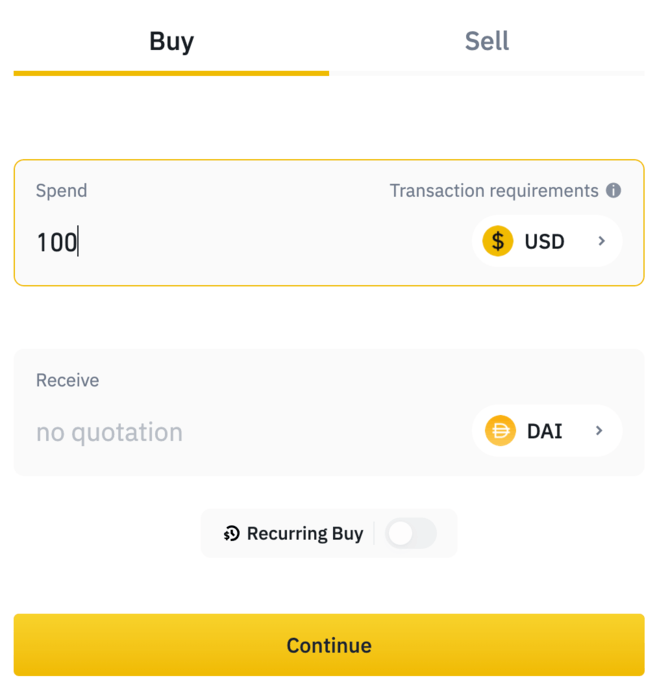
DAI can be purchased on major cryptocurrency exchanges, such as Binance. After creating an account and completing an identity verification check, you can purchase DAI directly using a credit or debit card.
Select the fiat currency you want to pay in the top area and select DAI at the bottom. You will then see specific instructions for adding the card to your account. If you wish, you can also use the exchange view to exchange DAI for another cryptocurrency.
How to participate in MakerDAO’s governance system?
To have a say and vote in MakerDAO, you need to hold the project's governance token, MKR. The maximum supply of the token is 1,005,577 MKR, and approximately 40% was allocated to the team and early investors. The DAO holds the rest for future sales.
MKR holders can vote to change the platform's stability fee, DAI savings rate, forced liquidation rate, and more. Their voting power is proportional to the amount of DAI they hold. You can visit MakerDAO's governance portal to view and participate in current votes.
Governance Polls
Governance polls allow users to create non-technical proposals for other MKR holders to vote on. For example, to adjust the governance model, goals, team, or budget. Governance polls use an instant-running mechanism, which means you can rank your choices from multiple options.
Executive Voting
An executive vote involves changes to the technical smart contracts. Proposals are voted on on a continuous approval system, which means that new competing proposals can be introduced at any time. An executive vote results in hard changes to the smart contract code, such as adjusting fees or collateral levels. An executive vote is required to implement some of the changes voted on in the governance poll.
Summarize
DAI has proven its success as a mainstream crypto-collateralized stablecoin. The system mitigates the volatility of cryptocurrencies without fiat collateral, which is an amazing feat. It also played an important role in the development of The DAO. It is the longest-running and largest DAO organization, and laid the foundation for the development of many other DAOs. If you decide to try DAI, remember that it has the same risks as other stablecoins.