

原文标题:《Forget Art, Let's Trade: How A 10-Person Startup Came To Dominate NFT Markets》
Interviewed: Tieshun Roquerre, Co-founder of Blur
作者:Maria Gracia Santillana Linares, Forbes
Compiled by: Kxp, BlockBeats
As the NFT buying frenzy of the past year has subsided, a new trader-focused NFT marketplace has quietly replaced OpenSea as the market leader.
Tieshun Roquerre, the 24-year-old co-founder of NFT trading company Blur, recalls the Vestaboard hanging on the wall of his home office, and remembers that just a few months ago, the noisy sound coming from this display was unbearable. The cloud-connected, leafed display is designed to look like a vintage train station departure card. Roquerre programmed it to remind himself that the display card flips every time an NFT is bought or sold on his emerging NFT marketplace, and each click means a new transaction on Blur.
When Blur was first launched in October 2022, the threshold for flipping a display card was 0.1 ETH, equivalent to about $130 in NFT value. But as traders flocked in, even if Roquerre raised the threshold to 1, 5, or even 10 ETH, it did not dampen people's enthusiasm for trading.
“It was such a commotion that we had to turn it off,” Roquerre admitted. “I was irritated, but I was happy to be irritated,” he said with a wry smile.
Over the past six months, Roquerre and co-founder Anthony Liu (until recently known by the online moniker “Galaga”) have built the largest NFT marketplace based on trading volume, displacing market leader OpenSea, which received a $13.3 billion valuation in January 2022, making its co-founders Devin Finzer and Alex Atallah the first NFT billionaires. In March, Blur, a small company with just 10 employees, had $1 billion in trading volume, while OpenSea had $260 million.
Like other digital assets, the NFT market has declined since its peak in January 2022, when sales reached $5 billion. But in March alone, trading volume reached $1.7 billion, and year-to-date trading volume has exceeded $4.7 billion. Some of the most popular NFTs, such as Bored Apes, often sell for more than $100,000.
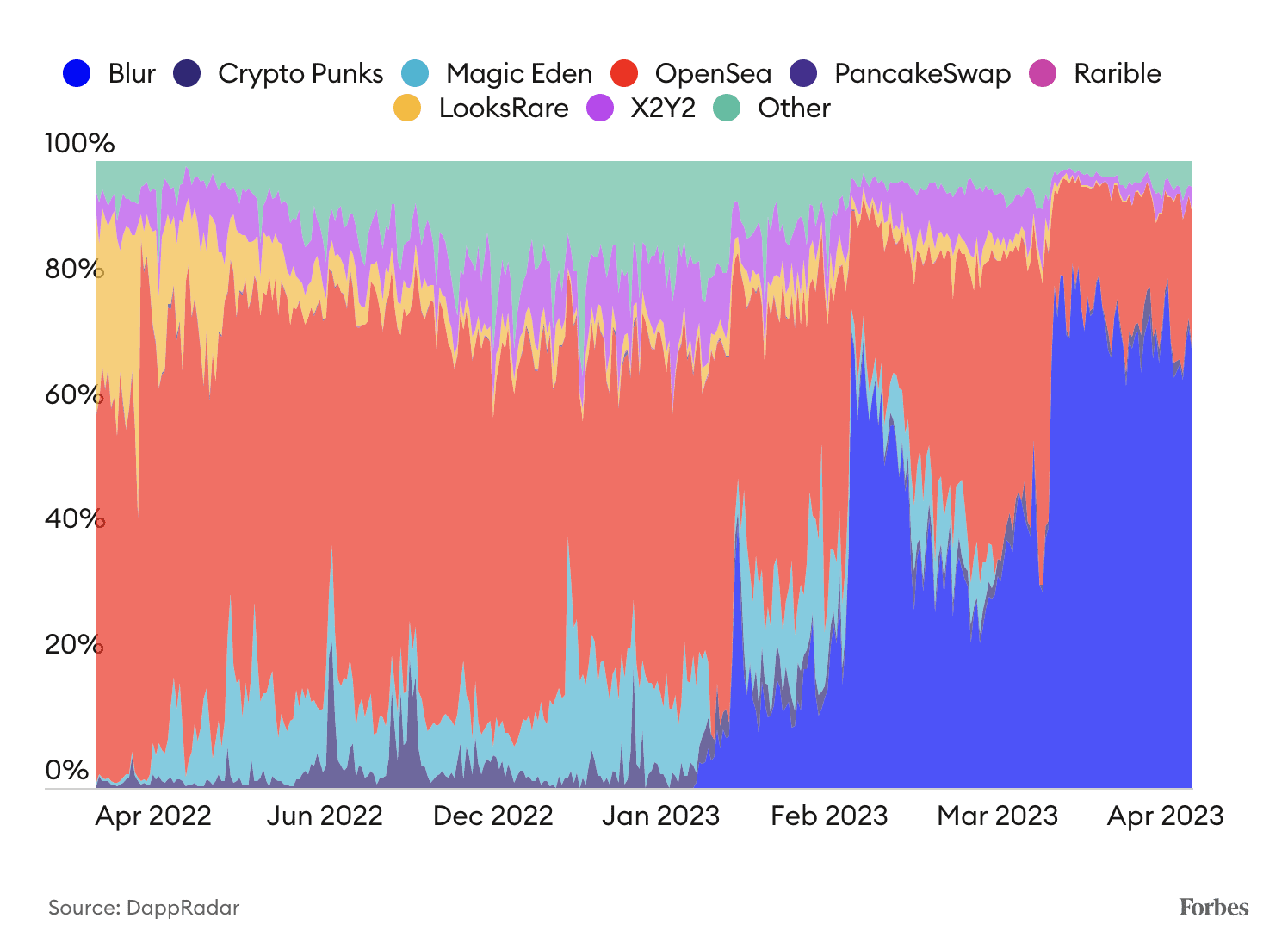
The rapid rise of San Francisco-based Blur has astonished industry experts as it was able to surpass New York-based OpenSea, even though other well-funded startups have tried and failed to surpass OpenSea. OpenSea dominated the NFT market in the summer of 2021, and even as competitors sprang up, OpenSea still had a 75% share of the market at the end of 2022. According to Dapp Radar, it generated $472 million in revenue from $18.8 billion in trading volume, with a transaction fee of 2.5%. A year ago, Coinbase launched its own marketplace to compete with OpenSea, but the results were very poor, with only $6 million in sales recorded so far.
There are many reasons for Blur's meteoric rise. First, while OpenSea has been catering to retail NFT buyers and art enthusiasts, Blur has taken a very different approach. Taking a page from Robinhood's growth playbook, Blur has targeted active NFT traders, undercutting its competitors on platform fees by supporting its business and growth with venture capital raised from crypto investors like Paradigm and Cozomo de Medici. Similar to Binance, Blur also rewards customers with its own minted tokens, something OpenSea has yet to launch. Blur's timing is ingenious. Casual purchases of NFTs by retail customers and collectors have largely disappeared for the user-friendly OpenSea. However, for-profit NFT traders are still trading digital assets in large volumes every day.
Blur’s alternative model and sudden emergence shook up the entire NFT ecosystem, prompting many players to re-examine audience targeting, creator royalties, and NFT utility.
The son of a Cambridge, Mass., family hotelier, Roquerre’s love of tech startups began in 2013 when he landed a summer job as a software engineer at fast-growing T-shirt startup Teespring at age 15. The internship turned into a full-time job when Roquerre dropped out of his Boston private high school and, with the help of his mother, moved to a San Francisco apartment he shared with roommates he found on Craigslist.
After a year at Teespring, Roquerre founded his own recruiting startup, StrongIntro, in 2015. He left the company a year later to attend MIT as a freshman, while Liu was a sophomore. A San Francisco native, Liu always knew he wanted to get into the startup world. “I came to MIT in large part because of the network,” he said.
Anthony Liu, who leads Blur's team of seven engineers, has only publicly used his real name today.
Liu met Roquerre during his junior year in 2018 at a mutual friend’s tea party, an opportunity for students on the MIT campus interested in startups to meet each other. “We were both very conscious in our search for partners,” Liu said.
In May of that year, Liu graduated with a degree in computer science, and Roquerre decided to drop out of MIT to join him in co-founding a blockchain startup called Namebase. Namebase operated a blockchain-based domain name marketplace. After three years of development, they sold it to Namecheap, the world’s second-largest domain name registrar after GoDaddy.
During the NFT craze in 2021, Roquerre began collecting and trading digital art, but was left unsatisfied by the existing market for traders. He said the existing market "treats NFTs as a retail shopping experience," which is not ideal for experienced collectors who want to trade more and faster. At the same time, Liu, who has created and sold digital collections online since middle school, was convinced by the idea. So, in January 2022, Liu and Roquerre wrote the first line of code for their new NFT startup, focusing on traders.
Marketplaces, where a company provides a venue and infrastructure for buyers and sellers to meet, are hard to disrupt. It’s hard for a new place to attract enough buyers and sellers if a good place to trade already exists, and the larger the existing market, the harder it is to disrupt it. For example, Craigslist had $660 million in revenue in 2021, even though the site remains the same after more than 20 years, and Coinbase, which is 11 years old, is still the most popular place to buy crypto in the United States. When it comes to buying and selling NFTs, there are dozens of marketplaces around the world.
Roquerre said it’s nearly “impossible” to compete with OpenSea’s dominance of the market for retail NFT buyers, but he sees opportunity among OpenSea’s less-served customer base: active traders who sometimes trade hundreds of thousands of dollars worth of NFTs per day.
To meet the needs of traders, Blur designed its user interface to be very different from OpenSea, which emphasizes NFT artworks and presents them in a gallery-style display. Blur borrowed from the interface of active stock trading, displaying important trading data such as minute-by-minute price, trading volume, and ownership information with a simple NFT collection list and sortable columns. Users can also further view information such as "depth", showing the trading volume at different price levels, and its "bidding pool" allows traders to bid on multiple works at once and buy NFTs in bulk with a single click.
That’s in stark contrast to the pre-Blur era, when traders who wanted to sell large numbers of NFTs on OpenSea had to list them one by one. “That was a real pain,” said Ovie Faruq, co-founder and artist of NFT collectibles Rektguyz.
To reduce costs for these traders, Blur adopted a controversial strategy: making royalty payments to artists optional. On OpenSea and other marketplaces, NFT creators are typically entitled to royalties, often as high as 2.5%, on secondary sales of their work. However, royalties are never embedded in the underlying, low-level code of the NFT on the blockchain, and can therefore only be enforced by software built on top of the blockchain, like OpenSea’s marketplace. Blur’s move angered artists, causing OpenSea to reduce its royalty fees, and as of February, both marketplaces have agreed to abide by a minimum royalty fee of 0.5%.
"Blur has said they don't care about artistry, they just want to build an exchange where people can create a market for these works, and they don't care what these NFTs look like," said Shane Cutra, a former Chicago Board Options Exchange trader who is now retired and is keen on NFT trading. Since he started trading in December 2020, Cutra, 53, said he has made about $400,000 by trading NFTs.
Blur also attracted customers by issuing its native Blur Token, which is deposited (or airdropped in the crypto space) into traders’ wallets based on their activity levels. Creating such “loyalty” tokens (which in Blur’s case can be used to receive discounts) and issuing them for free based on usage is a common marketing strategy in crypto to attract and retain customers. Blur’s token, like Binance Token, does not represent ownership of the platform, but does have voting rights, giving token holders a say in platform software changes.
Blur's first round of token airdrops took place in February for users who had been using the platform since its launch in October, offering additional tokens to traders who switched from competitors. It has also found an innovative way to reward trading activity with tokens, minimizing "wash trades," a common phenomenon in Crypto trading where people trade with themselves to get trading incentives or manipulate the market, essentially rewarding customers only for certain types of bids. NFT markets Looksrare and X2Y2 both launched in early 2022 in an attempt to disrupt OpenSea, but both were plagued by a large number of wash trades and never captured more than 15% of the NFT trading market share.
Roquerre declined to disclose how many Blur tokens he holds (a total of 342 million issued), only saying that 29% belong to Blur founders and employees. Of the remaining loyalty tokens, 51% are for Blur traders and 20% are for investors and consultants. According to CoinGecko data, Blur's current circulating token market value is approximately $250 million, and each Blur token is approximately $0.58.
The cumulative effect of Blur’s strategy has had a huge impact on the NFT market. In February, OpenSea announced that it was temporarily eliminating its 2.5% platform fee—a business model that earned it almost $500 million in revenue last year. In April, OpenSea launched OpenSea Pro, an NFT trading platform with 0% fees and similar trading tools as Blur. When Forbes called OpenSea for comment, they declined to speak directly about Blur, the change in fee structure, or whether they planned to launch their own loyalty token. “I’ve seen a lot of competition fail in my life,” said Erick Calderon, artist and founder of the well-known NFT studio ArtBlocks. “This is the most amazing thing in my opinion.”
In the crazy and sometimes confusing world of Crypto and NFT trading, it’s nearly impossible to build a sustainable moat around a business model. Blur has overtaken OpenSea as the market leader in less than six months since launching last year, but it faces a number of challenges if it hopes to stay ahead. For one, it charges no fees, so it relies primarily on its $11 million in venture capital funding. It will need to adopt fees or find other sources of revenue to sustain its expenses, and it currently has only 10 employees, most of whom are software engineers. In August, Blur’s token holders will vote on a proposal to turn on a 2.5% platform fee, but it could quickly lose a lot of users if those fees are enabled. Although Blur has been untouchably ahead of OpenSea in trading volume for the past seven weeks, OpenSea still has more monthly users than Blur, with OpenSea having 90,000 traders per week and Blur having about 40,000, according to data on Dune.
Blur has also been at odds with NFT artists for its audacious cut of all royalties given to creators. “How can you expect the economy to thrive when you don’t acknowledge or support the people who create what you trade?” Betty (pseudonym), founder and CEO of the popular Deadfellaz franchise, said in a recent tweet.
Then there’s the issue of regulation: The U.S. Securities and Exchange Commission (SEC) has been increasing its enforcement efforts against crypto companies and increasingly views NFTs as potential securities. A lawsuit against popular NBA Top Shot creator Dapper Labs alleges that the company’s NFTs are securities, and the SEC is reportedly investigating leading NFT studio Yuga Labs for its alleged sales of unregistered securities-like NFTs like Bored Apes.
Reward tokens such as Blur’s may also come under scrutiny, with Adam Pollet, a partner in the securities enforcement and litigation practice at Eversheds Sutherland, saying that even if the token is used only as a governance token to improve and fund the development of the platform, Blur could still face regulatory action.
He added: "It reduces the risk of non-compliance, but it definitely doesn't eliminate it." Roquerre said Blur is working closely with its legal team and partners at Paradigm to ensure they are on the right side of the law. "From day one, we've been focused on making sure everything we do is compliant with regulation," he said.