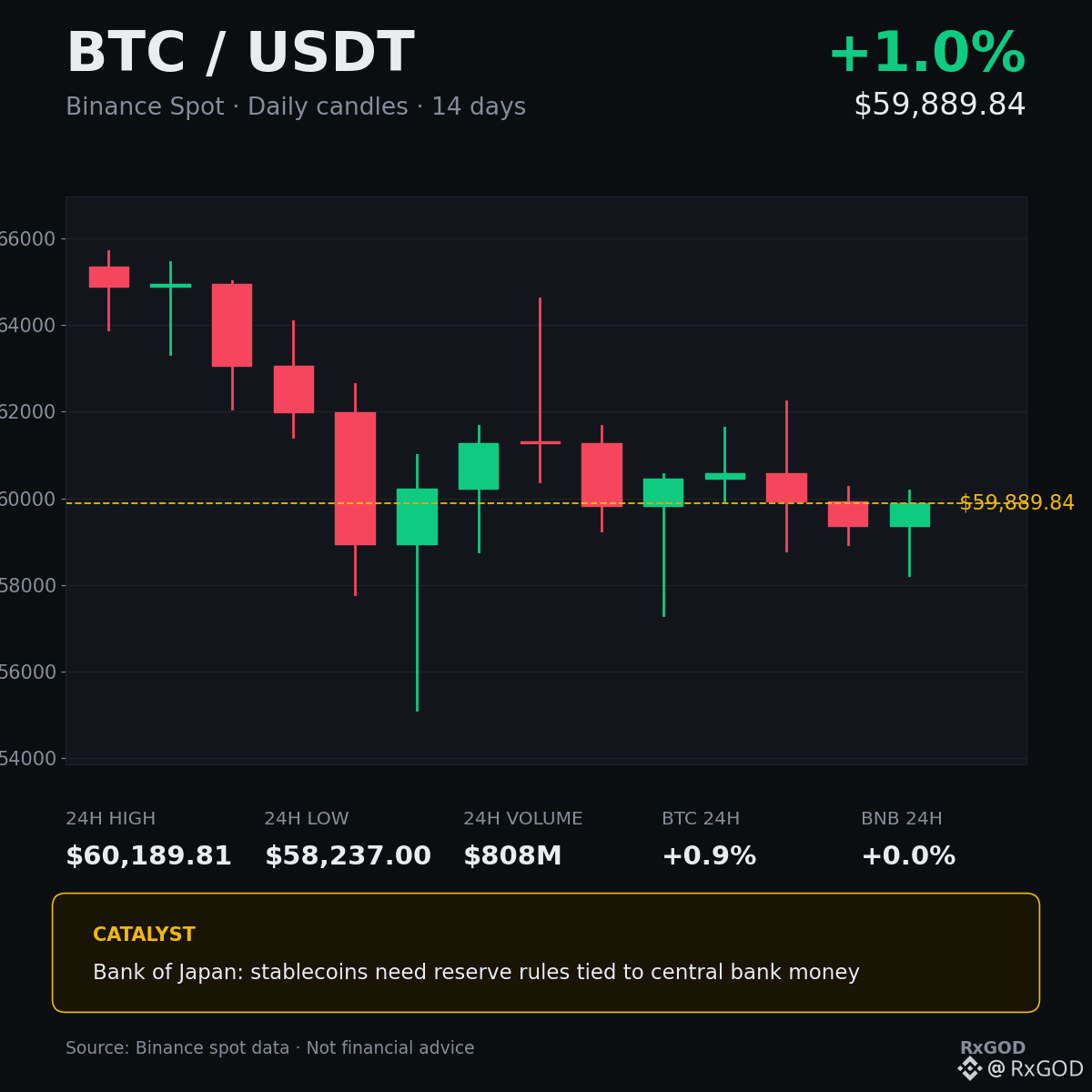
Japan just set the price of admission for stablecoins.
Bank of Japan Executive Director Kazushige Kamiyama told an IMF seminar in Tokyo on November 27 that stablecoins need "appropriate regulation of reserves and arrangements, together with well-designed links to central bank money." His principle is the "singleness of money": a yen is a yen, no matter which network moves it or who issued the token.
Two paths: tokenize central bank money itself, or link existing payment rails to new platforms. No new rule, no retail digital yen decision — a signal, not a law. But groundwork is moving: MUFG, Mizuho and SMBC aim to transact with a jointly issued stablecoin in fiscal 2026.
USD1 slipped to $0.94 on November 28 before recovering, and $USDT supply has drained $8.1B in 60 days. Kamiyama also warned smart-contract margin calls "could amplify market movements during periods of stress."
Meanwhile $BTC trades at $59,890, up 0.96% in 24 hours — mid-range at 45% of its 14-day span ($55,130–$65,696), still down 7.7% in two weeks. Relief, not a breakout.
The caveat: strict reserve rules raise the bar for every issuer — smaller stablecoins could get squeezed out. Japan picks safety over speed. If this model spreads, the stablecoin map changes fast.
Should every stablecoin be forced to prove its reserves to a central bank — real safety, or a leash on crypto? And if Japan's strictest version goes global, which stablecoin in your portfolio actually survives it?
Not financial advice — DYOR.
#CryptoNews #Stablecoins #BankOfJapan #ExtremeFear