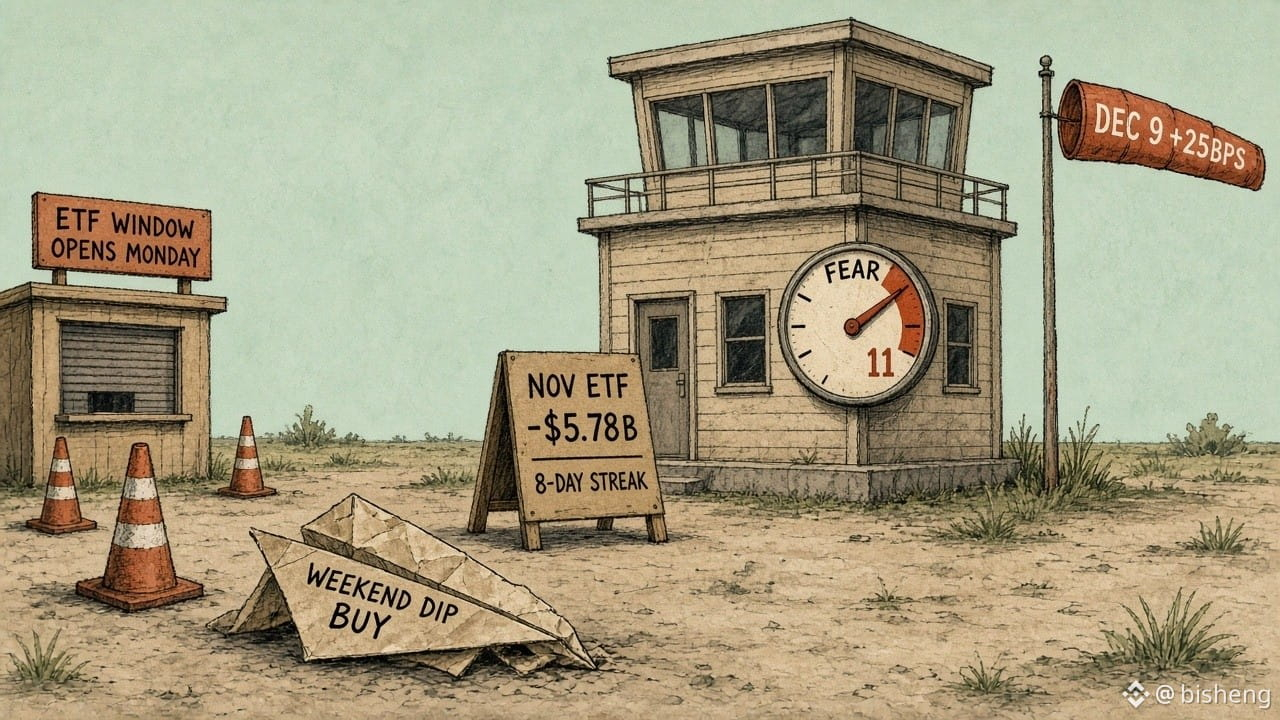
I disagree with turning the Fear & Greed Index dropping to 11 into “extreme fear means it’s time to buy,” or spinning the fact that U.S. spot Bitcoin ETFs have already set a record for monthly outflows in November into “the worst is already priced in, and things will stabilize on Monday.”
The index on alternative.me is at 11 today, down from 10 yesterday; both readings are in the extreme fear zone. It measures sentiment, not whether money has stopped flowing out. On the fund-flow side, Farside has filled in Friday’s figures: U.S. spot Bitcoin ETFs saw net outflows of $389.0 million during the half-day session on Black Friday, November 27. BlackRock’s IBIT alone saw $327.2 million flow out, about 84% of the day’s total. GBTC had outflows of $23 million, FBTC $20.8 million, BITB $12.3 million, and ARKB $5.7 million. Not a single fund recorded net inflows that day.
Adding up Farside’s daily data, there were 19 trading days through November 27, with cumulative net outflows of $5.7801 billion. The previous record, set in June this year, was about $4.51 billion, so outflows have now exceeded it by roughly $1.27 billion. There have been outflows for eight consecutive trading days since November 17, totaling about $3.441 billion; IBIT alone accounted for roughly $2.7855 billion. November has just one trading day left: Monday. Exchanges can take the weekend off, but the ETF creation and redemption window opens as usual on Monday.
Some people are treating “the index is already at 11” as a buy-the-dip signal. The index itself says that extreme fear may be a buying opportunity, not that it’s guaranteed. More importantly, there’s the interest-rate outlook. In its second estimate on November 25, the U.S. Bureau of Economic Analysis put third-quarter real GDP growth at a 4.3% annualized rate, up 0.9 percentage points from the initial estimate of 3.4%. On Kalshi, contracts for the December 8–9 rate decision put the odds of a 25-basis-point hike at around 93%, with only about a 5% chance of rates holding steady. The 10-year Treasury yield closed Friday at 4.94%. The market isn’t betting on a rate cut to save things; it’s pricing in a hike.
Prices haven’t recovered over the weekend, either. Bitcoin is around $59,161 on CoinGecko right now, down about 1.2% over 24 hours. Bitcoin’s daily candle on Binance closed yesterday at 59,373.3, after hitting a low of 58,934.6. So far today, it’s still hovering around $59,200, and it has not regained a firm footing above $60,000 over the weekend.
Treating 11 as a buy signal means reading the wrong thing into it. That number only tells you people are afraid; it doesn’t tell you whether money will keep flowing out. Outflows haven’t stopped, and a December rate hike is close to being a done deal. When the window opens on Monday, I’m betting redemptions will take another leg down. If Bitcoin can’t get back above $60,000, this month’s $5.78 billion outflow record will probably have to be revised again.
#比特币 #ETF