
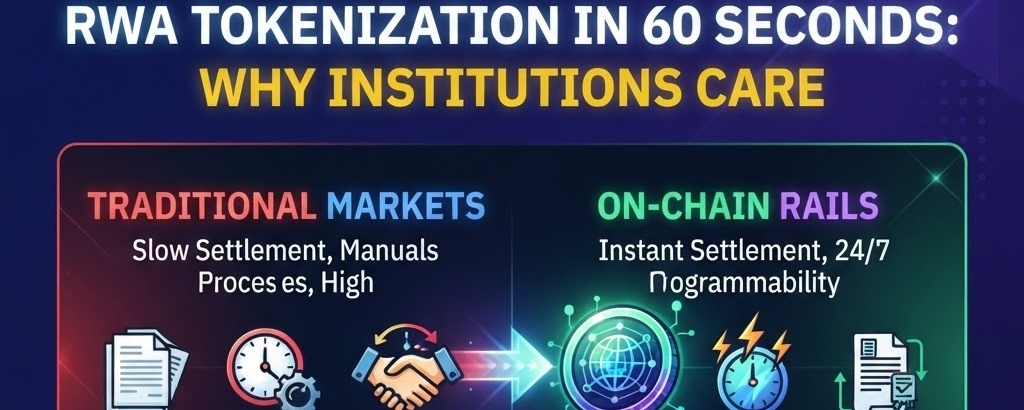

Real-World Assets (RWA) sound technical, yet the idea is straightforward: putting traditional assets—like Treasury bills, money market funds, private credit, commodities, or real estate—onto blockchain rails as digital tokens.
For Binance Square readers, here is why big institutions are paying attention in 60 seconds:
1. Faster Settlement & Always-On Rails
Traditional markets run on legacy clearing windows, cutoffs, and multi-day settlement delays. On-chain settlement can operate 24/7 with near-instant finality and lower operational friction.
2. Programmable Finance & Composability
Tokenized assets aren’t just static receipts—they can interact with smart contracts for automated collateral management, transparent tracking, and seamless on-chain liquidity.
3. Broader Access & Fractionalization
High-minimum institutional products or illiquid assets can be represented in smaller, auditable units—making cross-border distribution and portfolio management cleaner where regulations allow.
4. Real Yield Meets On-Chain Liquidity
As crypto matures, institutions look for yield backed by real-world cash flows alongside on-chain capital efficiency—bridging TradFi balance sheets with Web3 infrastructure.
What to Watch Next
Regulatory clarity & custody: Institutional scale depends on clear rules, compliant rails, and trusted custodians.
Liquidity & redemption: A token is only as useful as how smoothly holders can trade or redeem the underlying asset.
For informational and educational purposes only—not financial advice. Crypto and tokenized assets carry risks; always do your own research (DYOR).
Do you see RWA tokenization becoming a core pillar of institutional finance by 2030, or is regulation still its biggest hurdle? Drop your thoughts below!