BTC tests $60,150 and ETH lags behind: where is capital fleeing?
On a down day, capital doesn’t flee everything equally—it seeks shelter. And today, that shelter has a name: $BTC .
The numbers, side by side (11/28, ~8:00 p.m. CAT, live Binance data):
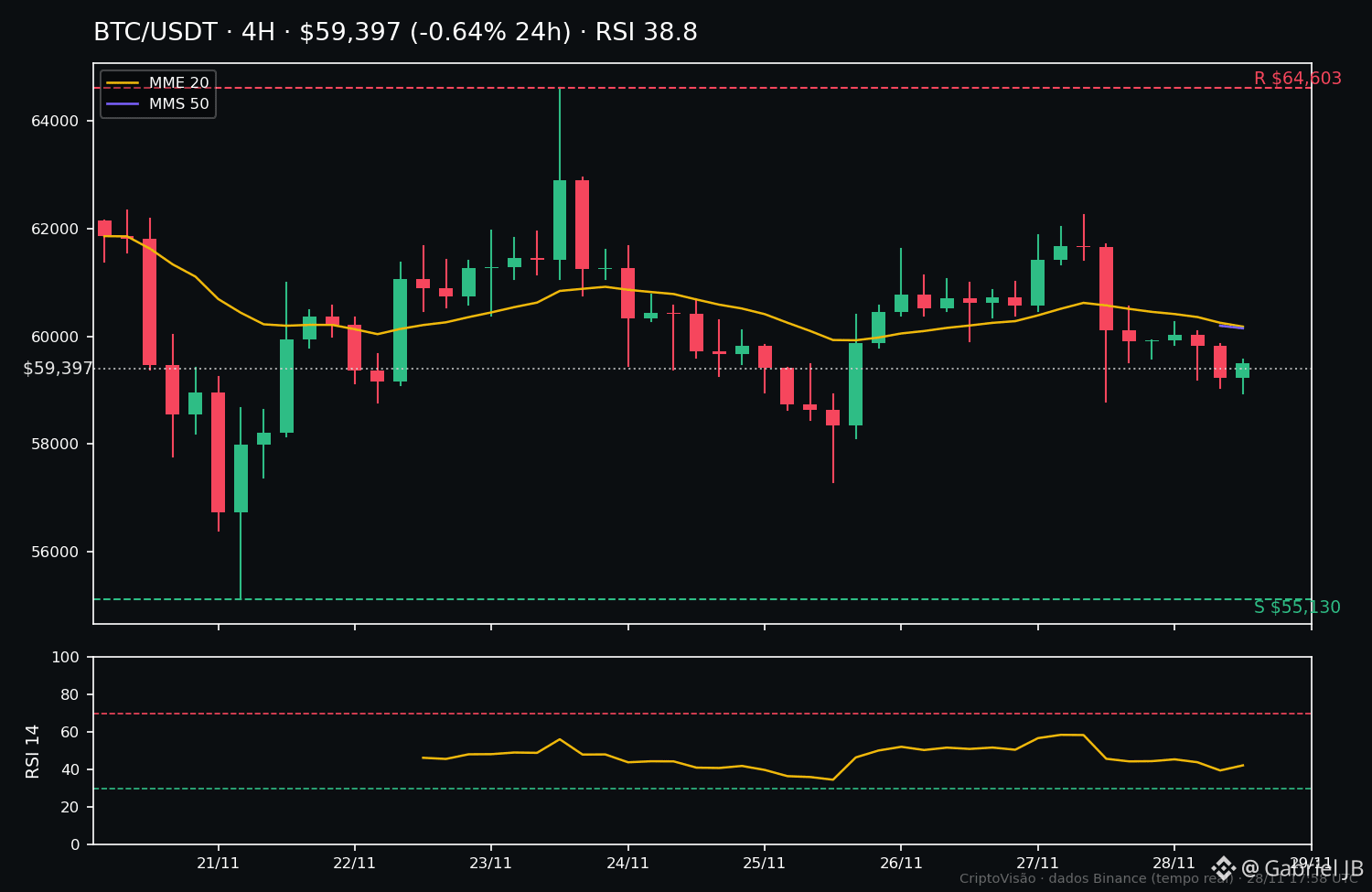
$BTC — $59,391 | -0.64% in 24h | -3.82% in 7 days | RSI 38.8 (neutral) | below the 4h moving averages ($60,150–60,227) | at 34% of the day’s range
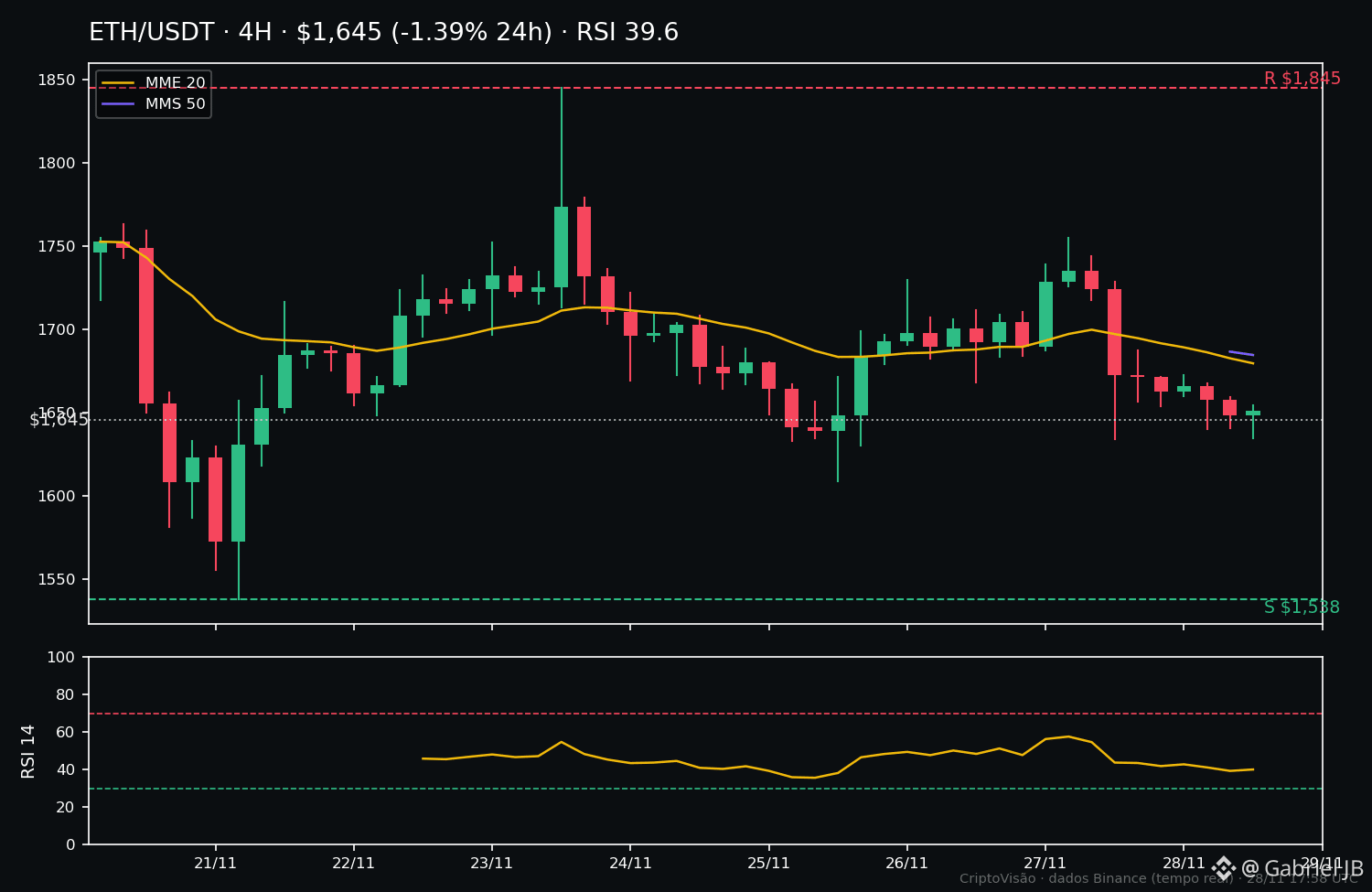
$ETH — $1,645 | -1.35% in 24h | -5.81% in 7 days | RSI 39.6 (neutral) | below the 4h moving averages ($1,683–1,685) | at 26% of the day’s range
Which one is stronger? $BTC , and it’s not even close: it’s down less than half as much as $ETH in 24h and almost 2 percentage points less over the week. $ETH is closer to the day’s low and farther from its moving averages—$1,645 versus averages of $1,683–1,685. $BTC , meanwhile, tested the $60,150–60,227 zone today and was rejected, but is holding above its 24h low ($58,935). The 7-day low for $BTC is $55,130; for $ETH , $1,538.
What does this mean for a trader? When the market falls and $BTC falls less, that’s defensive positioning, not risk appetite. A rotation into $ETH is only confirmed when $ETH starts falling less than $BTC or recovers its moving averages first—until then, capital is parked in $BTC .
Be careful how you read this: a one-day comparison doesn’t make a trend. Tomorrow, $ETH could recover faster—and $BTC still has the $60,150–60,227 resistance ahead. Relative strength is a reading of flows, not a forecast.
In your view, is this temporary shelter in $BTC or the start of a bigger rotation?
#Bitcoin #Ethereum #CryptoVision