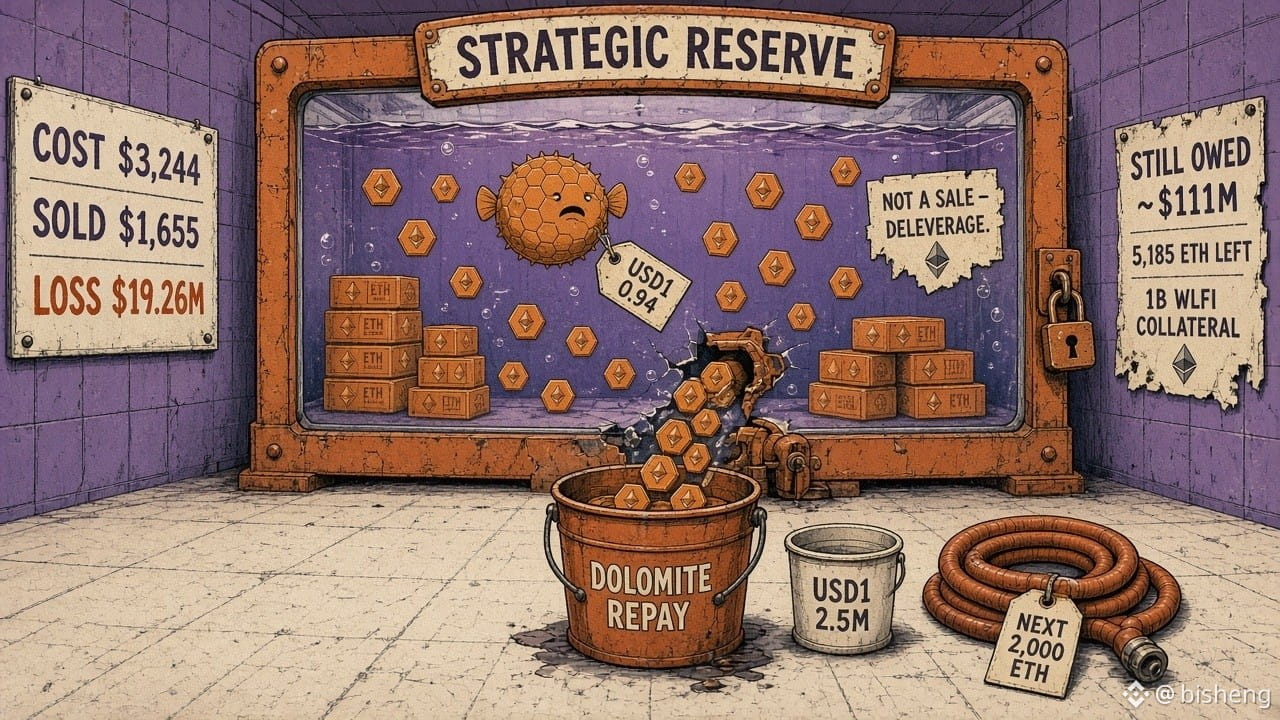
I disagree with calling WLFI’s 50% plunge in a single day a “normal fluctuation for a political coin.” I also disagree with calling a project-linked wallet selling ETH at half its cost basis a “strategic reserve rebalancing,” and I certainly wouldn’t equate this directly with the “investor fraud” Sun Yuchen alleged today.
Addresses flagged by Lookonchain and Arkham sold 10,600 ETH through CoW Swap on Friday evening, receiving 17.58 million USDC at an average price of about $1,655 to $1,659. Another 1,378 mETH were swapped for 2.48 million of its own USD1, bringing the total to about $20.06 million. The ETH had been accumulated last year at an average price of roughly $3,244, locking in a loss of about $19.26 million on the books in one fell swoop. The wallet was called the Strategic Reserve. Reserves aren’t meant to be sold at half price to pay off debt.
OnchainBeat checked the onchain activity: a few minutes before the selling began, the multisig withdrew 10,000 ETH and all of its mETH from collateral on Dolomite. After the sale, most of the stablecoins were immediately sent back to repay loans—16.59 million USDC, plus 2.5 million USD1. After repayment, two accounts still owed about 50.6 million USDC and 60.1 million USD1 as of 03:46 UTC this morning, or roughly $111 million in total. That same evening, another 2,000 ETH were withdrawn and left unsold, while about 990 million WLFI in collateral was transferred to a Dolomite account under another Safe with no publicly identified label. The collateral still includes about 5,185 ETH and 1 billion WLFI.
The real thing to look at is this structure. Their own lending product, World Liberty Markets, is built on Dolomite. Earlier this year, it also used about 5 billion of its own WLFI tokens as collateral to borrow $75 million in stablecoins. When the token crashes and the collateral deteriorates, they have to sell ETH from the reserve to plug the hole. That’s not strategic allocation; it’s deleveraging. USD1 also briefly fell to $0.9394, a level CoinGecko recorded as its all-time low, before recovering to near $1. At the time of posting, it was about $0.9979. If a “dollar stablecoin” issued by a company can depeg by about 6% on the very night that company is repaying loans, then that peg isn’t all that solid to begin with.
Today, Sun Yuchen called on exchanges to delist WLFI and USD1, and characterized the matter as circular borrowing to cash out, unauthorized sales, freezing investor assets, and fraud. His wallet was blacklisted after the token listed last year, and he sued the project in federal court this April. The project countersued him in May, accusing him of shorting the token and driving down its price. This is an ongoing lawsuit, so his characterization should be treated as one side’s claims; there’s no need to take them as proven. But the onchain sale speaks for itself, whether or not he says a word: ETH was withdrawn from collateral, sold for about half its cost, and immediately used to repay stablecoin loans on the same protocol. About $111 million in debt remains, and they’re still holding their own token—which has already been cut in half—as collateral.
CoinGecko currently puts WLFI at about $0.01970, with a 24-hour range of $0.01668 to $0.04033, a drop of about 51%. Today’s $0.01668 has already been recorded as an all-time low, down about 94% from last September’s peak of $0.3313. CoinGlass recorded about $16.89 million in liquidations on the futures market, with longs accounting for roughly 90%. What’s most likely next isn’t a rebound on the strength of the “Trump theme,” but that with collateral still tied up in WLFI, another leg down will force them to dip into reserves again. Those 2,000 ETH withdrawn but not sold are the next transaction to watch.
#WLFI #USD1