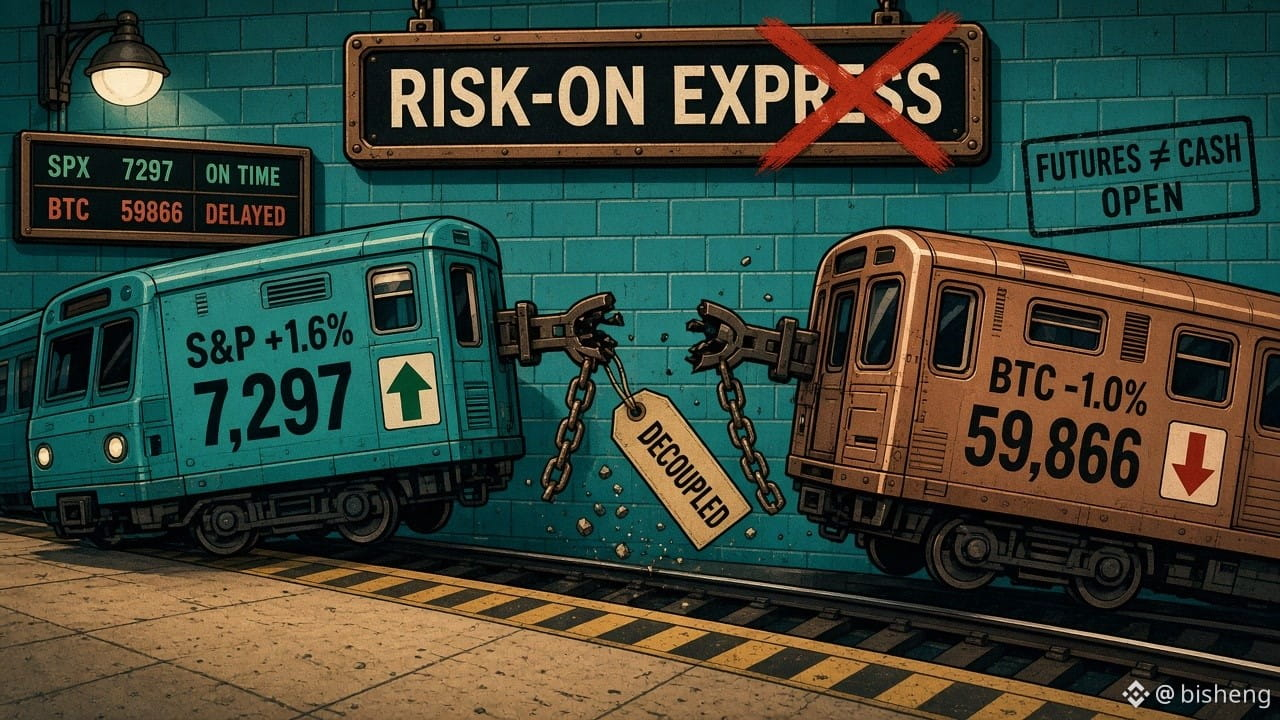
People in crypto circles are once again spinning yesterday’s rebound in U.S. stocks as a return of risk appetite, saying Bitcoin is taking the weekend off and will catch up with a rally on Monday. That logic doesn’t hold up.
Let’s lay out the sequence of events first. Yesterday was Black Friday, and U.S. markets were open for only half a day. Bloomberg reported that Bitcoin initially rose along with U.S. stock futures in the morning, briefly topping 62,000. But as soon as the New York cash session opened, Bitcoin started to fall on its own. Its 24-hour low was about 58,760, and it later traded around 59,900, while the S&P 500 closed up 1.6% for the day. Reuters and Xinhua reported the closing figures: the S&P 500 rose 114.71 points to close at 7297.49; the Nasdaq gained 543.70 points, or 2.31%, to close at 24129.50. For Bitcoin, CoinGlass recorded a high of 62104.9 and a low of 58759.5 on November 27, with a close at 59866.4, down 1.04% for the day. Binance’s daily chart showed a high of 62248.9, a low of 58792.4, and a close at 59923.1 yesterday. This wasn’t stocks rising first and Bitcoin lagging behind. Bitcoin initially moved with futures in the morning, then fell behind as soon as the cash session opened.
It’s Saturday afternoon now. CoinGlass has spot Bitcoin at around 60044. Today’s daily candle opened at 59893.1, reached a high of 60243.1, and dipped to 59803.2, hovering around the 60,000 mark. This bit of weekend sideways trading doesn’t change the fact that Bitcoin fell behind yesterday.
And there’s no point pretending November hasn’t happened. CoinGlass puts October’s close at 77434.7, and Bitcoin is around 60044 now, down about 22.5% so far this month. The monthly candle hasn’t closed yet. This year’s June monthly candle was down −20.41%. The current one has already fallen further. Bloomberg says Bitcoin is heading toward its worst month in more than four years.
Some people are also trying to explain this away by saying whales are buying the dip. CryptoQuant’s whale report dated the 27th covers data through the 21st: addresses holding between 1,000 and 10,000 coins added a net 121117 coins over 52 days, bringing their balance to 2947054 coins. But the unrealized profit margin for that same group of addresses fell from 33.9% on September 30 to 5.7%, the lowest reading in the report this year. Addresses holding more than 1,000 coins saw their paper profits fall from $124.7 billion to $23.8 billion, with net realized losses of $2.1 billion over 52 days. In October, they still averaged $65.6 million in realized profits per day; so far in November, that has turned into average realized losses of $197.2 million per day. A growing balance is not the same thing as profits holding up or selling pressure disappearing. The report also notes that addresses entering or leaving this range, and coins moving between addresses, can all change the balance; you can’t assume the same group of people is buying.
So here’s where I stand: yesterday wasn’t a return of risk appetite. Bitcoin fell behind in real time as U.S. stocks rebounded. Trading sideways around 60,000 over the weekend doesn’t prove that it will catch up with a rally. U.S. markets and U.S. spot Bitcoin ETFs will both have a full trading day next Monday. Whether Bitcoin can get back above 60,000 and hold there is more meaningful than repeating “when stocks rise, crypto follows.” If it’s still below 60,000 on Monday, this lag won’t be as simple as just taking a break.
#比特币 #BTC