


SOCRadar revealed on November 26 that suspected hackers linked to Vietnam breached government, military, and legislative bodies in Thailand and the Philippines between August and September 2026. The hackers are suspected of conducting intelligence gathering on the South China Sea.
Five intrusions, two governments
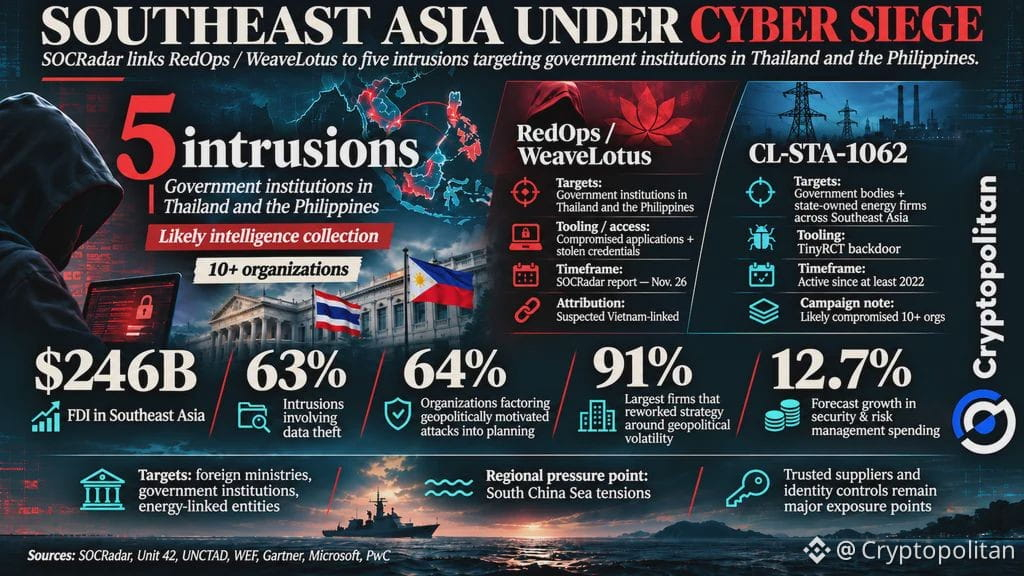
In its report, RedOps: WeaveLotus Targets Southeast Asian Governments for South China Sea Intelligence, SOCRadar named WeaveLotus as the group responsible for five confirmed cyber incidents in Thailand and the Philippines.
The hackers breached systems by taking advantage of known vulnerabilities found in GeoServer (CVE-2024-36401) and osTicket (CVE-2021-42235). In addition, they found a number of weaknesses in the way two other software applications, JasperReports and Laravel, were configured.
SOCRadar believes WeaveLotus may be operating with the help of the government of Vietnam. However, the researchers are only somewhat sure of that hypothesis. In the course of their investigation of the origins of the group, they also looked at the possibility of a connection between WeaveLotus and OceanLotus, a long-established cyberespionage group that is also known as Advanced Persistent Threat 32 (APT32). However, their research revealed only a weak link between the two groups.
A cyber front in the South China Sea
The cyberattacks come as Southeast Asian nations and China work toward an agreement on maritime conduct in the South China Sea. On November 15, Philippine Foreign Secretary Theresa Lazaro said ASEAN and China had provisionally agreed on roughly 80% of the text of a proposed Code of Conduct.
The ongoing negotiations make government networks important targets for cyberespionage. Confidential diplomatic communications could reveal the country’s bargaining positions. Access to defense agreements would provide intelligence agencies the advantage in making predictions about military actions and related policy decisions.
$246 billion in foreign investment nearby
Cyberespionage against Southeast Asian governments also raises concerns for foreign investors. The region attracted a record $246 billion in foreign direct investment (FDI) in 2025, up 10% from the previous year, according to the ASEAN Investment Report 2026.
Southeast Asia is also home to some of the world’s most important shipping chokepoints, making regional security a concern for businesses that rely on global supply chains.
While SOCRadar found no evidence that WeaveLotus specifically targeted private companies, breaches of government networks could put connected contractors and technology suppliers at risk. Foreign investors, accordingly, may require a closer examination of both cybersecurity practices and financial performance of prospective business partners.
A separate hand on the energy grid
Government institutions are not the only targets of cyberespionage in Southeast Asia. On June 25, Palo Alto Networks’ threat intelligence division, Unit 42, reported a separate campaign involving a Chinese-speaking hacking group known as CL-STA-1062.
Active since at least March 2022, the group targeted government institutions and state-owned energy companies. Researchers believe the hackers compromised at least ten organizations between October and December 2025.
The hackers used TinyRCT, malicious software that allows them to remotely access computers, steal files and capture screenshots. Although researchers have established no connection between CL-STA-1062 and WeaveLotus, the two campaigns show how multiple threat groups are targeting Southeast Asia.
 Southeast Asia Cyberespionage: Vietnam-Linked Hackers, Government Breaches and Rising Cybersecurity Risks
Identity and the supply chain
Stealing confidential information is still one of the main objectives of cyberattacks. According to Microsoft’s 2026 Digital Defense Report, 63% of all attacks involved data theft. Attackers may access confidential information through stolen credentials and accounts with weak cybersecurity defenses.
The risks also extend to business relationships. PwC’s Annual Threat Dynamics 2026 linked persistent espionage against critical infrastructure to geopolitical tensions. The report also highlighted how attackers exploit trusted suppliers to reach other organizations.
Even companies with strong cybersecurity defenses can be vulnerable when attackers breach the systems they share with suppliers.
What it means for security budgets
Geopolitical tensions are changing how businesses plan their cybersecurity investments. The World Economic Forum’s Global Cybersecurity Outlook 2026 found that 64% of organizations consider geopolitically motivated cyberattacks in their planning. Among the largest organizations, 91% have adjusted their cybersecurity strategies in response to geopolitical uncertainty.
Growing concerns over geopolitically motivated cyberattacks coincide with rising demand for cybersecurity products and services. Gartner forecast 12.7% growth in the information security and risk management sector, excluding the effects of currency fluctuations.
Another factor that could drive cybersecurity spending is the growing use of artificial intelligence (AI) in hacking. Cryptopolitan previously reported that Microsoft identified six hacking groups associated with China, North Korea, and Cambodia using ARTEX, an open-source, AI-powered security testing framework. One of those groups, Cambodia-based Storm-3358, targets Southeast Asian financial institutions.
For businesses operating in Southeast Asia, the challenge is deciding where to direct additional cybersecurity spending. Protecting user accounts, securing connections with suppliers, and detecting increasingly sophisticated attacks could become investment priorities.
Don’t just read crypto news. Understand it. Subscribe to our newsletter. It's free.