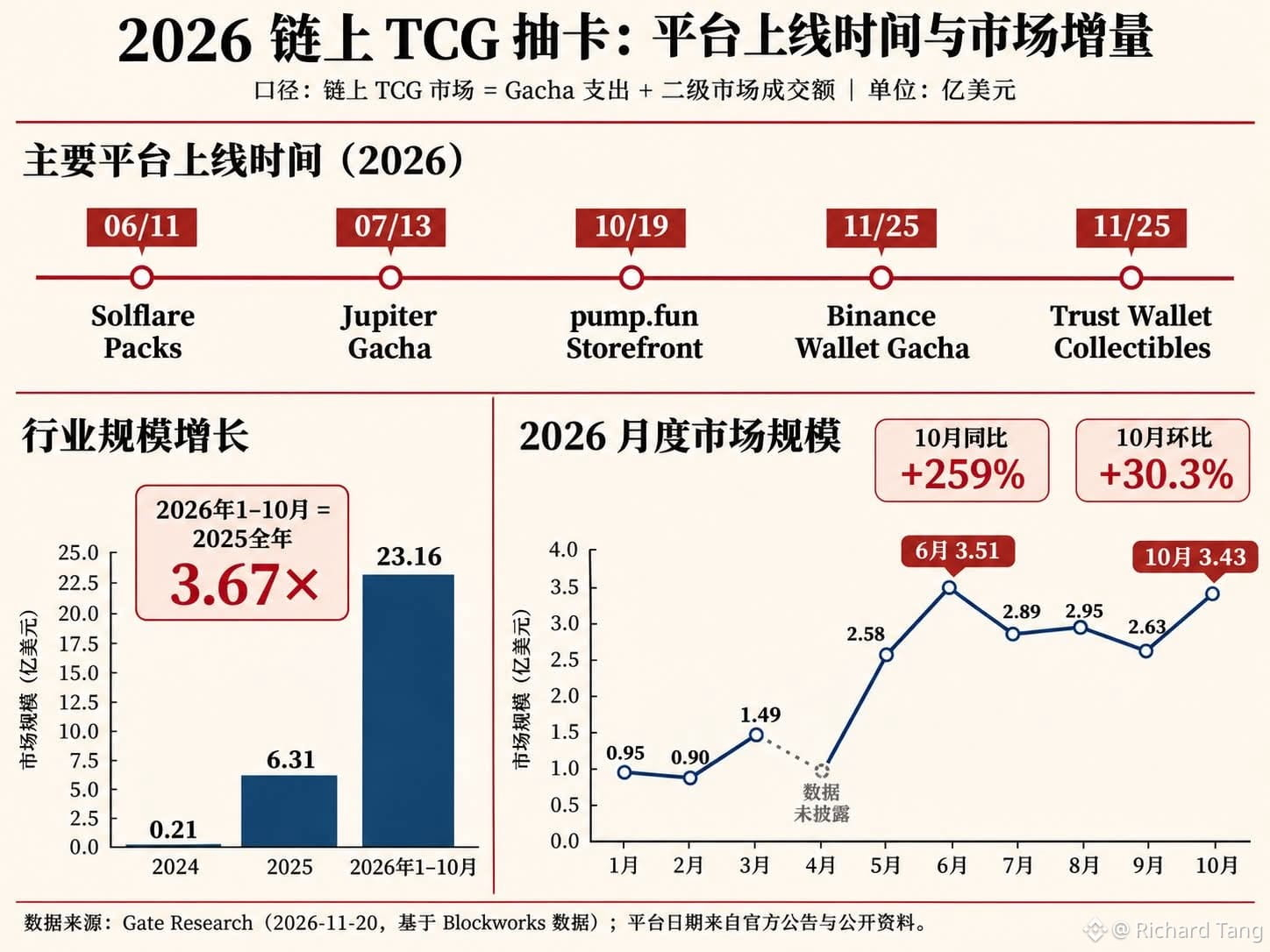
Damn, card pulls are addictive! $343 million in a single month—why are platforms rushing to offer them?
You can sell the cards after opening a pack, then use the proceeds to open more. This product knows exactly how to keep people around.
In October, spending on on-chain TCG card pulls, plus secondary-market sales, reached $343 million, up 259% year over year. Solflare, Jupiter, and Binance Wallet have all added the feature, competing for users’ spending time beyond trading.
The product puts payment, pack opening, card viewing, and resale into one flow, eliminating the hassle of finding buyers. Money from reselling can go straight into opening more packs, naturally encouraging more frequent spending.
Here’s a hypothetical example: You add $100, open packs, sell the cards back for $85, then spend that on more packs. Your cumulative spending would be $185. The increase in transaction volume comes from both new money and money that may be circulating repeatedly.
Wallets provide the access point, while card-service providers handle sourcing, custody, and pricing. Specific earnings are divided according to partnership agreements. Revenue from selling card packs also has to cover the costs of cards, buybacks, customer acquisition, and operations.
The hardest part is resale: offer high prices and players are more likely to stick around, but the platform’s margin shrinks; offer low prices and users may go elsewhere. Consistently sourcing desirable cards and letting people cash out at reasonable prices is harder to replicate than pack-opening animations.
I’ll be watching to see how many people return after the incentives end, and whether cards can be sold or withdrawn smoothly. Without points or airdrops, would you still pay to open packs? #Vitalik主张硬件钱包芯片开放至工厂图纸