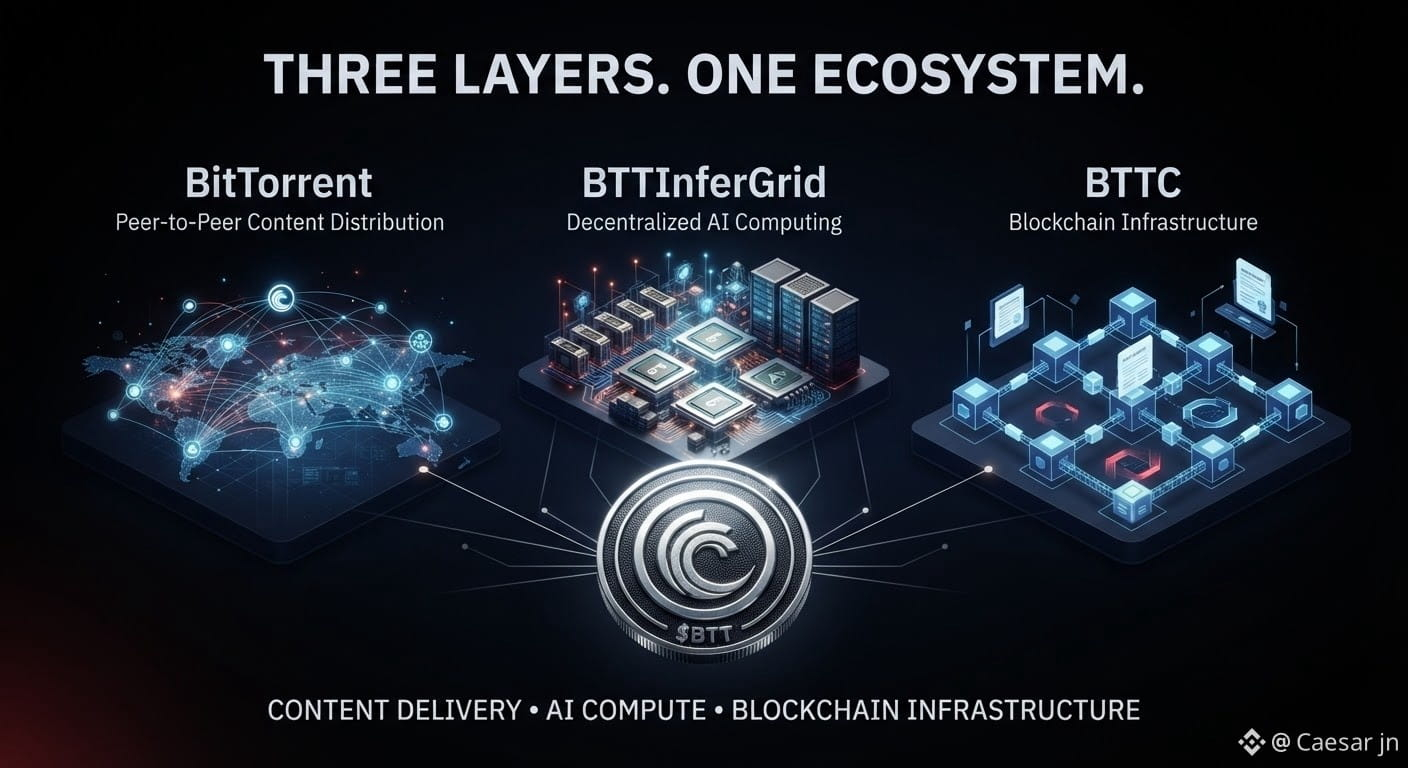
BitTorrent Is Building More Than a P2P Network: Understanding Its Three-Layer Infrastructure
BitTorrent's ecosystem expansion represents an important shift in how its infrastructure is positioned.
Rather than focusing on file distribution alone, the upgraded architecture brings together three complementary capabilities: decentralized data distribution, AI computing, and blockchain infrastructure.
The interesting part is how these layers are designed to work together.
1. BitTorrent: The Distribution Layer
The foundation remains BitTorrent's peer-to-peer technology.
Its network connects users and distributed resources to facilitate efficient data and content delivery without depending entirely on centralized servers.
This distribution capability also provides a foundation for handling large datasets and AI-related resources.
2. BTTInferGrid: The AI Computing Layer
AI applications need computing power, particularly GPU capacity for inference workloads.
BTTInferGrid is designed to aggregate distributed GPU resources, coordinate computing tasks, and connect resource providers with developers who need processing capacity.
This extends the ecosystem into decentralized AI infrastructure.
3. BTTC: The Blockchain Infrastructure Layer
BitTorrent Chain provides the blockchain infrastructure for smart contract execution, cross-chain interoperability, and on-chain settlement.
It creates an environment where digital assets and decentralized applications can interact across supported networks.
4. $BTTC : The Economic Connection
This is where the architecture becomes particularly interesting.
$BTTC is positioned as the common economic medium across the ecosystem, supporting resource payments, service utilization, incentives, staking, and governance.
The objective is to connect infrastructure providers, developers, and users through a shared token-based economic model.
Why This Architecture Matters
Each component addresses a different infrastructure requirement:
• BitTorrent distributes data.
@BitTorrent_Official $BTTC @Justin Sun孙宇晨 #BTTInferGrid #TRONEcoStar