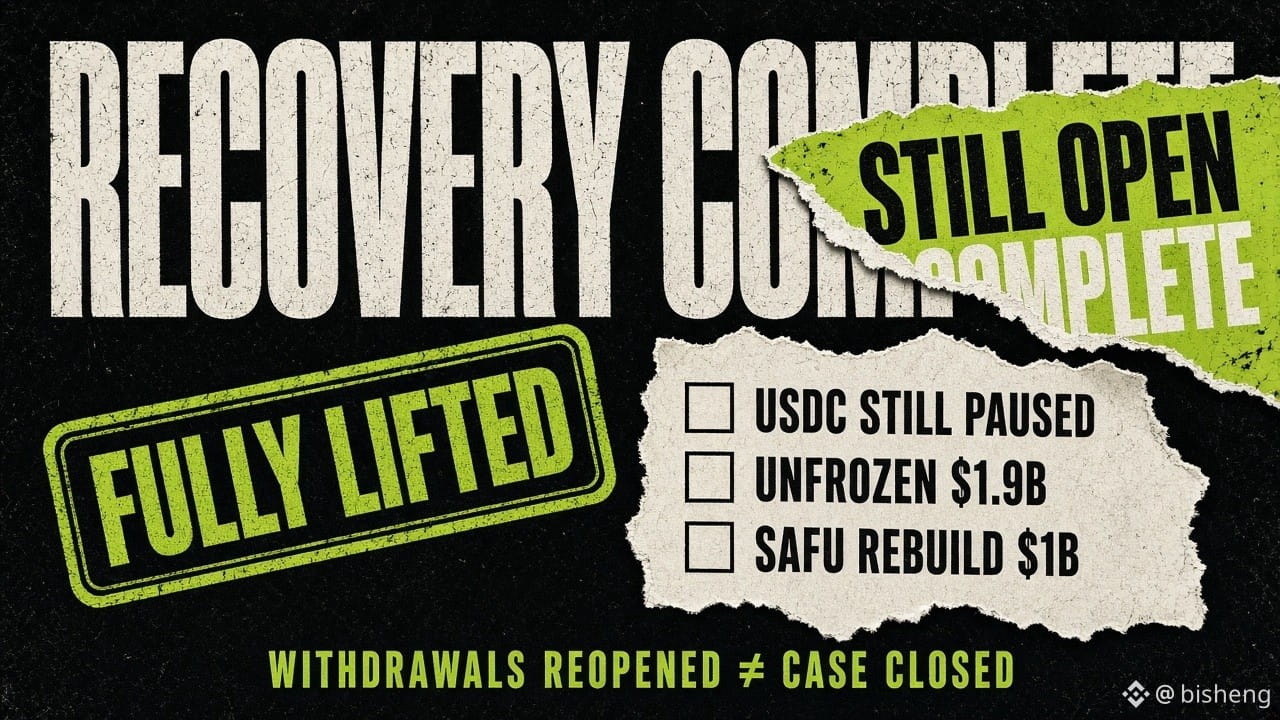
Binance’s announcement yesterday said that all withdrawal suspensions related to the October security incident had been lifted and that the recovery work was complete. People in the industry immediately started saying the $6.3 billion theft was behind us, user funds had never been at risk, and the exchange was back on track. That conclusion doesn’t hold up.
Let’s lay out the timeline. On October 29, hot wallets across multiple Binance networks were hacked, with losses of about $6.34 billion—the largest cryptocurrency theft on record. Cointelegraph, citing TRM Labs, pointed to North Korea’s TraderTraitor. Withdrawals were subsequently suspended. Bitcoin withdrawals resumed first on November 1, followed by a gradual reopening. crypto.news reported that during the nine and a half hours between 06:00 and 15:30 UTC on November 1, $4.65 billion was withdrawn and $1.01 billion deposited, for a net outflow of $3.64 billion. An update on November 14 said 87 more networks had reopened that week, with the rest expected to be brought back online the following week. By yesterday, 25 days had passed since withdrawals first resumed, and Binance announced that all withdrawal suspensions related to the incident had been lifted.
But the same announcement added that a small number of networks were still temporarily suspended due to maintenance or planned upgrades—and didn’t say which ones. When Cointelegraph checked Binance’s network status page at the time of publication, it found that USDC withdrawals on Hedera and World Chain were still suspended due to insufficient hot-wallet balances, while withdrawals on Sonic were suspended for security reasons. The headline says “all suspensions lifted,” but the status page still shows suspensions, citing hot-wallet balances and security issues. Those two claims don’t add up.
And the stolen coins didn’t disappear just because withdrawals reopened. crypto.news cited tracking by Onchain Lens showing that, on the 26th alone, wallets linked to the theft transferred out about $35.52 million in Ethereum. About $1.9 billion remains unfrozen, including roughly 18,350 Bitcoin (about $1.11 billion) and roughly 462,000 Ethereum (about $785.2 million). Another roughly $2.6 billion is estimated to be in frozen stablecoins. Just days ago, the U.S. Department of Justice filed a civil forfeiture lawsuit in federal court in Washington, seeking to seize more than $1.1 billion in Circle USDC allegedly linked to the theft. It said that since the incident, it had helped freeze, seize, or recover nearly $3 billion. Clearing the withdrawal queue is not the same as recovering the stolen funds or calculating the net loss.
Binance says it used more than $6.34 billion in company funds to cover the affected assets. The money came from the corporate treasury, part of the user protection fund SAFU, and the portion of the futures insurance fund above risk-control requirements. Binance also pledged to replenish the user protection fund to about $1 billion. A reserves snapshot taken at 00:00 UTC on November 12 covered 198 tokens, and cryptographic proof was provided on the 14th; the stated standard remains at least 1:1. Covering the shortfall means the platform used its balance sheet to fill the hole—it doesn’t mean the safe was never broken into. The protection fund still needs another $1 billion to be replenished, which shows that part of the cushion has already been drawn down.
This means the withdrawal channels have largely reopened after 25 days. It does not mean the $6.3 billion theft is settled. Three things still haven’t been clearly laid out: the actual net loss, how much of the hard-to-freeze assets like Bitcoin and Ethereum has been recovered, and exactly what has changed in the hot-wallet signing and authorization process. Until those three things are explained, I don’t accept “withdrawals restored” being presented as “the incident is behind us.”
#Binance #Binance