


Prediction market platform Polymarket announced yesterday (11/26) the official launch of a trading market based on AI compute prices. Users can predict and trade on the rental prices of three Nvidia GPUs—the H100, B200, and B300—for dates as far out as December 2028.
Polymarket CEO Shayne Coplan said in a post on X that this is the first step toward building a financial market for computing power, with more chip models and contract expiration dates to be added later.
How does Polymarket’s AI compute rental prediction market work?
Polymarket’s new AI compute rental price market uses binary event contracts that ask whether the average hourly rental price of a specific GPU in a given month will exceed a set threshold. For example, H100 contracts for December 2028 have thresholds ranging from $0.25 to $13.
The contracts settle against Ornn’s published compute pricing index, which is calculated from actual transaction data from independent cloud providers. They are cash-settled, and participants do not receive GPUs.
Polymarket combines the probabilities at each threshold into an implied rental price (PIRP), which Copeland describes as a yield curve.
How do traders view future compute prices? Forward curve points to expected decline in rental rates
Ornn’s settlement prices on November 25 showed H100 SXM at $3.10 per GPU hour, B200 at $9.76, and B300 at $10.83. Rental prices for all four models were higher in mid-November than the previous month.
How do market traders view future compute prices? As of November 26, Ornn’s H100 index showed an hourly rental price of $3.25, up 10.9% from the previous week. Polymarket’s prediction curve shows prices falling to $3.03 in December 2026, $2.67 in December 2027, and $2.16 in December 2028—a 33% decline from the current price.
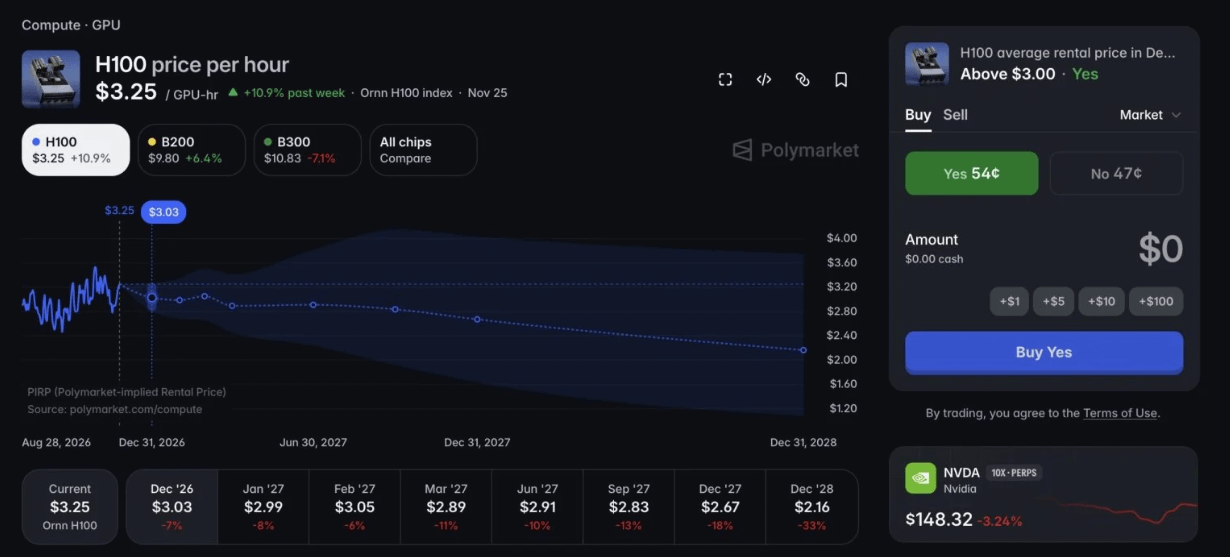 Image source: NextpredictHow do traders view future compute prices? Forward curve points to expected decline in rental rates
In terms of trading volume, the December 2026 H100 contract had a cumulative trading volume of approximately $501,000, but this figure does not indicate the liquidity available to immediately fill large orders.
What are the benefits of participating in AI compute prediction markets?
Copeland said hundreds of billions of dollars have been invested in future compute demand. Many transactions are essentially leveraged bets on GPU rental rates, and buyers, sellers, and financiers all need to hedge. Contract negotiations and GPU loans can also refer to market prices.
One benefit of participating in AI compute prediction markets is that infrastructure providers can buy contracts that profit when prices fall, offsetting revenue losses. AI developers, meanwhile, can take the opposite position to hedge against the risk of rising costs.
Polymarket announced on June 2 that FalconX and AneraLabs had completed a six-figure-dollar block trade referencing Ornn’s H100 benchmark to help a compute provider hedge renewal risk. However, the announcement did not name any other AI labs or financing providers adopting the new market.
U.S. regulatory review continues; what happens next remains to be seen
Meanwhile, Polymarket is facing regulatory scrutiny in the United States. Its international platform and the federally regulated Polymarket US are currently operated by separate entities.
On August 20, Polymarket US self-certified a value contract based on a compute index with the U.S. Commodity Futures Trading Commission (CFTC), but the platform had not yet launched a compute market as of November 25.
The review period for H100 and B200 rental index futures applied for by CME Group and Silicon Data has been extended to January 8, 2027. Kalshi and Intercontinental Exchange (ICE) are also pursuing similar products. The U.S. government began reviewing the CFTC’s final rule on event contracts on November 23, with no deadline set for completing the review.
For now, Polymarket’s new market offers a set of publicly viewable expectations for GPU rental rates. However, actual liquidity, institutional adoption, and the direction of U.S. regulation remain to be seen. These factors will also determine whether the market can serve as a reference for contract negotiations and financing.
(Crypto City note: Polymarket has been blocked by the Miaoli District Court for violating the Election and Recall Act in connection with contracts on Taiwan’s nine-in-one local elections. IP addresses in Taiwan cannot access the site.)
Related reading:
CFTC reopens investigation into Polymarket! Alleged violation of agreement banning U.S. users draws scrutiny
U.S. midterm elections could shape crypto regulation! Polymarket prediction contracts draw attention as prospects for the CLARITY Act grow more uncertain
“You can even bet on how expensive NVIDIA GPUs will get! Polymarket officially launches an AI compute rental prediction market” was first published on “Crypto City”