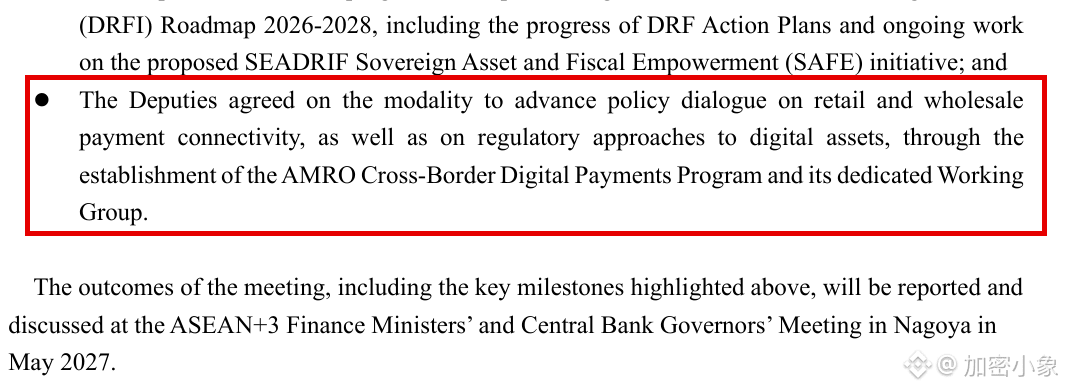
Everyone’s saying that more than a dozen Asian countries are joining forces to “build a network.” But look at the original joint statement posted by Japan’s Ministry of Finance on November 26, and there’s only one line related to crypto—the last item.
The joint statement by deputy finance ministers and central bank deputies from ASEAN+3 at the Kyoto meeting listed six outcomes. The first five covered the Chiang Mai Initiative, a bond market roadmap, and disaster financing. Only the sixth mentioned crypto: agreeing to establish an AMRO cross-border digital payments project and a dedicated working group to advance the interconnection of retail and wholesale payments, as well as “policy dialogue” on approaches to regulating digital assets.
There isn’t a single implementation clause in the entire statement, and it doesn’t name any exchanges. It concludes by saying the outcomes will be discussed again at the finance ministers’ and central bank governors’ meeting in Nagoya in May 2027.
If you’re cutting your position this week because of this, you may have been spooked by the headline. What’s really worth remembering is that, for the first time, cross-border stablecoins have been put on the same table for China, Japan, and South Korea. Nothing will change in your wallet in the short term. But in the long run, moving U between several Asian countries will eventually have to follow the same rules for reconciliation, and moving U over the counter will only get more expensive.
#ChinaJapanKoreaASEANToEstablishCryptoRegulationWorkingGroup