


The popular password manager 1Password confirmed a security incident in which hackers used a compromised employee GitHub account to gain access to internal systems and steal some customers’ names, email addresses, and account-related information.
According to 1Password’s official announcement on November 25, attackers also accessed the company’s source code and software build system. However, encrypted password vaults, passwords stored by users, and encryption keys were not affected.
The incident has drawn attention from the cryptocurrency community, and Binance founder Changpeng Zhao (CZ) urged users to change all their passwords. However, 1Password stressed that there is currently no evidence that user accounts have been taken over. The main risk at this stage is that hackers may use the leaked information to launch targeted phishing attacks.
Hackers breach an employee’s GitHub account, stealing users’ personal information and internal source code
According to 1Password’s official announcement, the company began investigating a suspicious incident on November 19 and discovered that attackers had gained access to an employee’s corporate GitHub account.
GitHub is a platform development teams use to manage source code. Using the access they had obtained, the attackers accessed 1Password’s private source code repositories and pushed malicious code to a backend service, allowing them to download some users’ account management data.
According to the company, the leaked information included customers’ names, login email addresses, account and user identifiers, account creation and last login times, as well as some non-confidential metadata used by internal systems.
In addition, the accessed data included public encryption keys, Secure Remote Password (SRP) authentication protocol parameters, and verification tokens from some account invitation, business account provisioning, and account recovery emails.
1Password said these public keys and SRP parameters cannot be used on their own to sign in to accounts. However, the attackers also obtained some private source code and accessed the company’s continuous integration and deployment (CI/CD) systems, which may have contained confidential credentials used by its infrastructure.
1Password has not yet disclosed the exact number of affected users, the attackers’ identities, or whether the data has been further exploited.
Official says password vaults are secure; login passwords and Secret Keys were not leaked
The biggest concern surrounding this incident is whether hackers might have obtained passwords, bank account details, and cryptocurrency wallet information stored by users in 1Password.
1Password emphasized that the attackers never obtained the contents of users’ password vaults and could not access their encrypted vault data through this breach.
This is due to 1Password’s security architecture. Passwords and other confidential data stored by users are encrypted using key material that includes their account password and unique Secret Key. 1Password does not store the account password or Secret Key needed to directly unlock a user’s vault. Therefore, even if some of the company’s backend systems are breached, attackers cannot decrypt vault contents using server data alone.
According to the company, the items unaffected by this incident include password vaults and their contents, the encryption keys protecting vaults, account recovery keys, and the 1Password apps and browser extensions.
However, the company also acknowledged that tokens in some account invitation and recovery links were accessed.
These tokens are one of the credentials required to complete an account invitation or recovery process. The relevant action still requires single sign-on (SSO) authentication or a verification code sent to the user’s email, so the tokens cannot be used on their own to gain control of an account.
1Password said that only a small number of users were affected by these specific tokens. It has notified them individually and extended verification codes from six digits to 10 alphanumeric characters to make brute-force guessing more difficult.
The company has also found no internal evidence that attackers successfully took over any user accounts using these tokens.
CZ urges users to change all their passwords; 1Password says no action is needed for now
The incident has also drawn attention from people in the cryptocurrency industry. Binance founder Changpeng Zhao recommended that all 1Password users change the passwords stored in the service in a reply to a post about the security incident on X. CZ said that while changing all passwords would be a hassle, taking this precaution was still necessary.
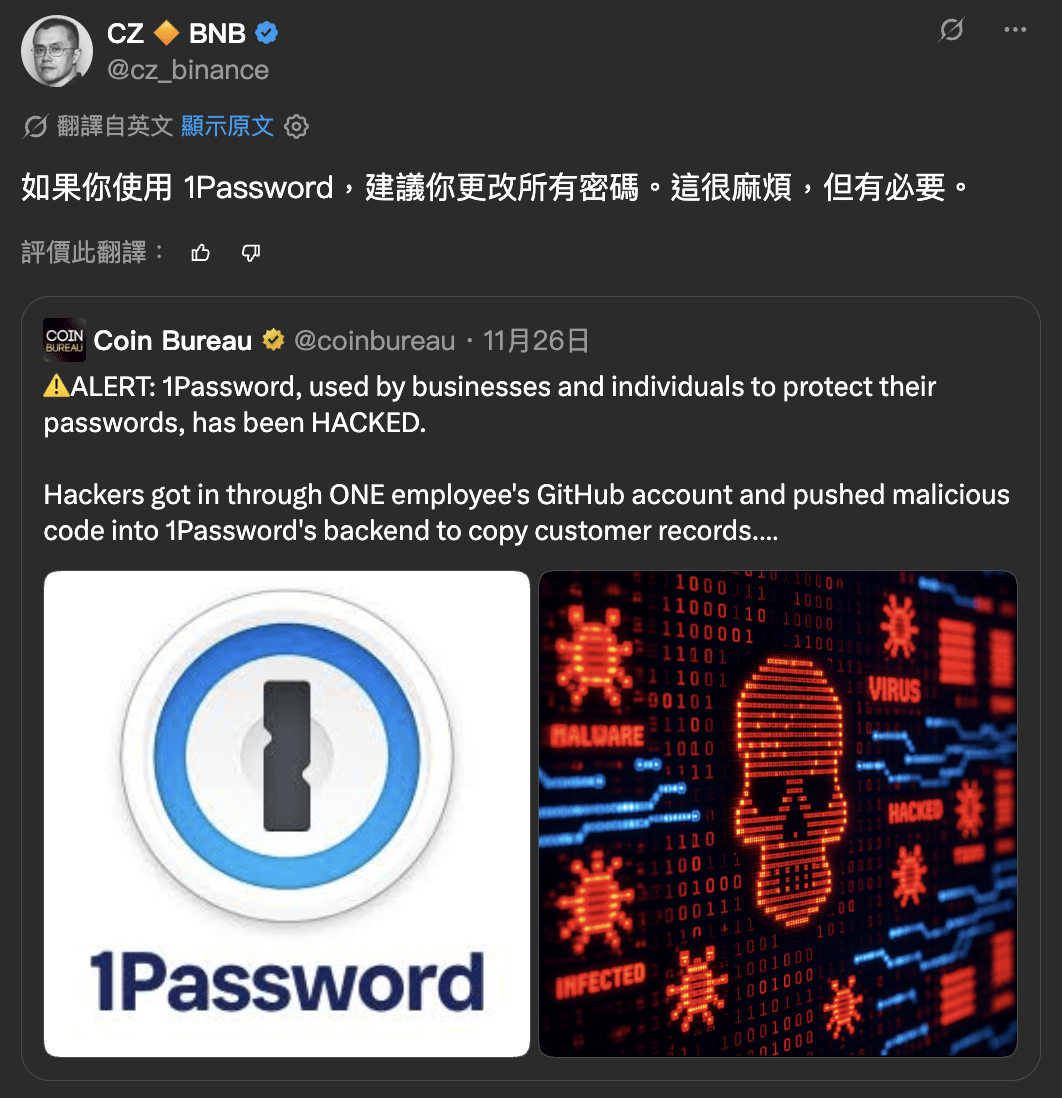 Image source: X/@cz_binance Binance founder Changpeng Zhao recommended that all 1Password users change the passwords stored in the service in a reply to a post about the security incident on X
However, this recommendation differs from 1Password’s current risk assessment.
1Password emphasized that the contents stored in password vaults were not leaked. Users therefore do not need to immediately change all their passwords because of this incident, nor do they need to reset their account password or Secret Key.
The company has disabled the compromised GitHub account, revoked the stolen access credentials, and removed the access permissions created by the attackers. It has also rotated potentially exposed internal credentials, strengthened security controls for GitHub, CI/CD, and employee devices, and hired independent cybersecurity experts to review its remediation measures.
Therefore, CZ’s recommendation to change all passwords reflects a more cautious personal cybersecurity approach. There is currently no public evidence that users must change all their stored passwords to prevent direct risks from this breach.
If users notice unusual logins, encounter phishing attempts, or suspect that the credentials for a particular account have been leaked, they should investigate the affected account and change its password.
Leaked data could be used in phishing attacks. How can cryptocurrency users protect themselves?
Although password vaults were unaffected, the exposure of customers’ names and email addresses could still increase the risk of subsequent phishing and social engineering attacks.
According to a report by Decrypt, attackers could use known information about 1Password customers to send emails disguised as official notifications, tricking users into clicking fake account recovery links, accepting unfamiliar invitations, or providing their login details.
This type of attack is particularly worth noting for cryptocurrency investors, as some users store sensitive information in password managers, including exchange login credentials, cryptocurrency wallet passwords, and wallet recovery seed phrases.
If attackers can obtain a user’s account password and Secret Key through a forged notification, they may try to sign in from a new device and access the vault, further putting the cryptocurrency-related credentials stored in it at risk.
Therefore, 1Password recommends that users pay particular attention to the following situations:
Unexpected account recovery notifications: If you receive an account recovery, device verification, or security update email that you did not request, avoid clicking its links directly.
Requests for your account password or Secret Key: 1Password will never proactively ask users to provide this confidential information by email, text message, or phone.
Suspicious login pages: If you need to sign in to 1Password, open the official app yourself or manually enter the official URL. Avoid following links in messages from unknown sources.
Unusual account activity: If you suspect that your account has been compromised, promptly check the relevant login records and report it through official customer support.
For the cryptocurrency industry, this incident also highlights the cybersecurity risks of password management services. These risks involve not only encryption itself, but also code management, development environments, and the protection of backend account data.
1Password found no evidence that vaults were breached in this incident. However, attackers did successfully use an employee account to gain access to internal systems and steal some user information. Whether the leaked data is later used in phishing attacks, and whether the company can determine the full scope of the impact, will be important points to watch as the incident develops.
The article “1Password Hacked! Some Users’ Personal Information Leaked; Official Says Password Vaults Unaffected” was first published on “Crypto City”.