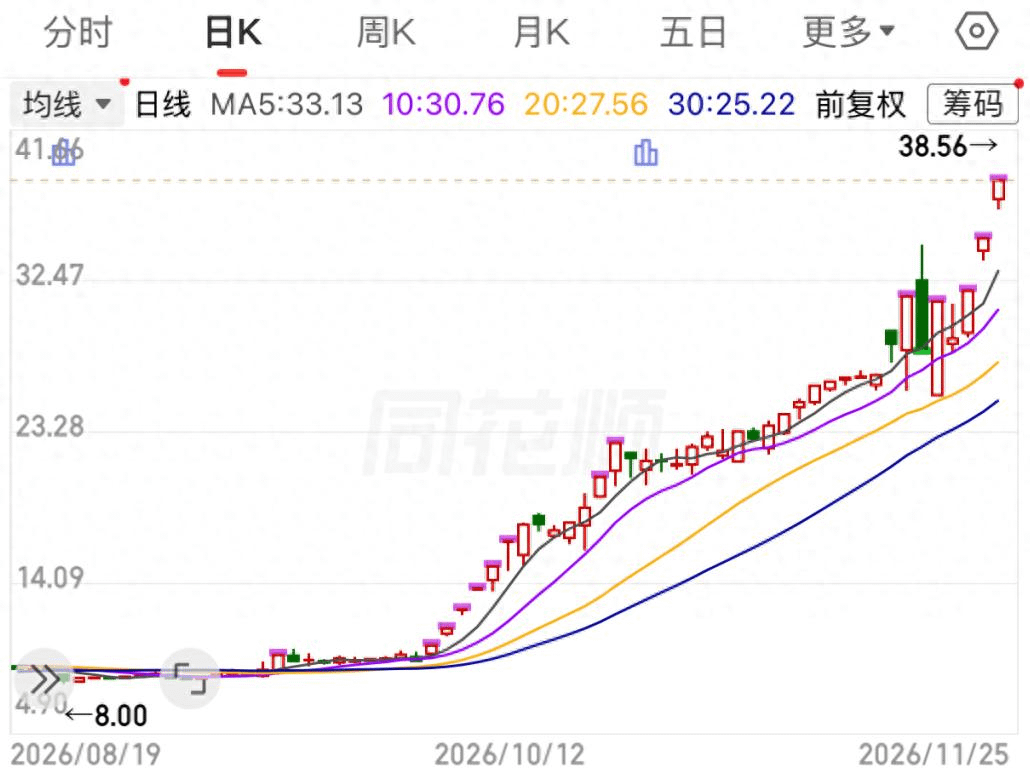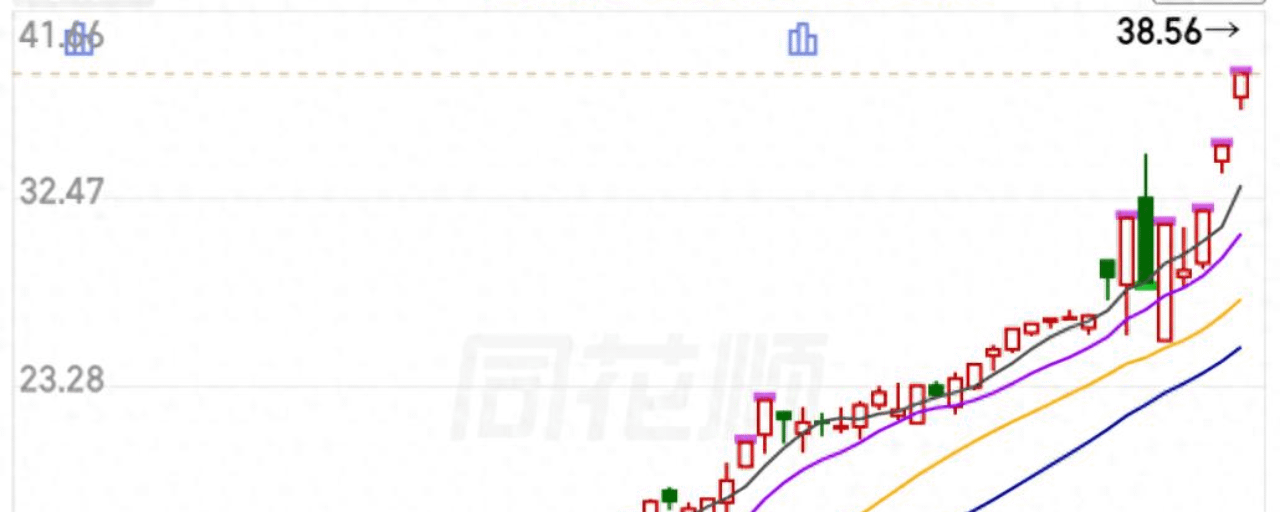


On November 25, Joyoung Co., Ltd. surged to the daily limit again, scoring its third consecutive limit-up.
If you look only at the daily chart, its recent extreme swings—from limit-down to limit-up, and vice versa—might give you a heart attack. But switch to the weekly chart, and the picture is nothing short of miraculous: from 9.39 yuan at the end of September to a high of 38.56 yuan today, all nine trading weeks closed higher, for a cumulative gain of 310%.
Nine weeks, a threefold gain, without a single losing week. One veteran on the stock forum sighed to the heavens: “Damn, he’s really mastered the Nine Yang Divine Skill.”
How can a small-appliance company that has sold soy milk makers for more than 30 years pull off an astonishing nine straight weekly gains amid a sluggish market?
The answer is so absurd it makes you laugh.
From mysticism to AI, investors force a story onto the stock
Investors spun three major stories for the stock over the course of this rally.
The first story: mystical forces will protect it.
In the name Joyoung, “Yang” sounds like the Chinese word for “sheep,” while “nine” is the highest single-digit number, meaning “the most.” So when the “sheep-themed” stocks took off, Joyoung led the way with six consecutive limit-up sessions, followed by Baiyang Co. and Yangguang Lighting in a market-wide frenzy. Investors came up with countless catchphrases: “You’ve got a lithography machine; I’ve got a soy milk maker,” “Drink soy milk and you won’t get heartburn,” and “Time will prove the value of the sheep module.” In the face of mysticism, fundamentals don’t count for a thing.
At the height of the absurdity, no matter how cutting-edge a technology leader was, if its name didn’t contain a sound resembling “sheep,” investors would change it for them: Zhongji InnoLight became “Zhongji Xuyang,” and CATL became “The Age of the Sheep.” It was as if a hint of a sheepish name could summon a limit-up.
The second story: the magic of AI.
Joyoung holds a 7.92% stake in DeepThink AI Robotics Technology, a company working on brain-inspired large models. As it happens, Huawei’s Hubble Technology also invested in the company, with a 3.31% stake. Investors saw this and thought, “What a combination!” The “Huawei + AI” story was instantly put into play. What’s more, Joyoung’s wholly owned subsidiary holds a 5.70% stake in Xiangke Intelligence, a company that makes robots for restaurants and hotels.
Joyoung issued clarification after clarification, carefully explaining that its stakes in the relevant companies were small, their businesses were still at an early stage, they had no material impact on its results, and there was no strategic partnership with Huawei whatsoever. But it made no difference. Investors’ logic was: “You say there’s nothing to it—that’s just modesty. The more you clarify, the deeper the waters must be.”
Some people on stock forums even joked that its blending technology was a “3nm-process soy milk GPU.” The company had to issue a serious clarification: its blending technology is used in food processing and has nothing to do with semiconductor “process nodes.”
The third story: macroeconomic maneuvering.
The Fed raised interest rates, pushing up dollar rates and widening the China-U.S. interest rate differential. The market began to expect the yuan to depreciate, strengthening expectations for exports of small appliances. Meanwhile, in September, China and the U.S. reached a framework for reciprocal tariff cuts covering $30 billion in trade, and small appliances were included on the list.
There is a theoretical basis for this logic, but its impact has been overstated. In the first half of the year, overseas revenue accounted for just 8.79% of Joyoung’s total, making its export business very small. Overseas gross margin was only 8.84%, leaving little profit to begin with. But that didn’t stop investors from using “a weaker yuan benefits exports” as fuel to push the stock to its daily limit.
The company also has a “space technology” angle. Its space kitchen equipment was used in projects related to China’s space station, and some of the same technologies have been applied to products such as heated water purifiers, coating-free rice cookers, and low-purine soy milk makers.
The story changed again and again, and each new one kept the rally going for a few days. Joyoung’s weekly candlesticks just refused to turn red.
A dismal financial performance, while the controlling shareholder cashed out 300 million yuan near the peak
Even the most powerful martial arts cannot withstand a major shareholder selling down at the top. And once you’ve looked at this company’s actual books, you’ll find the nine-week winning streak even more absurd.
Joyoung’s core business is small kitchen appliances. What does it actually sell? Soy milk makers, blenders, rice cookers, air fryers, water purifiers, and floor washers. Products launched in 2026 include a self-cleaning soy milk maker and a titanium nonstick rice cooker.
It sounds impressive, but this is a fiercely competitive, saturated market, and the company’s results have long been dreadful. From 2021 to 2025, revenue fell from 10.54 billion yuan to 8.21 billion yuan, while net profit attributable to shareholders dropped from 746 million yuan to 118 million yuan. Both figures declined for five consecutive years.
2026 was even worse. In the first three quarters, revenue was 5.052 billion yuan, down 9.55% year over year; net profit attributable to shareholders was 71.98 million yuan, down 41.75%; and adjusted net profit plunged 60.14%.
The most striking figure comes from the quarterly breakdown. In the third quarter of 2026, Joyoung’s net profit attributable to shareholders was just 216,300 yuan—not enough to buy a bathroom in Beijing, Shanghai, Guangzhou, or Shenzhen—yet it now supports a market capitalization of nearly 30 billion yuan.
No wonder the share price had already fallen for six straight years before this latest surge.
And during this nine-week frenzy, the first to “take profits and play it safe” was the platform controlled by the company’s ultimate owner.
On October 26, not long after Joyoung’s share price had defied gravity, a rare window to cash out opened. Shanghai Lihong, the controlling shareholder of Joyoung and indirectly controlled by founder Wang Xuning, made its move with precision, selling 14.47 million shares through centralized bidding. Based on the average trading price of 21.36 yuan that day, it cashed out 309 million yuan. A look-through calculation of the shareholding structure shows that the Wang family stood to receive 136 million yuan of that amount.
After the sale, Shanghai Lihong’s direct stake fell to 48.50%. Together with entities acting in concert, it still controlled 65.53% of the voting rights.
The “father of soy milk makers” amasses a fortune of over 100 billion yuan
Wang Xuning, Joyoung’s ultimate controlling shareholder, was born in 1969 and is known as the “father of soy milk makers.”
He was originally an electrical engineering teacher at a railway technical school in Jinan. As a student, he loved drinking soy milk. Seeing how much time and effort it took older people to make it with stone mills, he drew on his training in electric locomotives and tinkered his way to China’s first fully automatic household soy milk maker in 1994. That same year, he quit his secure job, took the money he had saved for his wedding, and pooled together 300,000 yuan to found Joyoung.
In the early days, there was no established market for household soy milk makers. Wang Xuning “sold the product while educating the market,” turning a niche invention into a household appliance found across China. Joyoung went public on the Shenzhen Stock Exchange in 2008.
Joyoung wasn’t the only card he had to play.
In 2017, he led the acquisition of U.S.-based small appliance brand SharkNinja. Its Shark and Ninja brands are household names in the United States. After the acquisition, he established the Hong Kong-listed platform JS Global Lifestyle, which went public on the Hong Kong Stock Exchange in 2019. Joyoung and SharkNinja’s assets were injected into the platform, making JS Global Lifestyle the indirect controlling shareholder of A-share-listed Joyoung. In 2023, SharkNinja’s North American business was spun off from JS Global Lifestyle and listed independently in the U.S.
Wang Xuning had built a small appliance empire spanning the A-share, Hong Kong, and U.S. markets. At the end of 2022, he stepped down as chairman of Joyoung and shifted his focus to SharkNinja overseas.
As SharkNinja’s results continued to grow rapidly, its share price doubled this year, bringing its latest market capitalization to $33.3 billion. After Joyoung’s surge, its market cap reached 29.4 billion yuan, while JS Global Lifestyle’s latest market cap was HK$5.4 billion. The three companies have a combined market capitalization of 256.6 billion yuan. Based on his shareholdings, Wang Xuning’s paper wealth has surpassed 100 billion yuan, making him an “appliance king” whom the market can easily underestimate.
This nine-week “Nine Yang Divine Skill” rally had essentially nothing to do with how many soy milk makers Joyoung sold, how much an AI company was worth, how much tariffs fell, or how much the yuan was expected to depreciate. Nor was it connected to any plans to inject assets, acquire shares, or restructure the business around the founder’s overseas companies.
It illustrates one brutal truth about the A-share market: when there is no clear market theme and institutional investors’ crowded trades unravel, money has to find a highly recognizable “monster stock” to channel speculative sentiment.
A catchy name, a relatively small market cap, dismal results, a six-year share price decline, and a clean shareholder base—Joyoung had all the perfect ingredients of a “monster stock.” As retail investors on stock forums shouted “New Year’s monster dragon,” investors from all corners piled in, while the controlling shareholder quietly pocketed 300 million yuan near the peak.
The “Nine Yang Divine Skill” was indeed mastered. But don’t forget: in Jin Yong’s novels, Zhang Wuji mastered his legendary martial arts after falling off a cliff. $SOL