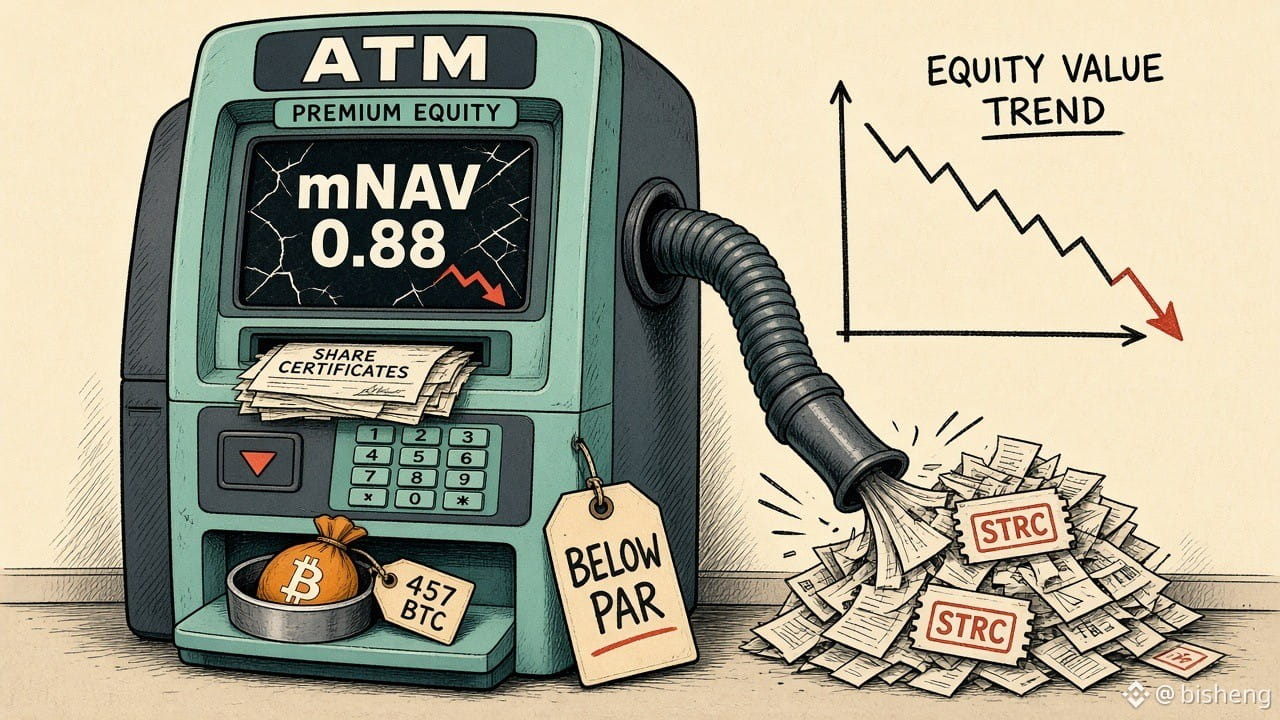
People in the space are already spinning Strategy’s mNAV dropping to 0.88x as: a discount means capitulation, JPMorgan has called the level, discounts like this have historically been near the bottom, so it’s time to buy the dip; and Saylor still plans to buy up the remaining 900,000 coins, so there’s still buying support. That logic doesn’t hold up. A discount isn’t a sale tag—it means the wheel of issuing shares at a premium to buy bitcoin has stalled.
Let’s lay out the numbers. In its report dated the 25th, JPMorgan analyst Nikolaos Panigirtzoglou wrote that Strategy’s valuation multiple relative to its bitcoin holdings had fallen to around 0.88x, below the previous low set before the end of June this year—a record. The Block quoted the original wording on the 26th: “premium to NAV collapses to a new record low of 0.88, signaling capitulation in bitcoin.” Strategy’s own dashboard showed 0.88x at 10:39 a.m. ET on the 25th, later recovering to 0.94x. Both readings were below parity.
The 8-K the company filed on the 23rd is clear. As of the 22nd, it held 851,305 bitcoins, with a total cost of $64.23 billion and an average purchase price of $75,446. Spot bitcoin is now around $60,600, which puts the market value of those coins at roughly $51.6 billion—about $12.6 billion below cost. On the 25th, MSTR hit an intraday low of $70.37 and closed at $79.96. U.S. markets were closed for Thanksgiving on the 26th, and Friday’s half-day session hasn’t opened yet.
Now look at what they actually did last week. From the 16th to the 22nd, the company sold 1,925,676 shares of common stock, raising $176.7 million net. Only $29.6 million went toward buying bitcoin: 457 coins at an average price of $64,898. The bulk of the money went to repurchasing STRC preferred stock: 2,183,747 shares in total, for $211.8 million. Of that, $147 million came from the proceeds of the common-stock sale, and $64.8 million came from cash on hand. This isn’t adding to its bitcoin holdings during a discount; it’s issuing common stock to shore up the preferred-stock side.
The strategy worked before because the stock sold for more than the coins it held. With a premium, it could issue new shares to buy bitcoin, and the coins and share price would lift each other. At 0.88x, issuing shares means selling them at 80 cents on the dollar relative to net asset value. Existing shareholders get diluted, and the company’s firepower for buying bitcoin shrinks too. Recasting 0.88 as “the kind of discount you buy at the bottom, like in 2022” turns a broken financing loop into a bargain sale.
At the ITC conference in Miami on the 21st, Saylor said there were about 900,000 coins left to be mined by 2140, “Our plan is to buy it all,” and that he wanted to see the price reach $10 million per coin. But right after that, he said he couldn’t predict the next few weeks or months. A slogan reaching into the next century isn’t a buy order for this week. JPMorgan’s own report also said that when prices briefly rebounded, IBIT still saw outflows—and at a faster pace than during the May-to-June period this year. The report said “capitulation”; it didn’t say a bottom had been confirmed. Those last two words were added by someone else.
#比特币 #Strategy