

After an epic rally, the gold market suffered a sharp reversal. Gold prices have fallen more than 30% from their record high in January this year, while silver has plunged more than 64%. The brutal correction in precious metals has once again brought Warren Buffett’s long-standing doubts about investing in gold into the spotlight: Gold generates no profits, pays no dividends, and produces no cash flow—so can it really be a tool for long-term wealth creation?
Why has gold plunged amid market turmoil?
Commodity analysts attribute the recent sharp correction in gold prices to shifting expectations for monetary policy and investor profit-taking. The opportunity cost of rising interest rates, a stronger U.S. dollar, leveraged investors closing out positions, and investors selling gold to raise liquidity during periods of market turmoil may all have intensified the decline in gold prices.
Tushar Badjate, a director at wealth management firm Badjate Wealth, noted that gold is not a hedge against stock market declines, but a hedge against panic. When markets fall due to genuine panic, a currency crisis, or geopolitical uncertainty, investors often flock to gold as a safe haven. But if a stock market correction is driven by valuation repricing or interest rate hikes, gold may not rise.
He noted that during liquidity-driven market corrections, gold may also fall alongside stocks. This unstable correlation calls into question gold’s reliability as a core portfolio asset.
Historical Data Reveals a Harsh Reality: It Can Take Years for Gold to Recover
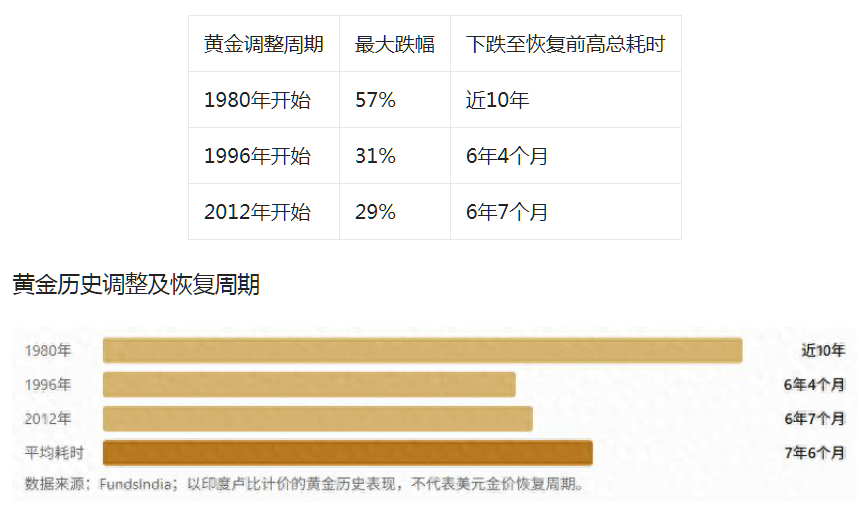
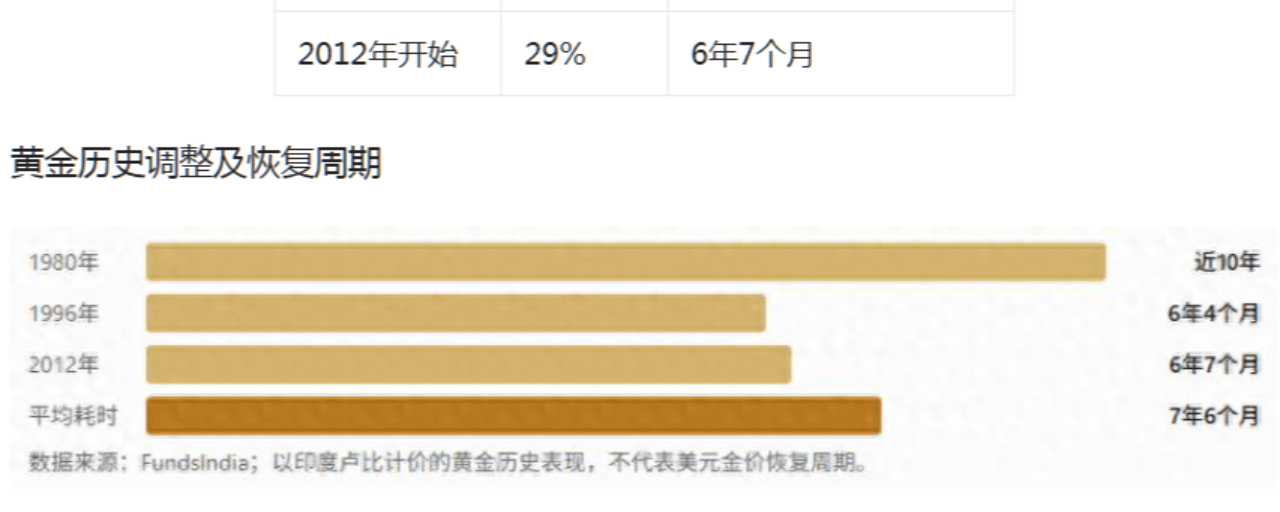
A November 2026 report by FundsIndia analyzed the performance of gold priced in Indian rupees during three major historical corrections.
Gold correction period Maximum decline Time from decline to recovery of previous peak
Starting in 1980 57% Nearly 10 years
Starting in 1996 31% 6 years and 4 months
Starting in 2012 29% 6 years and 7 months
Historical Gold Correction and Recovery Periods
Across these three periods, gold took an average of 2 years and 8 months to fall from its previous peak to its lowest point, then an average of 4 years and 7 months to regain its former high. The full correction and recovery cycle averaged about 7 years and 6 months.
Why Has Buffett Been Bearish on Gold for So Long?
Buffett has said on several occasions that gold is not an attractive long-term investment because it neither generates income nor produces goods or services.
At Berkshire Hathaway’s 2011 annual shareholders’ meeting, Buffett divided investments into three broad categories: first, monetary assets such as bonds, bank deposits, and cash; second, assets that produce nothing tangible, with gold as a typical example; and third, productive assets such as businesses and farmland that can create value over time.
Buffett once used all the gold ever mined around the world as an example, noting that no matter how much gold investors hold, it cannot generate income on its own. Its investment returns depend mainly on whether someone in the future is willing to buy it at a higher price.
By contrast, businesses can generate profits, and farmland can produce crops. The value of these assets can be assessed based on their actual productive capacity and future income, rather than depending solely on what the next buyer is willing to pay.
Buffett also warned that when the price of a particular asset class keeps surging, investors can be tempted by others’ gains to blindly chase rising prices without fully understanding the asset’s value. This is not a reliable strategy for building wealth over the long term.
Gold Is Insurance, Not a Wealth-Growth Engine
Narender Agarwal, founder and CEO of Wealth1, noted that gold pays no interest, dividends, or rent, and its investment returns depend mainly on price increases. This means that holding gold comes with a real opportunity cost.
This is especially true in a high-interest-rate environment, when holding gold means giving up the interest income that assets such as bonds can provide. In addition, owning physical gold may incur extra costs for fabrication, storage, and insurance, further eroding investment returns.
Agarwal believes gold is more like insurance than a wealth-growth engine. Investors give up some potential income in exchange for protection against risk.
Beware of a New Wave of Selling in the Gold Market
Carsten Menke, head of next-generation research at Julius Baer, warned that the precious metals market could face renewed downward pressure if the U.S. economy shows relative strength again while the dollar continues to strengthen.
Another major risk comes from investment products backed by physical gold and silver. Although holdings in these products have so far remained broadly stable, investors may eventually withdraw funds on a large scale if they continue to be disappointed by recent price performance.
Agarwal suggested that investors consider keeping gold at 10%-15% of their portfolio and buying in installments over the next 3 to 6 months, rather than trying to time the market bottom. $BNB