Fire the open-source creator, then roll out a crippled paid version! Google is cracking down on third-party AI, locking Gmail down for Gemini
Even if users explicitly grant permission, third-party AIs like ChatGPT and Claude will have to pass through Google’s “tollbooth” to read your Gmail, search Google Drive, or manage your calendar. On November 24, Google launched its official Workspace MCP server and command-line tools, while setting two deadlines: starting February 1, 2027, third-party AI must give up direct connections to legacy APIs and switch to Google-managed MCP channels; starting April 1, usage will be billed.
Starting next February, third-party AI won’t be able to expand its capacity on legacy direct-connection APIs, even if it’s willing to pay. It will have to migrate to the official MCP instead. The free tier offers 5,000 requests per day for each developer project and product, shared among all users. Searching one Gmail email thread counts as 10 requests, meaning the entire app’s users can collectively search a maximum of just 500 times per day.
Once the free quota is exceeded, developers must upgrade to a paid tier. For regular software using legacy APIs, upgrading still retains a daily free quota, and projects for internal enterprise use can also apply for an exemption. But for AI using the MCP channel, upgrading immediately removes all free usage: billing starts with the first successful request, at $0.10 to $0.50 per thousand requests. There are no exemptions for internal enterprise use.
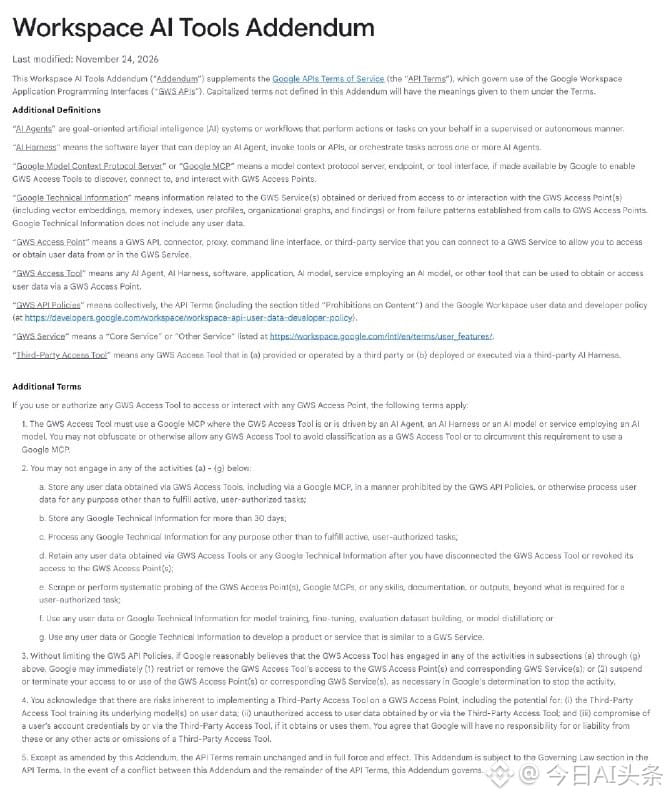
The “AI Tools Addendum,” which takes effect at the same time, also puts a hard limit on third-party AI’s long-term memory: memory indexes, vector data, user profiles, and organizational relationship maps generated by external AI from users’ emails and files can be stored for no more than 30 days, and may not be used to train models or develop similar office products.
This official channel mandated by Google actually has far fewer features than the open-source version. In March this year, former Google employee Justin Poehnelt open-sourced a similar tool, gws. It reached the top of Hacker News because it let AI directly operate Google’s entire suite of office software. In April, Google announced it would make an official version, then fired him two days later. After the official version launched, Poehnelt tested it and found that the new version offers just 23 commands for Gmail, 9 for Calendar, and 9 for Drive—far fewer than the open-source version’s 79, 38, and 64 interfaces. At present, it can’t send emails directly, or share, move, rename, or delete Drive files. In a post on November 25, he wrote, “Now it all makes sense”: Google most likely fired him to block competitors’ AI, charge for API usage, and effectively lock Gmail, Calendar, and Drive down for its own Gemini.
$ANT
What do you think? 👇