
Breaking down the Korean, Hong Kong and A-share markets: U.S. stocks are rising, while over here everyone’s selling?
U.S. stocks had a heart-stopping session last night. The Dow fell more than 1,100 points at its lowest intraday, then staged a strong comeback to close up 0.33%. The Nasdaq still fell 0.62%.
Across Asia-Pacific today, investors were doing the same thing: pulling out of hardware—the “borrow money to buy AI” trade—and shifting into things they can actually see and touch.
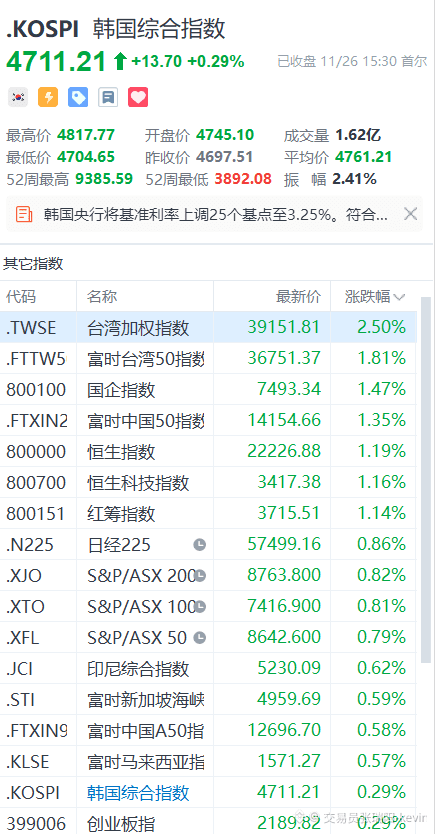
South Korea’s KOSPI closed up 0.29% at 4711.21. Samsung Electronics rose just 0.35%, while SK Hynix gained 2.23%. Hyundai Motor fell 3.9% and Hyundai Mobis dropped 5.72%. Institutions were net buyers of 752.9 billion won, but foreign investors changed course late in the session and became net sellers of 116 billion won. The Bank of Korea’s 25-basis-point rate hike to 3.25% was in line with expectations. The market didn’t crash, but no one was chasing the rally either.
Hong Kong was a more typical example. The Hang Seng Index rose 1.19%, and the Hang Seng Tech Index gained 1.16%. Large-language-model names Zhipu and MiniMax jumped more than 8% and 7%, respectively, while PCB and optical communications firm Zhongji Innolight climbed more than 6%. But southbound funds were net sellers of over HK$21.3 billion for the day. The index was up, but mainland investors were heading for the exits. The rally was led by computing-power applications, while investors dumped hardware shares that had been crowded into earlier.
In the A-share market, major investors recorded net inflows of 4.8 billion yuan into electronics, 4.5 billion yuan into nonferrous metals, and 6.7 billion yuan into Huawei-related stocks. Semiconductors, however, saw net outflows of 2.567 billion yuan. Agriculture, forestry, animal husbandry and fisheries stocks have risen for five straight days.
Don’t call it a bottom just because the Dow turned positive. We’ll know who’s swimming naked only after trading volume returns following Thanksgiving. $KORU $MINIMAX $ZHIPU