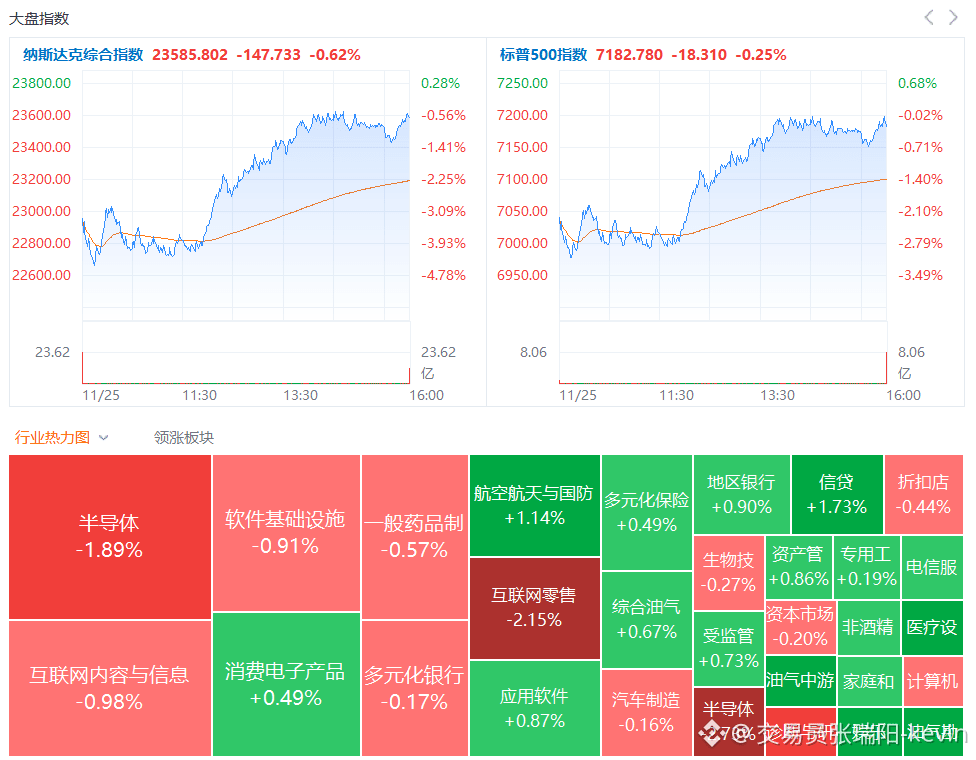

Is the V-shaped reversal in U.S. stocks a mirage? Is the AI faith starting to loosen?
U.S. stocks staged a big V last night. The Nasdaq at one point plunged more than 4%, and the Dow dropped over 1,000 points intraday, but by the close it had been yanked back up: the Dow rose 0.33% to 50,182.95 points, while the Nasdaq still fell 0.62% and the S&P 500 lost 0.25%. The Dow turning green does not mean the risk is gone; it was capital making a short-term rotation amid extreme panic.
Looking at how different assets reacted, the clues are clear:
Stocks: the main selloff came from AI hardware. Nvidia fell nearly 4%, Micron dropped 4.5%, and the Philadelphia Semiconductor Index came under pressure. The trigger was not bad news from a single company, but inflation data turning “rate cuts” into “there may still be rate hikes”: October PCE rose 3.8% year over year, core PCE rose 3.3%, above expectations, and a December rate hike was almost treated by the market as a foregone conclusion. High interest rates directly weigh on high-valuation AI assets.
Bonds: money rushed into U.S. Treasuries as a safe haven, with the 10-year yield falling 7 basis points and briefly touching a two-month low intraday.
Gold: it briefly fell below $3,500 intraday, then made a V-shaped reversal to close up 0.5% at around $3,575. First squeezed by liquidity, then bought back as a safe haven.
Crude oil: Houthi attacks on a Saudi refinery pushed Brent up 3.5%, while WTI rose 2.5% to $84.13, as the geopolitical premium returned.
VIX: the fear index surged to 34.95 intraday, then pulled back below 30 at the close, but it remains above the long-term median of 17.6.
As long as inflation refuses to die down, AI valuations will struggle to hold up. The Dow turning green was just a technical rebound in thin pre-holiday trading, not a reversal of the narrative. For high-priced AI hardware, don’t mistake a V shape for a bottom; the real stress test comes after the rate hike lands. $XAU $BTC $SOXL #美国核心PCE超预期,美联储加息预期增强