
#感恩节美股休市,市场休整后能否迎来反弹? Nvidia has been put on S&P’s radar — is faith in AI starting to waver?
Last night, U.S. stocks traded like a roller coaster. The Dow once fell more than 1,000 points intraday, but by the close it somehow turned positive, rising 0.33% to 50,182.95 points; meanwhile, the Nasdaq fell 0.62% and the S&P 500 slipped 0.25%, with tech stocks clearly dragging things down. The Dow’s recovery was entirely due to money rotating away from AI hardware and into other areas, but that escape looked anything but secure.
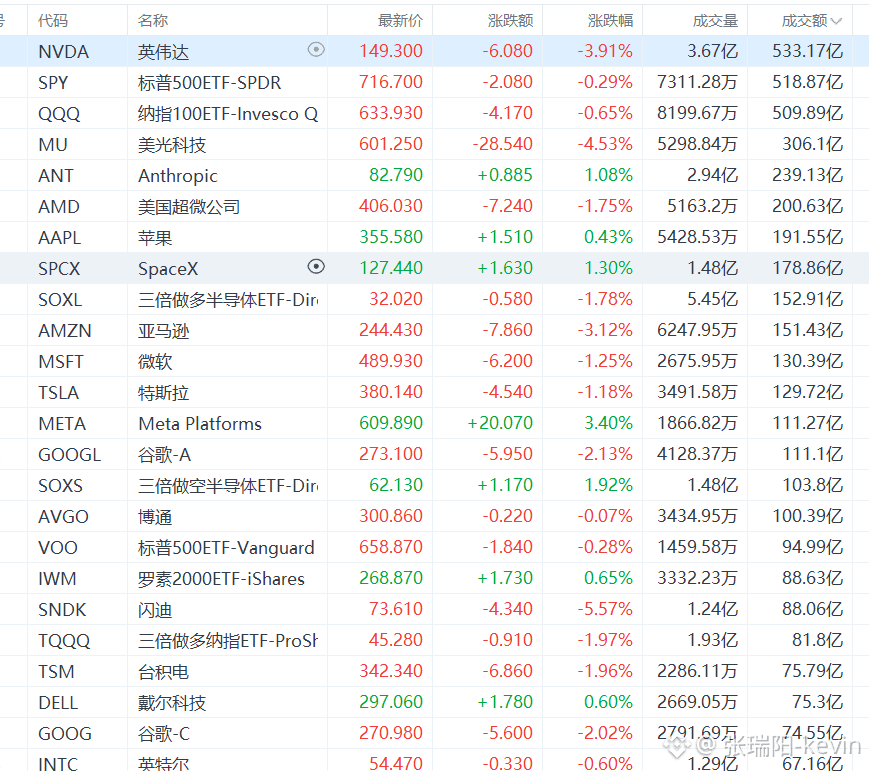
Nvidia was still the most traded name, with turnover of $51.993 billion for the day. It closed down 3.91% at $149.30 per share. What really stood out was the news flow: S&P placed Nvidia’s issuer credit rating on negative watch, with a possible downgrade within 90 days. At the same time, CDS across the AI supply chain surged to record highs, and CoreWeave’s five-year CDS implied default probability topped 70%. Put simply: the market has started repricing the borrowing costs of AI companies, and the highly leveraged players are the first to come under scrutiny. Micron also fell 4.53%, with turnover of $30.084 billion. There was no standalone negative catalyst — it was simply dragged down by the broader pullback in AI hardware.
But there were also names moving against the trend. Meta rose about 3.4%, Apple edged up 0.43%, and Tesla’s decline narrowed to 1.18%. Money is not leaving tech stocks; it is shifting from the “selling shovels” camp to the “using shovels” camp.
The Dow turning positive does not mean the risk is gone; it means money is changing seats. Nvidia being singled out by S&P is, in the short term, suppressing not just one day’s sentiment but the entire credit narrative around the AI hardware chain. Don’t rush to buy the dip in high-flying AI hardware names — wait for the outcome of the negative watch first.$KORU $SOXL $NVDA