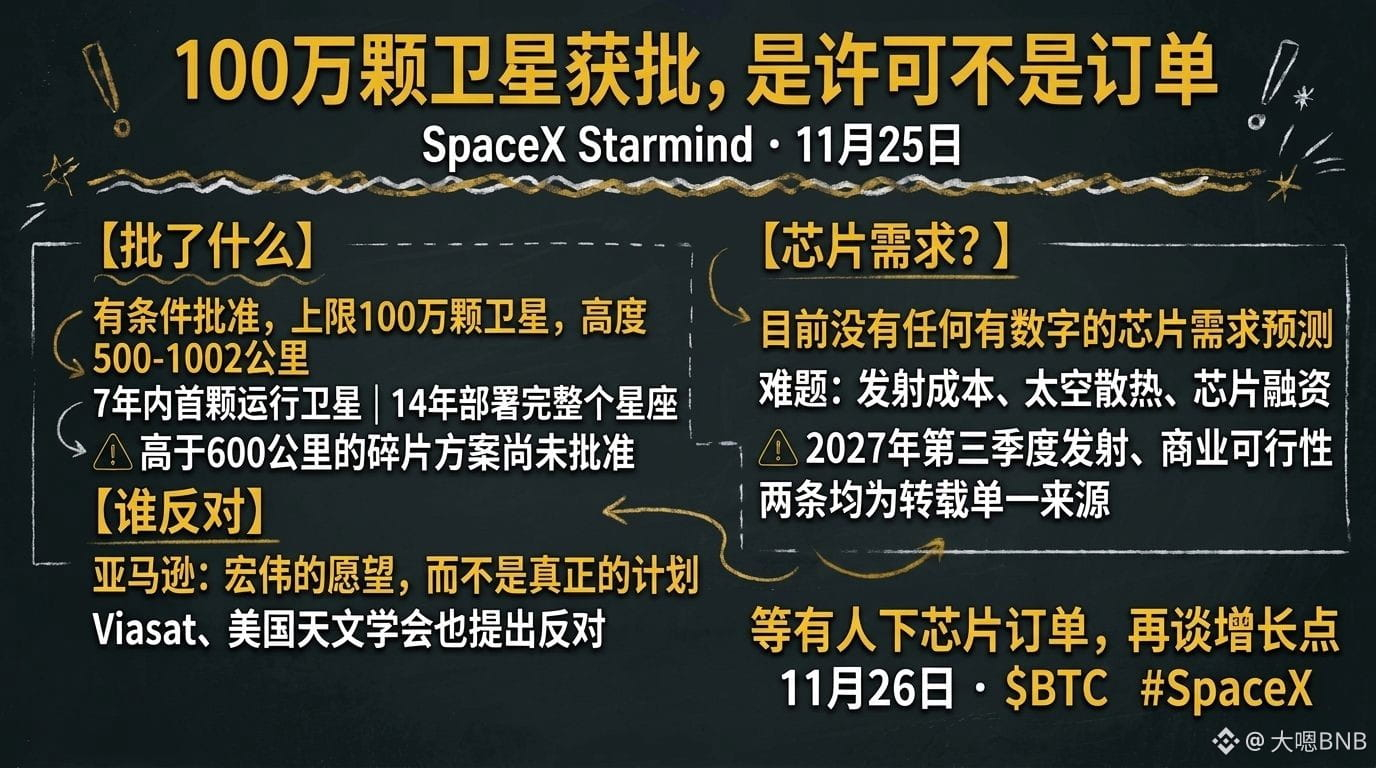

One million satellites—approved. But what was approved is a license, not an order.
On November 25, the U.S. Federal Communications Commission conditionally approved SpaceX’s orbital data center plan, called Starmind. It allows for up to one million satellites in orbits 500 to 1,002 kilometers high, with satellites communicating mainly via lasers. FCC Chair Carr said this opens a new frontier for U.S. computing infrastructure, and Musk thanked the commission on X. These details come from TechCrunch. I didn’t open CNBC’s page; I only saw the headline.
Let’s look at the conditions first, instead of focusing only on the words “approved.” First, the timeline is very generous: SpaceX has seven years to launch its first operational satellite, and 14 years to deploy the full constellation. Second, the commission has not yet approved a debris mitigation plan for altitudes above 600 kilometers. Third, Amazon, Viasat, and the American Astronomical Society all objected. Amazon’s exact words were “an ambitious aspiration, not a real plan.” TechCrunch itself also noted that approval doesn’t mean orbital data centers are coming anytime soon.
Now, about the question mark in the headline: could this create a new source of growth for AI chip demand? I looked around and couldn’t find a single chip demand forecast with figures. TechCrunch, in fact, listed “finding funding for chips to send into space” as one of the challenges, along with heat dissipation and launch costs. One reposted article said Musk estimated that the first computing units could launch as early as the third quarter of 2027. That claim comes from a single source, and the repost page also says its summary was AI-generated, so I’m treating it only as a lead. SpaceX’s own securities filings also say that orbital computing has not yet been proven commercially viable—but that, too, is reported secondhand in a repost. So “a new source of growth” is still a question mark, not a conclusion.
Let’s look back at November 20, when Nvidia fell 14% in a single day, closing at $125.53. After just getting schooled by AI stocks, it’s easy to get swept up emotionally by another AI story—this time, with a space angle.
I don’t know if it’ll work, but there’s no need to talk about a new source of growth until a chipmaker announces a concrete order.
Do you think space data centers are the next big story, or just the next PowerPoint deck?
$BTC $SPCXB
#SpaceX
#spacex太空数据中心获批,ai芯片需求迎来新增长点?