


There’s been a big drop over the past few days, and someone in the group bought the dip on $HYPE , so I gave them a detailed analysis of Hyperliquid. I’m sharing it here as a reference for everyone, too.

Bottom line: In the next bull market, HYPE will start at $200. (For reference only—if you make money, no need to tip me; if you lose money, don’t come asking me for compensation either 😂)
1. How do I assess HYPE’s growth potential?
Let me first explain my evaluation logic in detail:
I use the classic stock valuation model: HYPE price increase = Hyperliquid profits / total supply of HYPE tokens × valuation assigned by the market
For example, applying this model to $AAPLB ’s stock price increase gives a very accurate result. From when Cook took over Apple in 2011 to today, Apple’s stock price has risen 23-fold = 5-fold growth in Apple’s profits / 55% reduction in the number of Apple shares × 2.5-fold growth in the valuation assigned by the market
My estimate of HYPE’s upside this time is based on these three figures.
(1) Project Profit
First, profits: Hyperliquid’s average monthly revenue is now $80 million, compared with $113 million per month at the peak of the previous bull market.
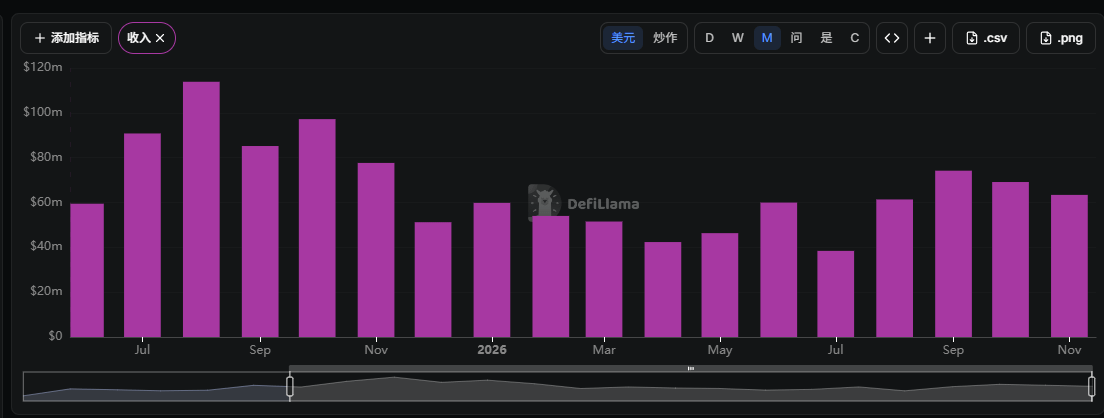
If you want the details, you can look them up on DefiLlama yourself:
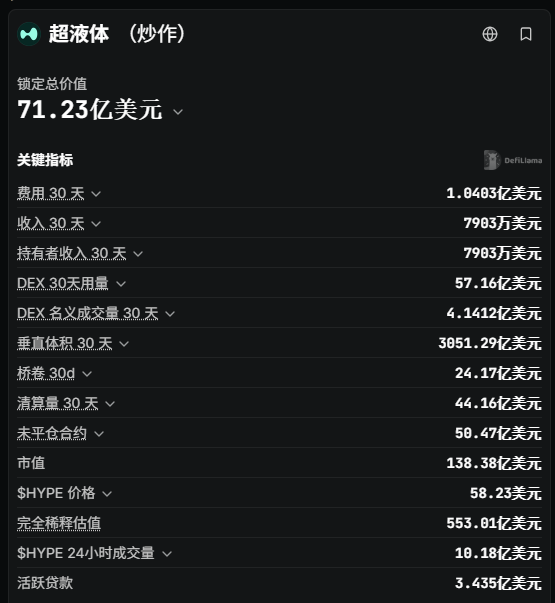
Here’s how to read the figures: “30-day fees” means the amount users have spent on Hyperliquid over the past 30 days; “30-day revenue” means the project’s revenue over the past 30 days (since some of what users spend goes to validators and other parties); and “30-day holder revenue” means all the revenue that flows back into the token price (since the project uses 99% of its revenue for buybacks, this figure is roughly the same as “30-day revenue”).
When a bull market arrives, users will be much more active in trading. Also, a new bull market means more money will flow into crypto (for example, trade.xyz in the US), and Hyperliquid should capture a large share of it. Based on this, I think Hyperliquid’s revenue will grow by at least 2.5x.
(2) Project Valuation
Next is valuation: HYPE’s fully diluted market cap is currently $55.5 billion, giving it a price-to-earnings ratio of 57x.
But when we account for token unlocks, only 25% of the supply is currently circulating. Using the circulating market cap of $14.5 billion, that gives us a P/E ratio of 14x.
What does that mean? For comparison, Apple currently has a P/E ratio of 40x, Kweichow Moutai is at 22x, and Tencent is at 11x.

Based on these figures, when the bull market arrives, wouldn’t a 30x P/E be reasonable for Hyperliquid, given that it captures 80% of the entire market’s perpetuals trading? That would mean 2x upside.
The third issue, the token supply, is more complicated, so I’ll discuss it separately.
II. The Biggest Headache: Is the Token Deflationary or Inflationary?
You really have to love the Hyperliquid team, because they use 99% of the project’s revenue to buy back and burn tokens$HYPE .
But you also really have to hate them. I’ve never seen such a top-tier project make such a mess of its tokenomics, with all sorts of conflicting figures.
Coinglass says 14.18 million HYPE unlock each month; Tokenomist says 9.92 million tokens unlock each month; UnlockPulse says 6.61 million tokens unlock each month…
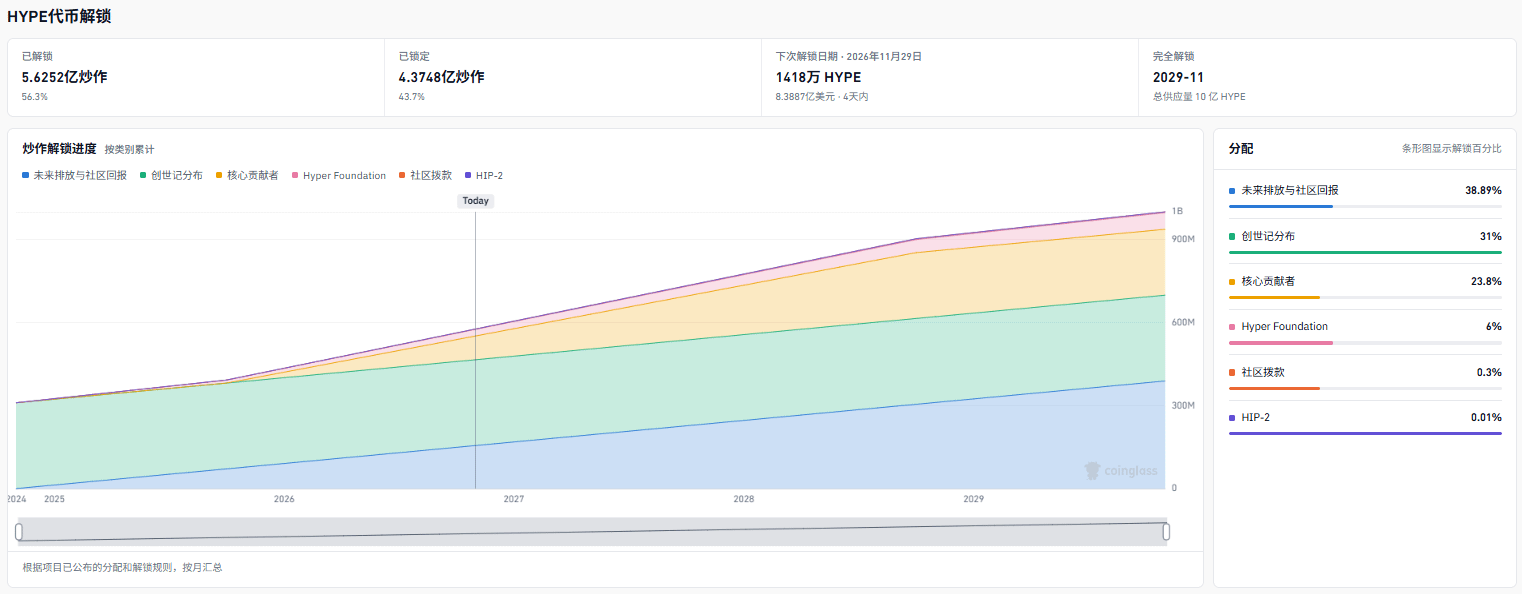
Even the unlock date is disputed: Some say tokens unlock on the 29th of every month, while others say it’s the 6th…
What’s actually going on? Let me break it all down for you:
First, HYPE’s total supply: It was originally 1 billion tokens. Over the past two years, the team has used revenue to buy back and burn 50 million tokens, leaving a total supply of 950 million.
Next is how these tokens are unlocked: Of the 1 billion tokens, only two allocations are clearly in circulation: the 31% “Genesis Airdrop” and the 6% “Hyper Foundation” allocation. The rest is a complete mess.
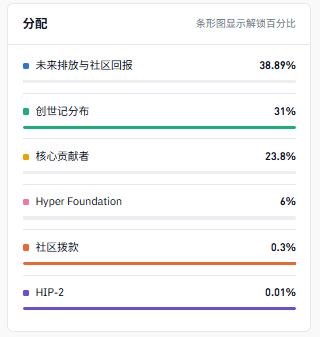
The mess mainly comes down to two allocations: 38.89% for “Future Emissions and Community Rewards” has never been distributed, and it’s unclear how it will be; the other is the 23.8% “Core Contributors” allocation, which is essentially the team’s allocation (since the project hasn’t allocated tokens to market makers or other partners).
The project team hasn’t explained any of this clearly, and they claim their unlocked tokens whenever they feel like it, leaving users completely confused.
One issue is the unlock schedule: The project launched its genesis airdrop on November 29, 2024. At the time, it said the “Core Contributors” allocation would be locked for one year, then unlocked in monthly installments over two years.
So it was reasonable to assume that the first tranche would unlock on November 29, 2025, followed by proportional unlocks on the 29th of each month.
But that’s not what happened. Last year, the team posted on Twitter that its allocation unlocks on the 6th of every month. Some websites missed that post, so they kept using the 29th as the unlock date. But on-chain data shows that the actual unlock date is the 6th.
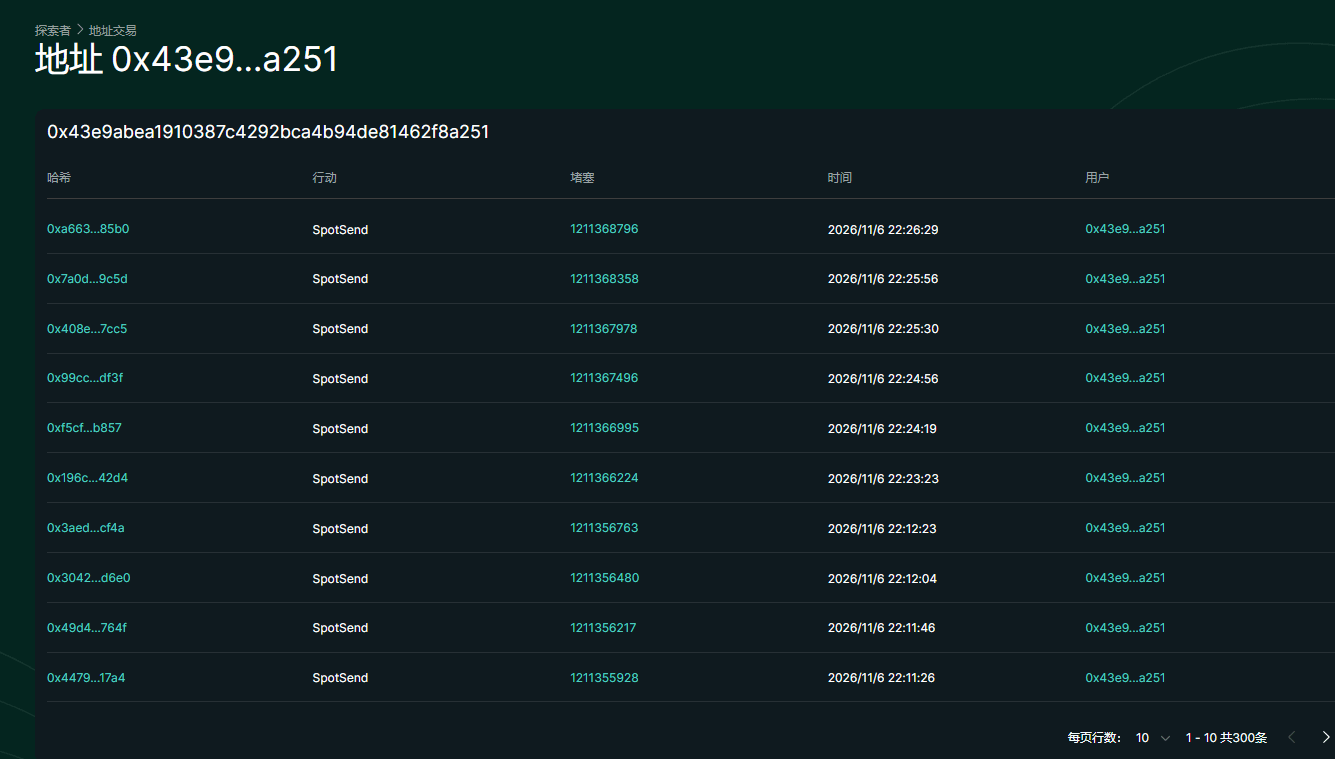
The other issue is the unlock amount: It was reasonable to assume that the project’s 23.8% allocation would unlock evenly over 24 months, which would mean 9.92 million tokens per month.
But the team isn’t short on money—they’re just doing their own thing. They claim tokens whenever they feel like it. Of the 9.92 million tokens unlocked each month, they only claim around 400,000 to 500,000.
This chart shows the team’s actual claims over the past six months. The only time they claimed 3.75 million HYPE was to sell it over the counter to an institution.
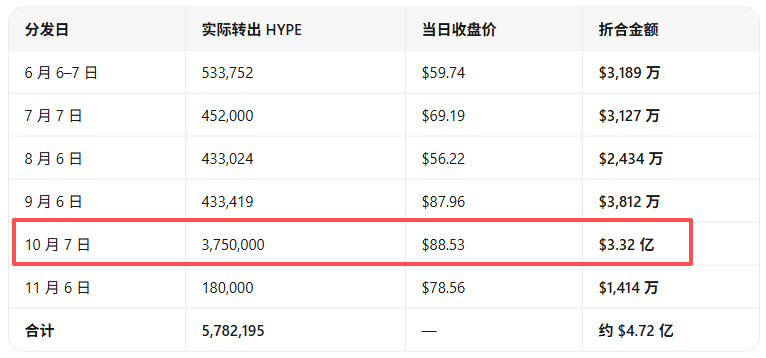
A while ago, the project team posted on Twitter that they might hold on to some of the team allocation until 2028 before claiming it. So some institutions changed the team allocation’s unlock schedule from two years to three, leading to claims that 6.61 million tokens unlock each month.
Since the team has never claimed more than that amount, and the tokens they didn’t claim earlier are simply being held and can be claimed at any time, basically no one knows the team allocation’s exact unlock schedule.
All we know is that the team has no intention of dumping its tokens for cash.
So estimating the token supply is a perennial headache:
At the team’s current revenue level, around 16 million tokens will be burned each year, meaning a deflation rate of 1.7%;
If we calculate inflation based on the team’s actual claims, then less than 10 million tokens will unlock each year. Add in buybacks, and the overall effect is still deflationary.
But if we calculate inflation based on the team’s theoretical unlock schedule, then 120 million tokens would unlock each year, for an inflation rate of 12.6%—far higher than the 1.7% deflation rate.
All I can say is that, given the team’s current mindset, I lean toward them locking up or even burning excess tokens in the future. Taking an optimistic view, I’ve decided to use a 150% inflation rate in my calculations.
III. The Answer Is In
Once we have answers to all three questions, we can also work out how much the next bull market could drive the price up.
Price increase = 2.5x revenue growth / 150% inflation rate × 2x valuation increase = 3.3x
At the current token price, that would put it right around $200 to start with.
Note: For reference only. You are responsible for your own gains and losses~ DYOR