
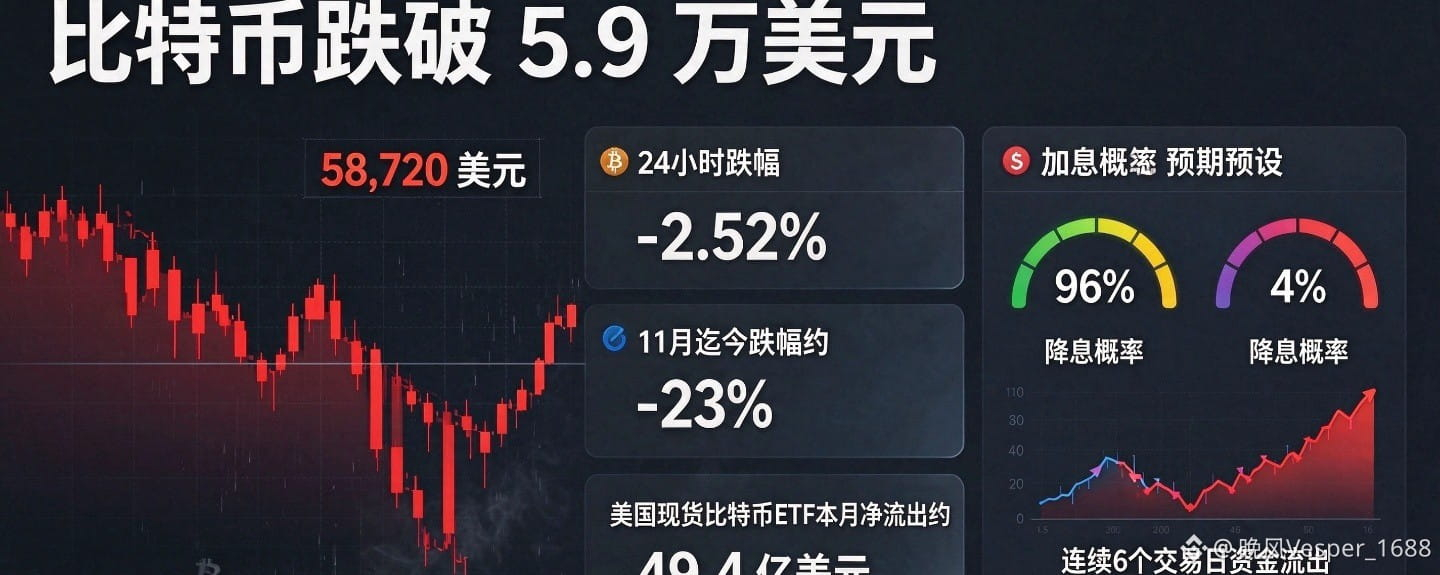


On November 25, according to HTX market data, Bitcoin fell below $59,000 and is currently trading at $58,720, down 2.52% over the past 24 hours. It has fallen about 23% so far in November, putting it on track for its worst monthly performance since June 2022.
In terms of fund flows, U.S. spot Bitcoin ETFs have seen cumulative net outflows of about $4.94 billion this month, with outflows recorded for six consecutive trading days. BlackRock's IBIT alone has seen redemptions exceed $4 billion.
Meanwhile, the market currently puts the probability of a 25-basis-point Fed rate cut in December at just 4%, while the probability of a 25-basis-point hike stands at 96%. Continued selling by institutions, limited buying support from major holders, and rising expectations of tighter Fed policy are keeping Bitcoin under downward pressure.
Bitcoin fell below $59,000, down about 23% in November and on track for its worst monthly performance since June 2022. Selling pressure has shifted from on-chain whales to regulated channels: U.S. spot ETFs saw net outflows of $4.94 billion this month, the largest monthly total since their launch. BlackRock’s IBIT alone saw more than $4 billion in redemptions—the biggest demand pipeline is now turning against the market.
Interest rate expectations are a hidden accelerator: the probability of the Fed raising rates by 25 bps in December is 96%, while the odds of a cut are just 4%. In October, ETFs had still recorded a single-day net inflow of $526.6 million, with $665.2 million flowing into IBIT; within a month, buying had turned into selling pressure. As of November 14, outflows had totaled $2.35 billion over two consecutive weeks, while IBIT had seen 11 straight days of withdrawals. The mid-November rebound was driven solely by short covering. Now that $58,720 has fallen below the July range’s lower boundary of $61,300, that level matters more than the round-number $59,000 mark when ETF outflows and rate hike expectations are aligned.
