

A project on GitHub has recently blown up: Vibe-Trading, which has already racked up 38.8k stars.
With a single `pip install vibe-trading-ai`, it can spin up 30 preset investment research teams, 478 Alpha factors, backtest across the entire US stock and crypto markets, and even connect to 19 broker and exchange APIs.
The comments are full of people shouting, “Retail traders are finally turning things around!” and “Soon we’ll just lie back while agents automatically print money.” But as a humanities student with zero coding experience who’s constantly paying tuition on-chain, after playing around with it, I came away with just one thought:
The more powerful open-source quant agents become, the more dangerous the fantasy that ordinary people can use them to “make money fully automatically.”
Today, let’s expose 3 counterintuitive truths behind this ➡️
1️⃣ The moment it goes open source, Alpha is already halfway dead
Quantitative trading is fundamentally a zero-sum game, or even a negative-sum game.
It’s like someone suddenly handing out a free (foolproof grocery-shopping guide) at the market. If everyone in town is using the same public factors and the same moving-average crossovers to trade BTC and U.S. stocks, who’s actually making money—and whose money are they making?
When a strategy that anyone can reproduce with a single pip install is out in the open, your counterparty has the exact same code—and a server that’s 100 milliseconds faster than yours.
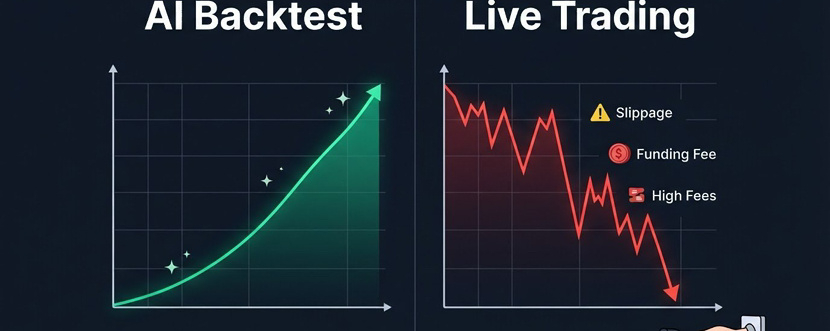
2️⃣ The sexiest profits on backtest charts all die in live trading
No matter how great the Sharpe ratio AI gets from historical candlestick data looks, it tends to fall apart in real markets.
Slippage in shallow crypto markets, funding rates on perpetual contracts every 8 hours, and liquidity gaps before and after the U.S. stock market opens—one sudden move can wipe out all the model’s theoretical returns.
3️⃣ An Agent can click the buy button for you, but it can’t weather a drawdown for you
A lot of people think they lose money because they’re too slow to trade or don’t know how to write Python.
But that’s not it. What really determines whether you make money is whether you dare to stick with a strategy when it goes through a prolonged drawdown.
——————————
So what use is this library with 38,000 Stars to everyday people?
🔎 Use case 1: Use its backtesting to “shoot down” your gut-feel ideas
Whenever you hear someone in a group chat say “a golden cross always means prices will rise” or “this indicator has an 80% win rate,” don’t rush in. First, have the Agent run a historical backtest and calculate the maximum drawdown. It can disprove 90% of bogus patterns on the spot.
🧠 Use case 2: Use a Shadow Account to experiment at zero cost
Don’t enable live trading yet. Have it use a paper-trading account and your trading journal (/journal) to monitor your daily trades and spot exactly when you’re most likely to get carried away chasing prices.
📊 Use case 3: Borrow only its “research team” to filter information
Have multiple Agents sift through U.S. stock earnings reports, ETF holdings, and on-chain anomalies. But whether to buy—and how much to invest—must be your call.
Tools can make your research 10 times more efficient, but they can never become “you”.