

UniCredit has begun accepting orders from retail clients in Italy for a six-year bond linked to the price of bitcoin, a product that promises to return the initial principal at maturity while capping any gains at 65%.
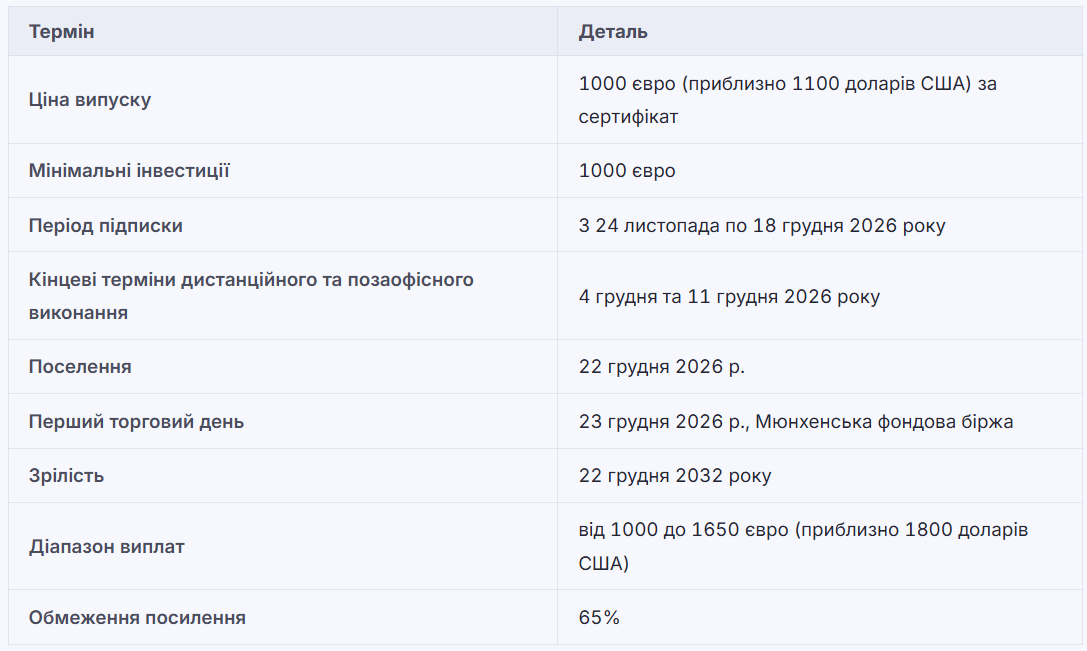
Subscriptions opened on November 24 and will close on December 18, with settlement scheduled for December 22 and the first day of trading on the Munich Stock Exchange on December 23. Each certificate has an issue price of €1,000 (approximately US$1,100) and pays between €1,000 and €1,650 (approximately US$1,800) at maturity on December 22, 2032. The bank is distributing the bonds only through its advisory service, meaning buyers must already be clients and contact an adviser rather than purchase them independently through the app.
The payout is calculated by comparing the value of BlackRock’s iShares Bitcoin ETP on the initial observation date, December 21, 2026, with its level on the final observation date, December 15, 2032. A 30% gain in the underlying asset would result in a payout of €1,300 (approximately US$1,400) on a €1,000 certificate; a doubling of the ETP would result in the maximum payout of €1,650. A 40% decline would still return the €1,000 principal. No interest is paid, and the payout is made in cash one week after the final observation.
The maximum capped return is approximately 8.7% per year on a compound basis over six years, before taxes and other costs. The terms include an initial product cost of €25 (approximately US$27), or 2.5% of the subscription amount. Since the certificate does not participate in gains above 65%, a buyer whose underlying asset doubles will receive €350 (approximately US$380) less than a direct holder of the same ETP position, before trading costs and taxes.
Cicco Di Stazio, who heads UniCredit Group’s investment products division, said the launch brings to Italy a structure the bank has already used in Germany and Austria, describing it as a response to growing customer demand. The bank called the offering its first certificate to give Italian retail investors access to bitcoin performance.
The capital protection is narrower than it may initially appear. The minimum amount of €1,000 applies only if the bond is held until its scheduled maturity, and it depends on UniCredit’s own solvency: the certificate is an unsecured obligation of the bank, so its holders will rank as ordinary creditors and could face a write-down under bail-in rules if the lender runs into difficulties. Investors who sell the bond before 2032 receive the market price at that time, which could fall below the issue price, and the bank warns that sellers may have difficulty obtaining an adequate price under exceptional market conditions. Certain regulatory events may also trigger early redemption at €1,000, ending any participation in gains.
The key information document, aimed at depositors who are familiar with complex products and cannot afford any loss of capital, models an investment of €10,000 (approximately US$11,000), with an entry cost of €250 (approximately US$270) and a further €50 (approximately US$55) charged for an exit before maturity. In the stressed, unfavorable, and moderate scenarios, the initial amount is returned and nothing more; only the favorable scenario yields more—€13,698 (approximately US$15,000).
UniCredit is not the first lender in the group to take this route. Its German subsidiary HypoVereinsbank sold retail clients a capital-protected certificate on the iShares Bitcoin Trust ETF in March, denominated in dollars and capped at $1,600 per certificate. The Austrian platform issued a similar dollar-denominated bond on the same U.S. fund from April 20 to May 29. In Italy, the bank first offered professional clients a five-year, dollar-denominated certificate on the fund in July 2025, with an 85% cap and a $25,000 minimum.
The advice-only structure sets the Italian rollout apart from BBVA’s approach in Spain, where the lender opened bitcoin and ether trading and custody through an app to adult retail clients in July 2025, allowing them to initiate trades themselves. By contrast, UniCredit clients receive fixed-term securities with a cash payout linked to an ETP. The bank’s website states that it does not facilitate or allow direct investments in cryptocurrencies.
This distinction also matters for the underlying asset. The iShares Bitcoin ETP is itself a bitcoin-backed debt security and is already traded in euros on Borsa Italiana; an investor who buys it directly is exposed to price movements in both directions, with no fixed maturity or cap. UniCredit’s offering wraps the same asset in a fixed-term bank obligation with a different risk profile.
For Italian depositors, the product offers a way to take a position in bitcoin without holding the asset, but the trade-off is a hard cap on gains and a six-year lock-up, during which the only reliable exit is at the market price. For UniCredit, the sale extends a template already tested in two other markets and gives its advisory network a structured product for clients asking about cryptocurrency. The bank is also considering cryptocurrency custody and brokerage services, which would deepen its involvement beyond packaged exposure.
