Seedance 2.5 faces a formidable rival: MAGI-2 tops the image-to-video leaderboard, with 1080p generation costing just RMB 0.5 per second
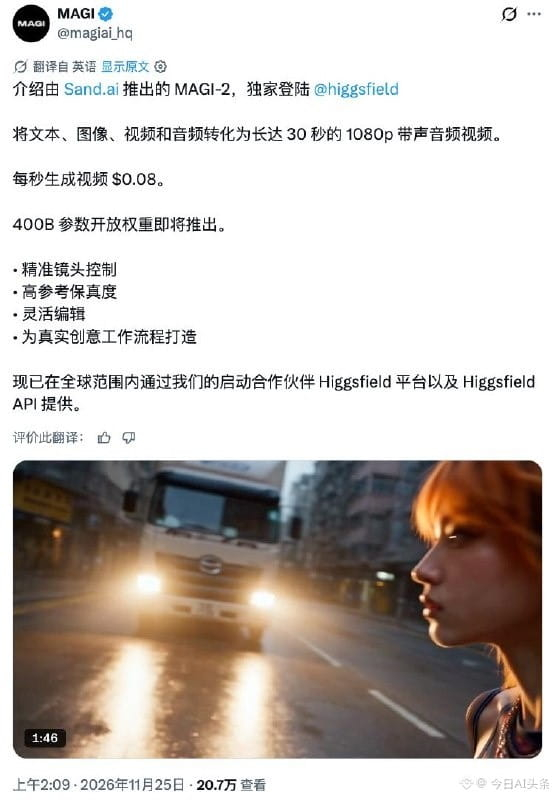
Sand.ai, a company specializing in large video models, has released its next-generation video generation model, MAGI-2. It scored 1,165 points on Artificial Analysis’s image-to-video leaderboard, narrowly beating ByteDance’s Seedance 2.5, which scored 1,161, to take the global top spot.
The score gap between the two is small, but the price difference is huge. Generating 1080p video with MAGI-2 costs just RMB 0.5 per second, so a 30-second clip costs only RMB 15—about 87% less than Seedance 2.5 at the same resolution.
Sand.ai was founded in early 2024. Its founder, Cao Yue, holds a PhD from Tsinghua University and is a former principal researcher at Microsoft Research Asia. He was also one of the lead authors of Swin Transformer, a well-known vision model whose research received the Best Paper Award at ICCV 2021, a leading computer vision conference. Cao Yue also helped co-found Beyond Horizons. Since the beginning of this year, Sand.ai has raised a total of US$300 million in just 10 months, surpassing a US$1 billion valuation.
In August this year, Sand.ai had already open-sourced MAGI-2 Preview, a video model with over 100 billion parameters, which ranked sixth globally on the image-to-video leaderboard at the time. Just over three months later, the full version’s total parameter count grew from 114 billion to 480 billion, while the scale of its pretraining data also increased roughly threefold.
Thanks to its MoE (Mixture of Experts) architecture, the model activates only about 28 billion parameters when processing each token—less than 6% of its total parameter count. This allows the model’s capacity to grow without causing computational costs to skyrocket.
MAGI-2 can generate up to 30 seconds of 1080p video with sound in a single go. It supports using up to 20 images, videos, and audio clips as references at once, and can precisely control camera movements, character actions, and shot transitions, as well as make localized edits to existing videos.
Based on tests by its first creators, MAGI-2 excels at complex camera movements, following prompts, and maintaining stylistic consistency. In some camera movement scenarios, it even looks more natural than Seedance 2.5. However, its visual quality and physical details still fall slightly short of the latter, and the audio—especially character dialogue—still has a distinctly AI-generated quality.
MAGI-2 is now available on LibTV and Higgsfield. Sand.ai has also made it clear that it plans to open-source the weights of this 480-billion-parameter model.
What do you think? 👇