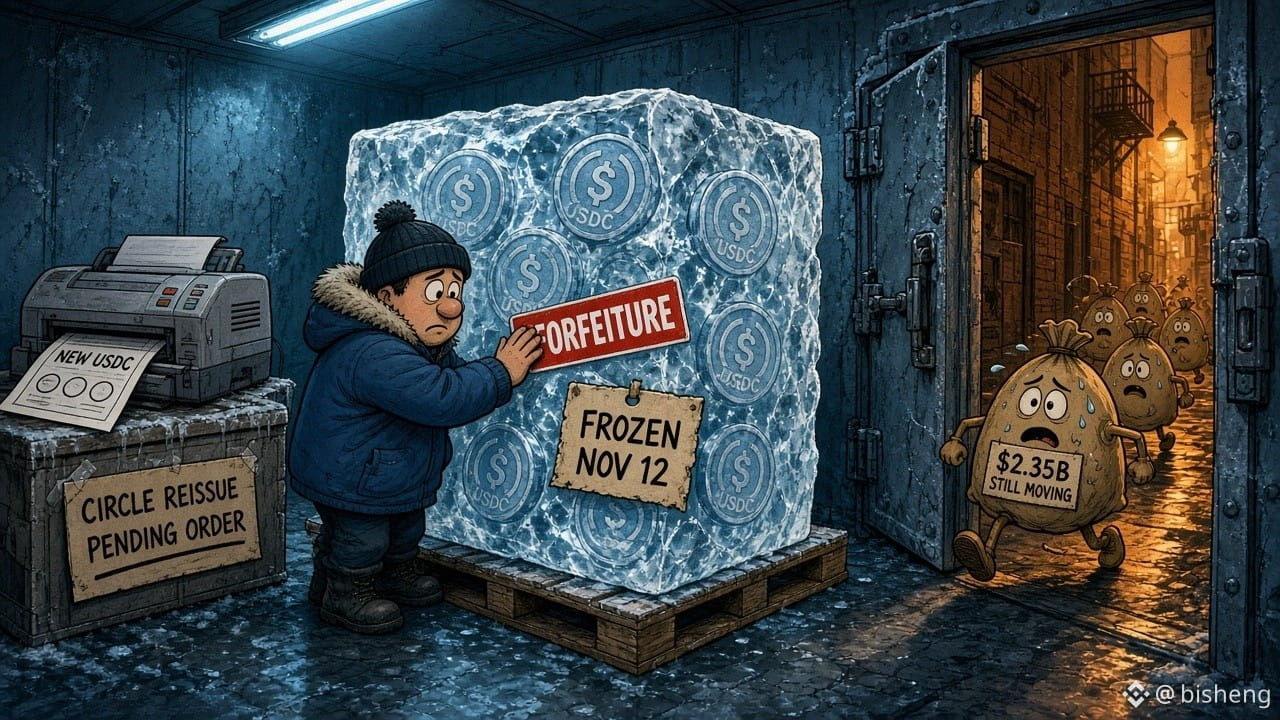
People in the industry are already framing this as: the US recovered $1.1 billion, the Binance theft case is wrapped up, and Circle can mint another batch to make up the difference. That logic doesn’t hold. A forfeiture complaint isn’t a newly recovered sum of money.
On Monday, November 23, the US Department of Justice filed a civil forfeiture complaint in the US District Court for the District of Columbia. The official press release said it was initiating forfeiture proceedings against more than $1.1 billion in USDC. The stablecoins were issued by Circle, and the DOJ alleges they are proceeds of the October 29 Binance theft, including funds that were later transferred. The Block added up the balances listed in the complaint and put the total at about $1.17 billion, spread across 36 addresses on 18 blockchains.
The key point comes in the second half of the press release: these assets had already been frozen under a restraining order obtained by the government. The Block reported that prosecutors obtained a temporary restraining order on November 12; on Monday, they filed a separate motion seeking to keep the assets frozen and avoid a gap when the original order expires. CoinDesk also reported on the 24th that the complaint seeks to legally transfer ownership of USDC that is already frozen, not to freeze a new batch of funds.
Circle’s role is also easy to misrepresent. The Block quoted the complaint: Circle has already blocked these USDC, but told prosecutors it cannot transfer the original tokens out of the blacklisted addresses. What Circle agreed to do is voluntarily issue an equal amount of new USDC and transfer it to the US government if the court issues a forfeiture order. That means minting a new batch outside the blacklist—not pulling coins out of the stolen wallets.
Now look at the figures often used to wrap up the story. The DOJ said that since the October 29 theft, the US has helped freeze, seize, and/or return more than $2.9 billion. Note the wording: freeze, seize, and return are grouped together. This $1.1 billion was already frozen; it isn’t a newly recovered portion. The Block cited Binance’s own figures, which put the losses at about $6.34 billion, and said it had covered the affected assets with its own funds. The exchange fronted the money to fill the hole for its users.
And what remains is no small amount. CoinDesk cited Elliptic’s figures from Monday: about $2.35 billion is still in wallets linked to the theft, most of it potentially still under the control of the people behind the theft. The FBI previously identified the group as TraderTraitor. Elliptic also reported that at least $247 million had passed through coinjoins or mixers. Last week, an Abu Dhabi court granted Binance a global freezing order for $6.5 billion, but CoinDesk made clear that the order cannot stop Bitcoin and Ethereum wallets still controlled by the other side from transferring funds out.
So this isn’t “$1.1 billion has been recovered, and the case is nearly over.” It’s a forfeiture proceeding for USDC that had already been frozen on November 12. The court has not issued a forfeiture order, and Circle has not transferred the newly minted coins. Whether more funds can be frozen depends on the $2.35 billion still moving outside the freeze, and the portion that has already gone through mixers—not on this complaint.
#USDC #Binance