
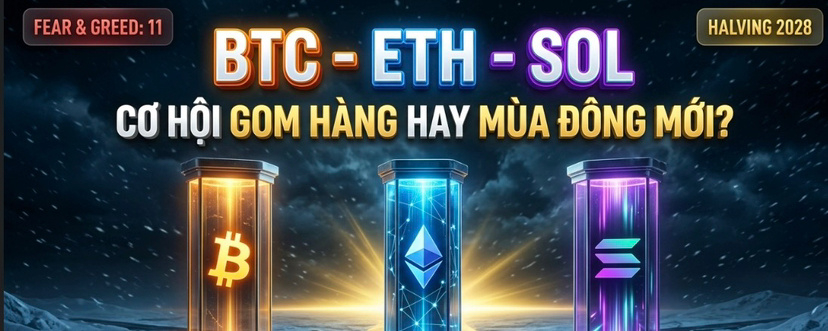

What lies ahead for BTC, ETH, and SOL after breaking below $60,000: a chance to accumulate for the next cycle or a new crypto winter? 🟠🔷🟣
With BTC falling to the $59,200–$59,500 range and the Fear & Greed Index plunging to 11 (Extreme Fear), the entire market is entering its most intense psychological test yet. The big question now is no longer whether tomorrow will be green or red, but which asset—BTC, ETH, or SOL—will attract the money and lead the next wave over the next 1–2 years.
Looking beyond the short-term panic, the outlook for the market’s three biggest names is clearly diverging:
🔴 Short term (Late 2026 – Early 2027): A test of overall liquidity
U.S. spot Bitcoin ETFs just recorded a record monthly net outflow of more than $4.71 billion in November, adding deleveraging pressure across the entire large-cap sector.
To confirm a reversal, BTC needs to hold the $55,000–$58,000 support zone, then reclaim the $62,000–$66,000 range and the average cost basis of short-term holders, around $74,000. Until BTC establishes a stable price base, both ETH and SOL will continue to face sharp swings.
🟢 Medium and long term (2027–2028+): Each name has a different role
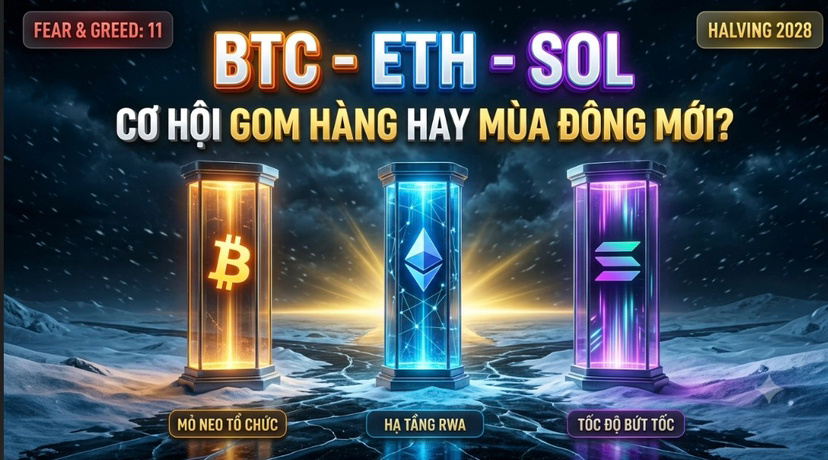
BTC — The institutional “anchor” and launchpad for the 2028 Halving: Despite short-term net selling, cumulative net inflows into U.S. ETFs since early 2024 remain positive at over $53 billion (holding about 6.1% of total market capitalization). The 2028 Halving will further cut the block reward from 3.125 BTC to 1.5625 BTC, and historically, cycle bottoms have often formed around 500 days before a halving. BTC remains the first destination when global liquidity turns around.
ETH — Wall Street’s financial infrastructure, but it needs to prove its resilience again: Despite ongoing debate over price performance and the fragmentation of Layer 2 networks, Ethereum remains the No. 1 “backbone” for institutional capital, stablecoins, and tokenized real-world assets (RWA). ETH’s future depends largely on how effectively the Layer 2 ecosystem can channel value and real demand back to the native coin.
SOL — The liquidity and speed machine: Unlike ETH’s more "steady" nature, Solana has shown a remarkable ability to attract retail users, DEX trading volume, and high-speed Web3 applications. SOL has a wide trading range—it can take a sharp hit when the market sells off, but whenever a recovery wave returns, it’s often the name with the strongest bounce and the fastest influx of speculative capital.
👉 Personal take: The next phase of the crypto market won’t see everything rise together on rumors; instead, price action will be closely driven by macro liquidity and real capital flows. When sentiment is at its bleakest, it’s often a good time to rebuild a portfolio with discipline: prioritize gradual accumulation (DCA) over using margin to try to catch the bottom, use BTC as a safe anchor, and choose selectively between ETH (resilient, awaiting a revaluation) and SOL (more reactive to market swings, with a wider trading range) based on your risk appetite.
If you could choose just one name to steadily accumulate from now until the 2028 Halving, which team are you on: BTC (the sure bet), ETH (waiting for a comeback), or SOL (the strongest breakout potential)? Comment your choice below


