

One year and nine months, 46.6 billion yuan: JD Takeaway has shifted from offense to defense.
Liu Qiangdong—the man who once treated delivery riders to hotpot, announced that full-time riders would receive social insurance and housing provident fund benefits, and drew a line in the sand saying JD Takeaway’s “net profit margin must never exceed 5%”—probably never imagined the battle would come to this.
The commander-in-chief’s top lieutenant has left first.
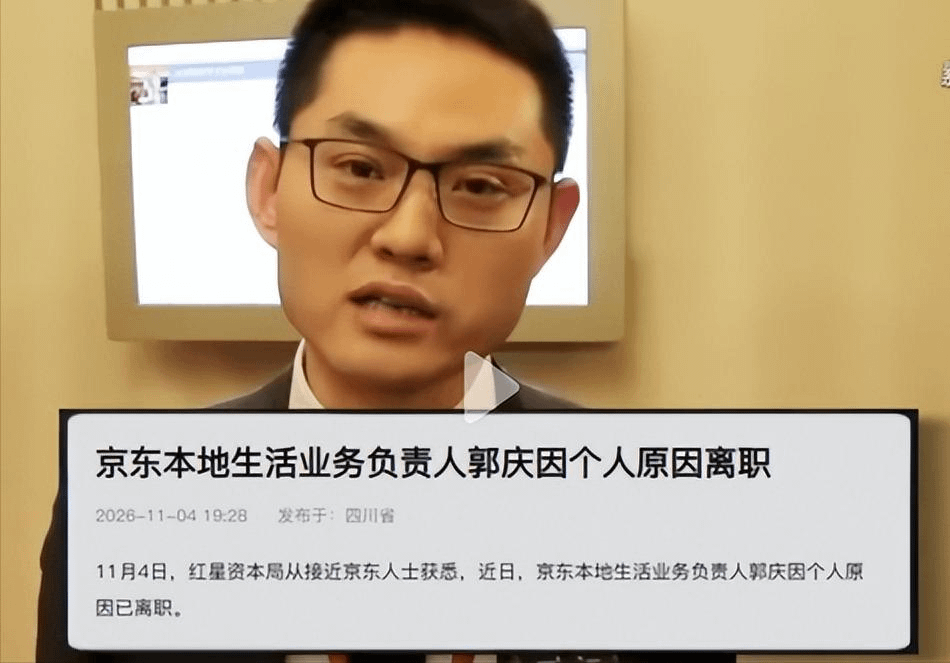
Guo Qing, head of JD’s local services business, has reportedly resigned. A former Meituan executive, he became the undisputed top leader in JD’s local services and on-demand delivery business after joining the company. In JD’s open letter about its food delivery business at the end of February this year, the company was still pledging to “capture 30% of the market by year-end.” Now, before the battle is even over, its top lieutenant has already left.
JD Food Delivery launched in February last year, and Liu Qiangdong personally donned a courier uniform to deliver food in Beijing and treat couriers to hot pot. Back then, everyone thought the food-delivery market, dominated by Meituan for a decade, was about to be turned upside down.
But wars aren’t won by whoever gets off to the strongest start; they’re won by whoever has the most ammunition.
What did 46.6 billion yuan buy?
For all of 2025, JD’s new businesses, led by food delivery, posted an operating loss of 46.6 billion yuan. JD Group’s overall operating profit plunged from 38.7 billion yuan to 2.8 billion yuan. Nearly all the operating profit painstakingly earned over the year by JD Retail, its core business, was swallowed up by food delivery.
What did it get in return? In September this year, a reporter visiting a county town interviewed a bubble tea shop owner who said her shop was down to single-digit daily orders on JD Food Delivery.
After burning through 46.6 billion yuan, JD failed to win genuine repeat business from users.
What happened in between?
JD Food Delivery launched in February last year. In late April, Alibaba upgraded its on-demand delivery service to Taobao Instant Commerce and had Ele.me bankroll it. In July, it poured another 50 billion yuan into subsidies. By the end of the year, it had gone so far as to rename Ele.me Taobao Instant Commerce.
Taobao already had far more daily active users than Meituan and JD. Once it opened the traffic floodgates, daily orders peaked at 120 million in August, with a weekly daily average of 80 million.
After all JD’s efforts, it indirectly helped Taobao revive Ele.me—and ended up giving the biggest rival to its core e-commerce business an even larger traffic gateway.
The first reason, and the most painful one: Taobao beat Dong Ge to the punch.
The subsidy war can’t go on
Regulators summoned the platforms for discussions twice in 2025. On April 10, 2026, the Rules on Pricing Conduct by Internet Platforms officially took effect. Then, on June 17, the State Administration for Market Regulation sought public comment on the Ten Rules for Regulating Subsidies by Food-Delivery Platforms. The key provisions are clear: no prolonged, large-scale subsidies to exclude or restrict competition; no forcing merchants to participate or bear the cost of subsidies; no using capital advantages to create monopolies or engage in unfair competition; and no selling below cost.
Put simply, whoever depends most on subsidies takes the hardest fall.
Once the subsidy tap is tightened, the food-delivery war immediately reverts to what it really comes down to: who has more merchants, whose courier network is denser, and whose users have more deeply ingrained habits. All three are JD’s weak spots—and all three are Meituan’s moats.
As subsidies wind down, orders decline and couriers earn less. Add to that the fact that other platforms are also starting to provide social insurance, and couriers can switch to a rival with no qualms. Delivery efficiency drops, and orders fall further. A vicious cycle.
After burning through 46.6 billion yuan, JD retained no couriers, no merchants, and no customers. It built no barriers to entry with all that spending. Instead, the spending spree drew regulators in to rein in the capital-fueled free-for-all, while rivals consolidated internally and came back fighting—and couriers and consumers hopped between platforms.
Using food delivery to funnel traffic to e-commerce: a promise unfulfilled
Some say that as long as food delivery brings traffic to the JD app, the money is well spent. That was also the story JD told the capital markets: food delivery is a high-frequency traffic gateway, and its losses are essentially marketing expenses that can drive traffic to its main e-commerce business.
The reality is harsh. Last year, JPMorgan ran the numbers: JD’s food-delivery cross-selling rate would have to exceed 30% to offset a loss of 5 yuan per order. In other words, at least 3 out of every 10 food-delivery customers would have to buy something else from JD, generating enough sales profit for JD to break even.
So what happened? If food delivery really were driving traffic, JD’s flagship 3C and home appliance categories should have benefited first. But in the fourth quarter of 2025, JD’s revenue from electronics and home appliances fell 12% year over year. It fell 8.4% in the first quarter of 2026, then another 11.8% in the second quarter—three consecutive quarters of contraction.
Home appliances are a classic category tied to the property market’s downstream cycle: each new home handed over creates the first demand for a refrigerator and an air conditioner. In 2025, sales of newly built commercial housing nationwide totaled 881 million square meters, down 8.7% year over year. The business model that has made JD the most money over the years—new homes being handed over, complete appliance sets, and delivery with installation—is no longer as effective as it used to be.
Worse still, JD’s 3C and home appliance business is also under pressure from Douyin. During this year’s 618 shopping festival, home appliance merchants participating in the national subsidy program on Douyin saw average transaction value grow 121% year over year. Douyin is steadily strengthening its search-and-buy shopping experience, where consumers actively search for and purchase products—and that has traditionally been one of JD’s strengths.
Whatever traffic food delivery brings is a drop in the bucket compared with JD’s core 3C market. The supposed synergy of using food delivery to drive e-commerce is mostly just a story told to the capital markets.
From offense to defense
After senior executive Guo Qing left, news emerged that JD’s local services business was entering the JD Food Delivery 2.0 phase, centered on supply chain innovation. It’s clear that JD is shifting from offense to defense.
JD can’t win a platform-versus-platform traffic war. But its self-operated supply chain and high-quality product offerings have always been traditional strengths. For JD, this is a graceful and realistic way out.
To be fair, in its one year and nine months, JD Food Delivery has pushed for couriers to receive the “five insurances and one housing fund” benefits and for commissions to be made more transparent, breaking Meituan’s dominance. That has benefited the industry, couriers, and merchants alike.
The 46.6 billion yuan that was burned ultimately became social insurance and housing fund contributions in couriers’ accounts, a few percentage points less in merchant commissions, and a spending spree for consumers.
But when it comes to business, cutting losses in time was Liu Qiangdong’s clearest-headed decision in this battle.
The 46.6 billion yuan bought JD a lesson: you can’t win a traffic war just by having money. What do you think—can JD make its shift toward the supply chain work? Let’s talk in the comments. $SOL