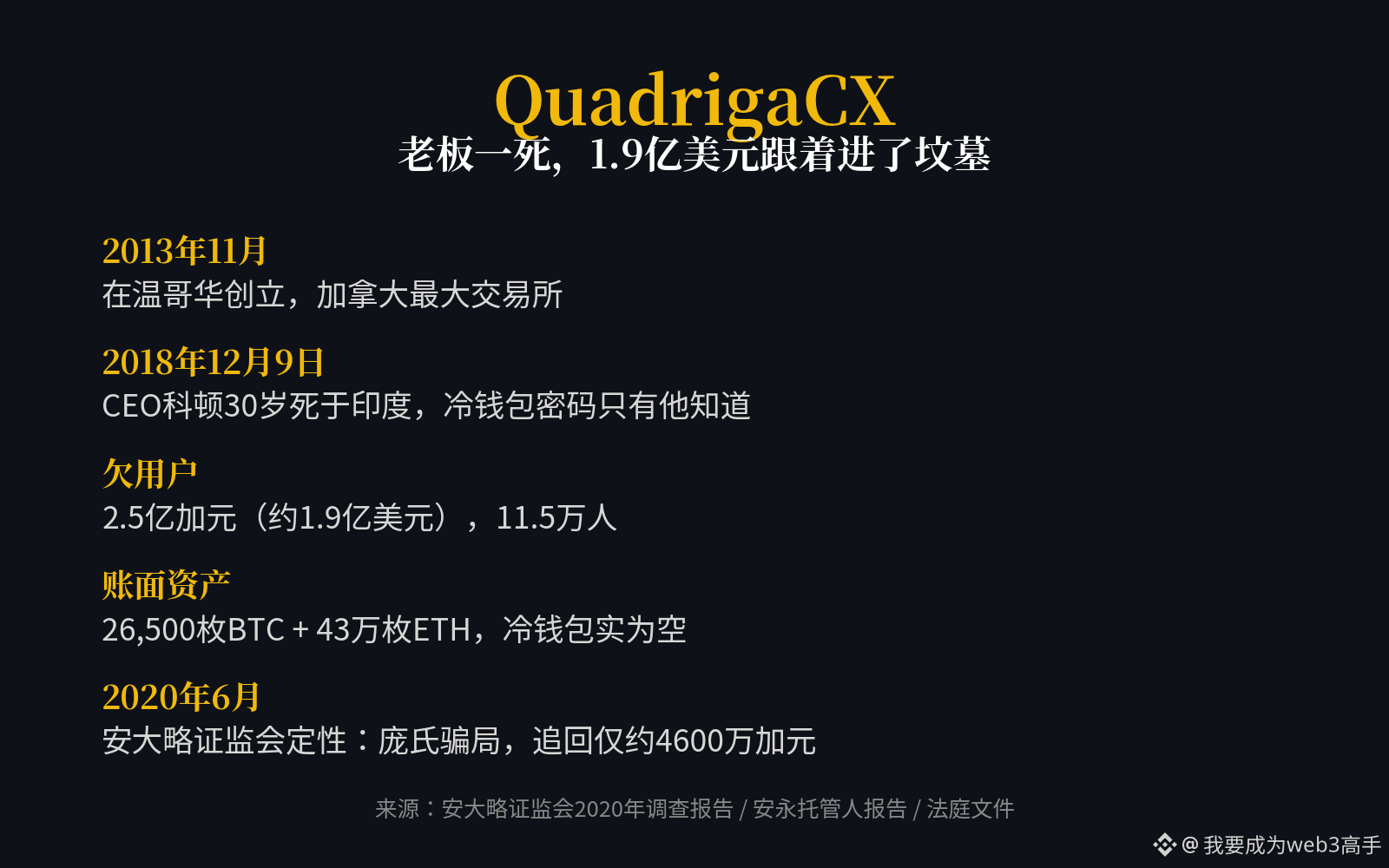
On December 9, 2018, the head of Canada's largest exchange died in India, and $190 million went to the grave with him.
Gerald Cotten, 30, founder and CEO of QuadrigaCX, died in Jaipur, India, from complications of Crohn's disease. Just 12 days before his death, he had drawn up a will, leaving his entire estate of 9.6 million Canadian dollars to his wife.
More than a month later, on January 14, 2019, the exchange announced his death. It owed 115,000 users 250 million Canadian dollars, about $190 million. That included 180 million Canadian dollars in cryptocurrency and 70 million in fiat currency. Its books showed 26,500 bitcoins, worth $92.3 million, along with 430,000 ether and nearly 200,000 litecoins.
His wife told the court that he alone knew the cold wallet passwords, and that the encrypted laptop could not be opened. But when Ernst & Young came in to investigate, only a few thousand dollars remained in the cold wallets. They had been empty since April 2018.
In June 2020, after a 10-month investigation, the Ontario Securities Commission classified it as a Ponzi scheme. Cotten opened accounts under false names, fabricated balances, and used customers' money to trade for himself. He lost $115 million trading, lost another $28 million on external platforms, and spent what remained on luxury cars, yachts, and planes. More than 76,000 customers were owed 215 million Canadian dollars; only about 46 million was eventually recovered.
Today, $BTC 59414 dollars, down 1.5% in 24 hours, $ETH 1664 dollars, $LTC 40.5 dollars. If you don't hold the private keys, the coins aren't yours. The numbers on an exchange's books and the actual numbers on the blockchain are never the same thing.