


TL;DR
· Nvidia’s board unanimously agreed to reinstate Jensen Huang as president, CEO, and director. A committee of independent directors will continue to complete the investigation.
· Bernstein reversed its rating downgrade from 11 days ago, upgrading Nvidia back to “Outperform.” The $200 price target remains unchanged.
· Based on Nvidia’s November 20 closing price of $125.53, the $200 price target implies approximately 59% upside.
· Bernstein estimates Nvidia’s adjusted earnings per share for fiscal years 2028 and 2029 at $17.18 and $23.90, respectively. The $200 price target represents about 10 times the average earnings over those two years.
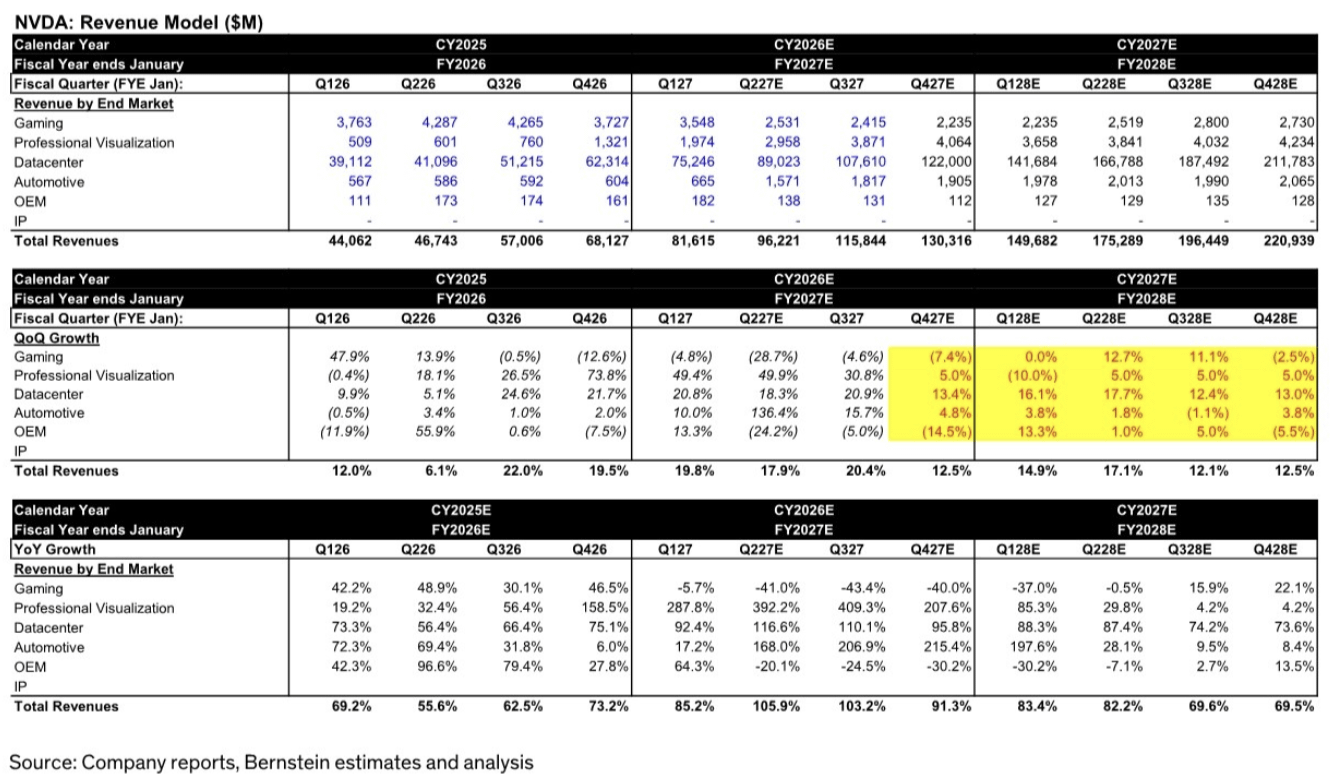
· Bernstein expects Nvidia’s data center revenue to rise from $393.9 billion in fiscal 2027 to $959.1 billion in fiscal 2029, when it would account for about 96% of the company’s revenue.
· Bernstein believes the internal investigation and the board’s decision-making process could still constrain a valuation recovery. Even if the governance turmoil eases, whether AI customers continue to spend and whether they accelerate adoption of in-house chips will still affect earnings forecasts.
Two rating changes in 11 days; price target remains half its pre-turmoil level
On November 23, Nvidia announced that its board had unanimously voted to reinstate Jensen Huang as president, CEO and director. According to Nvidia’s filing with the U.S. Securities and Exchange Commission (SEC), the board made the decision on November 22, effective immediately. Harvey Jones will remain chairman, while Colette Kress, who served as interim CEO during the turmoil, will continue as chief financial officer.
Bernstein analysts led by Stacy Rasgon promptly upgraded Nvidia from “Market Perform” to “Outperform.” Eleven days earlier, the firm had judged that Huang might leave, downgraded its rating and cut its price target from $400 to $200. Since then, Nvidia shares had at one point fallen nearly 30% from their level at the time of the previous rating change, closing at $125.53 on November 20.
The rating and price target answer two different questions. By Bernstein’s definition, “Outperform” means the firm expects Nvidia’s shares to outperform the S&P 500 by at least 15 percentage points over the next 12 months. The $200 figure is the price target calculated using the firm’s earnings forecasts and valuation multiple. Huang’s reinstatement removed the main trigger for the earlier downgrade, while the share-price decline during the turmoil widened the gap between the market price and the target.
Based on the closing price on the last trading day before the reinstatement announcement, $200 is about 59% above $125.53. This figure depends on the share-price benchmark, and the implied upside to the target will narrow as the share price recovers. Bernstein has kept its price target at $200, reflecting its concerns about governance risks and the outlook for AI spending.
How did Bernstein arrive at $200? It values average earnings over two years at about 10 times
Bernstein forecasts adjusted earnings per share of $17.18 for fiscal 2028 and $23.90 for fiscal 2029, averaging about $20.60. At this earnings level, the $200 price target implies a price-to-earnings ratio of about 10 times.
At Nvidia’s November 20 closing price, the shares were trading at 13.0 times forecast earnings for fiscal 2027 and 7.3 times forecast earnings for fiscal 2028. As earnings per share in the model rise rapidly, the forward P/E at the same share price falls. So the first question in assessing whether $200 is supported is whether Nvidia can deliver the earnings growth Bernstein forecasts.
Bernstein’s key financial forecasts for Nvidia
Source: Bernstein research report. Nvidia’s fiscal year ends in January. The data center share of revenue is calculated using the report’s forecasts.
These forecasts rely on two important assumptions. First, the data center business can maintain high growth even as its revenue base expands rapidly. Second, adjusted operating margins can remain around 65% while revenue more than doubles over two years. In other words, Bernstein expects Nvidia to sell more computing products while preserving its profitability as the business scales.
Revenue forecast approaches $1 trillion, with nearly all growth coming from data centers
Bernstein expects Nvidia’s total revenue to rise from about $424 billion in fiscal 2027 to about $997.6 billion in fiscal 2029. Over the same period, data center revenue is expected to increase by about $565.2 billion, accounting for roughly 98.5% of the company’s total revenue growth. Gaming, automotive and other businesses will continue to contribute revenue, but their contributions to growth over these two years will be relatively limited.
This also explains why Bernstein still lists the sustainability of AI spending as a major risk even as it upgrades its rating. To meet these forecasts, Nvidia needs the AI infrastructure spending that customers have announced or planned to translate into purchases as expected. If major customers slow their purchasing or allocate more of their budgets to in-house chips, Nvidia’s data center revenue could fall short of the model’s expectations. Profit margins could also come under pressure if competitors challenge Nvidia on market share or pricing.
In its discussion of risks, Bernstein also notes that slower growth in key markets could lower the valuation multiples investors are willing to pay and weaken operating leverage. When sales growth slows, expenses such as R&D and administration may not decline at the same pace, meaning operating profit could grow more slowly than revenue—or fall faster. For Nvidia, weaker AI spending affects valuation on two levels: the market may first lower its forecasts for future earnings per share, then reduce the multiple it is willing to pay for those earnings.
Jensen Huang reinstated; board decisions and internal investigation remain in focus
Nvidia’s board said that, after hearing from senior U.S. federal government officials, it determined that reinstating Jensen Huang would not pose a national security risk. A committee of independent directors will still complete its investigation, and Nvidia will continue to cooperate with the government’s ongoing investigations and inquiries. The company has also established a separate national security and export controls committee and begun recruiting a chief compliance officer.
Bernstein questioned the board’s process for reversing its decision in such a short time. The team led by Rasgon believes the board’s back-and-forth over whether Huang should remain in his role gives investors reason to reassess its judgment and decision-making process. The research note also raises questions about Huang’s judgment on the matter and his communication with the board and other key stakeholders. These issues affect how investors assess the company’s governance risk, especially given that export controls and trade compliance could affect its business.
Huang’s reinstatement led Bernstein to renew its positive view on Nvidia’s share-price performance relative to the market. Whether the $200 price target can gain further support will depend on whether the independent investigation and compliance measures reduce governance risks, and whether data center revenue and profit margins over the coming quarters meet the research note’s assumptions about AI spending.