


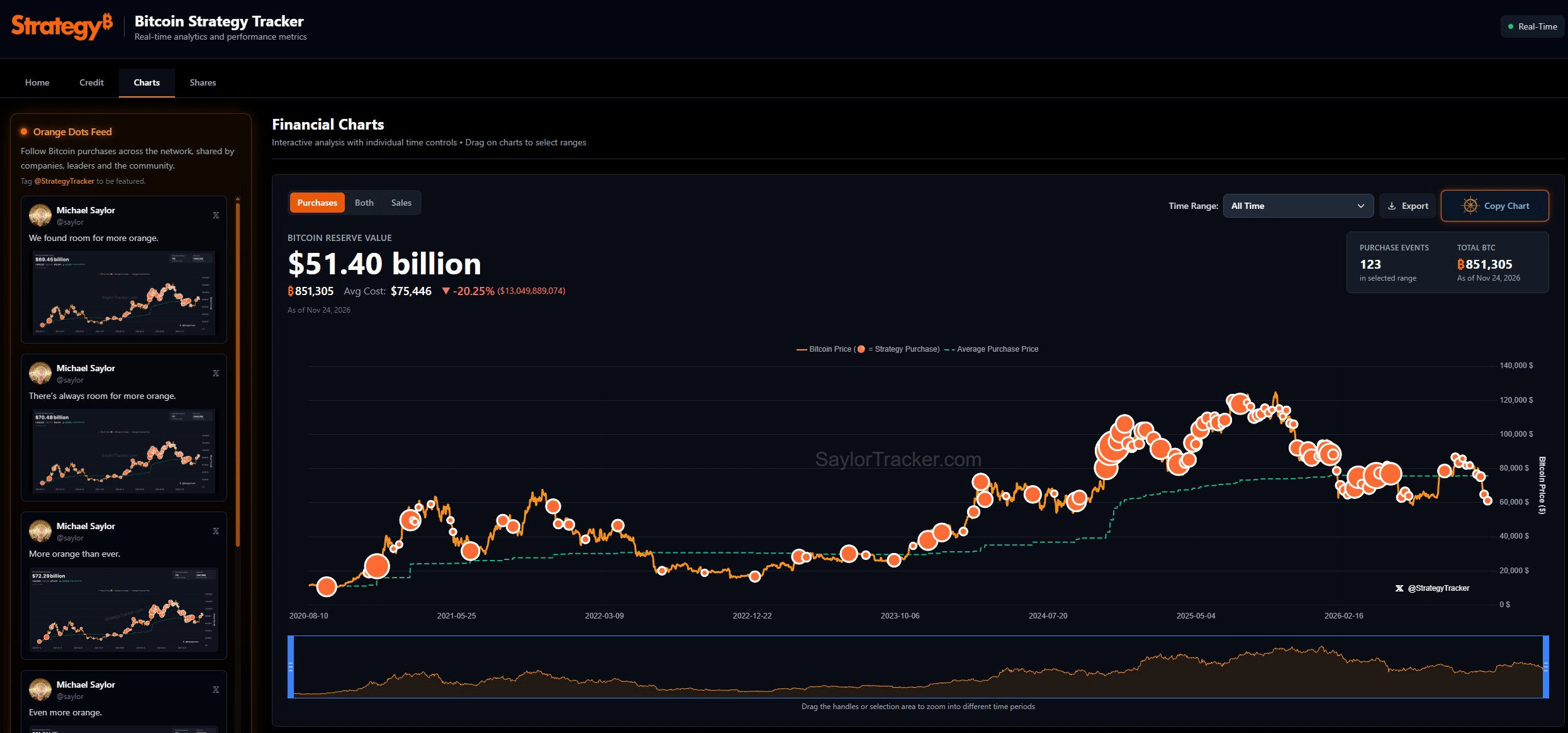
Looking back at Strategy’s history of accumulating Bitcoin ($MSTR ), there is a paradox that may sound rather silly: the company often buys aggressively when BTC is rising, but its accumulation slows when the market falls sharply.
- Example: In 2024, it bought 258,320 $BTC for approximately $22.1 billion, at an average price of $85,447/BTC.
=> Even from the perspective of an ordinary spot investor, this way of buying might seem very poor. However, Strategy uses the capital markets to increase the amount of BTC per share—they’re actually smarter than that.
=> Some analysts consider Strategy’s model “genius,” so let’s take a look at it together, folks. Their DAT is completely different from all the other copycat DATs!
1. How Strategy raises capital
- When the market is rising, MSTR stock typically trades at a premium to its net asset value (NAV). Strategy takes advantage of this gap by issuing more shares and using the proceeds to buy BTC.
*For example, suppose a company:
- Holds 100 BTC, worth $100,000/BTC.
- Has 1 million shares outstanding.
- Has assets worth $10 per share.
- However, its shares trade on the market at $20.
=> If the company issues an additional 250,000 shares, raises $5 million, and buys 50 more BTC, the result is:
- Total BTC holdings increase from 100 to 150 BTC.
- The number of shares increases from 1 million to 1.25 million.
- BTC per share increases by 20%.
=> Thus, although shareholders’ ownership stakes are diluted, the amount of BTC represented by each share still increases.
- Strategy buys BTC at a high price, but it can issue shares at a valuation even higher than the value of the assets those shares represent.
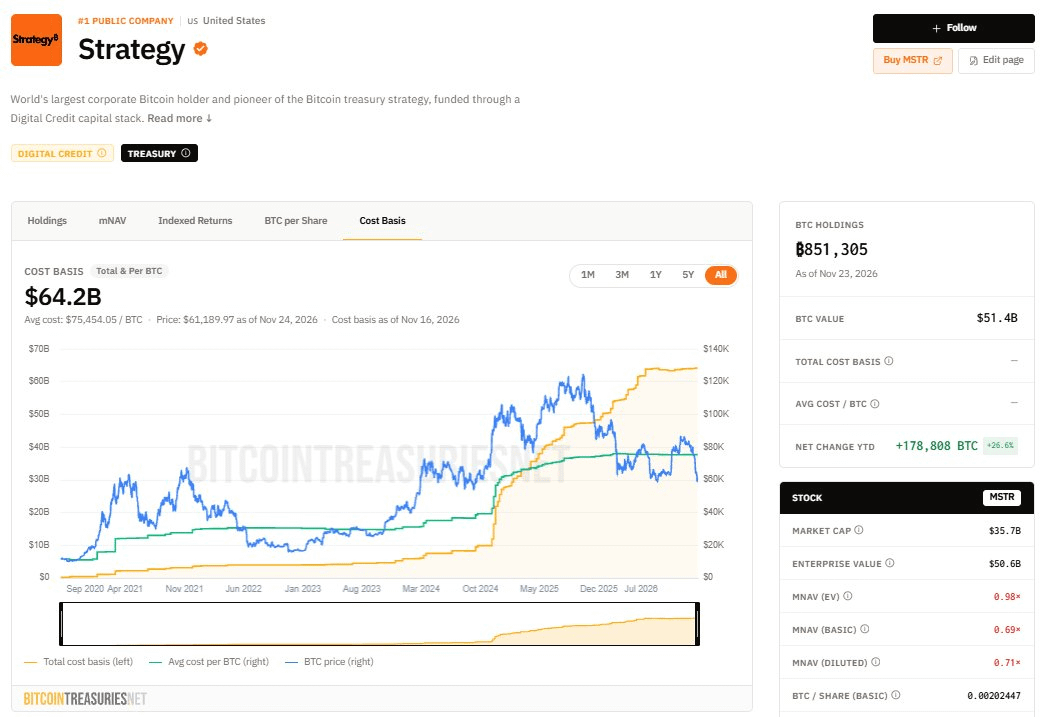
=> This is also why Strategy can often buy more BTC in a bull market. When the market falls, BTC becomes cheaper, but MSTR’s premium also shrinks, weakening its ability to raise capital and increasing dilution risk.
2. How has Strategy taken advantage of bull markets?
- In Q4 2024 alone, Strategy issued approximately 42.31 million shares, raising $15.1 billion net, or about $356.9 per share.
- At MSTR’s current price of $77.8, those shares would now be worth only about $3.29 billion.
=> This shows that Strategy made very effective use of the period when the market valued its shares highly to raise capital.
- However, the $11.81 billion difference is not profit for Strategy. The funds raised were converted into assets, while the additional shares issued remain outstanding and share in the benefits alongside existing shareholders.
=> The advantage of issuing common stock is that the company does not have to repay the funds it raised if the stock price falls, unlike when issuing bonds or borrowing.
3. Strategy’s current financial position
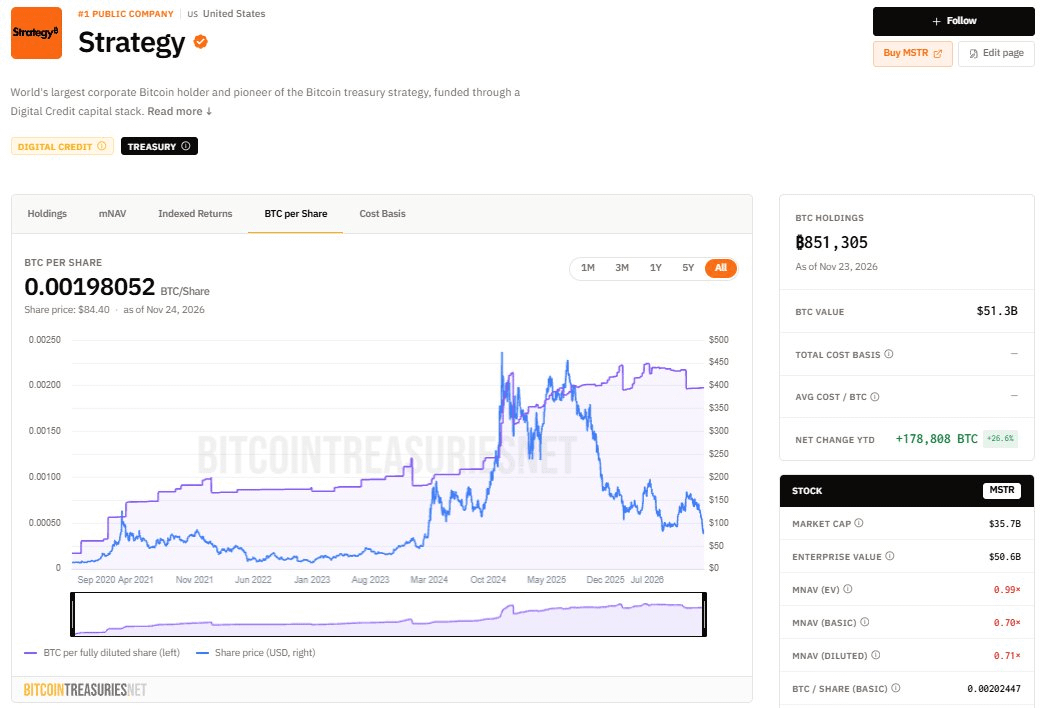
*Based on data disclosed on 23/11/2026:
- Total BTC holdings: 851,305 BTC.
- Total cost basis: $64.23 billion.
- Current value of BTC: Approximately $52.09 billion.
- Loss compared with cost basis: $12.14 billion (-18.9%).
- USD assets: $4.82 billion.
=> Total debt: $6.71 billion.
- Par value of preferred stock: $12.49 billion.
=> If we add the total value of BTC and USD assets, then subtract debt and the par value of preferred stock, the remaining assets attributable to common shareholders amount to approximately $37.71 billion, excluding taxes, the software business, and other liabilities.
- This shows that Strategy still has a significant asset cushion, but it does not mean MSTR shareholders are making a profit or that the company faces no financial risks.
=> At present, instead of continuing to use all of its raised capital to accumulate BTC, Strategy is using most of its new capital to restructure its capital base and reduce financial obligations related to preferred stock.
4. An assessment of Michael Saylor’s strategy
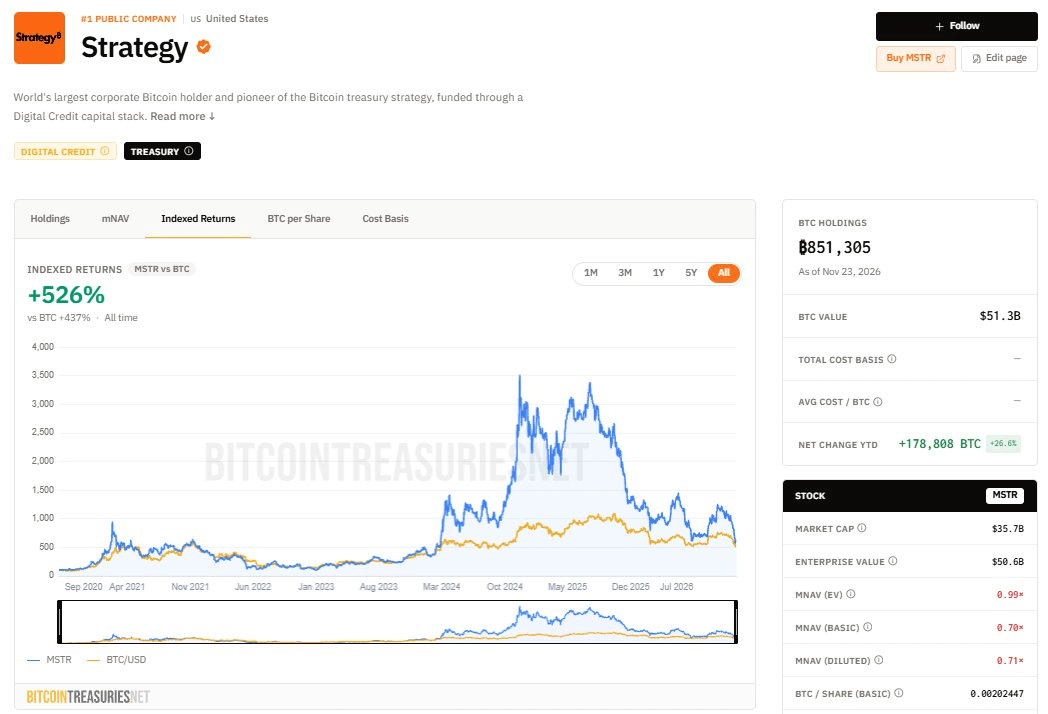
- In my view, Strategy buying a lot of BTC at high prices is not necessarily a mistake. The company’s advantage lies in its ability to convert its high stock valuation into real assets on its balance sheet.
=> However, this model only works effectively when Strategy can continue raising capital at a reasonable cost, while the value of the additional assets is sufficient to offset dilution and financial obligations.
=> Most importantly, when the market reverses, MSTR’s premium shrinks and its ability to raise capital weakens, while interest payments, preferred dividends, and debt obligations remain. As a result, it will be difficult for the company to buy much $BTC during prolonged market downturns.
=> We can track Strategy’s performance as one of the indicators reflecting current market conditions. Pretty interesting, folks.
- What do you think?