
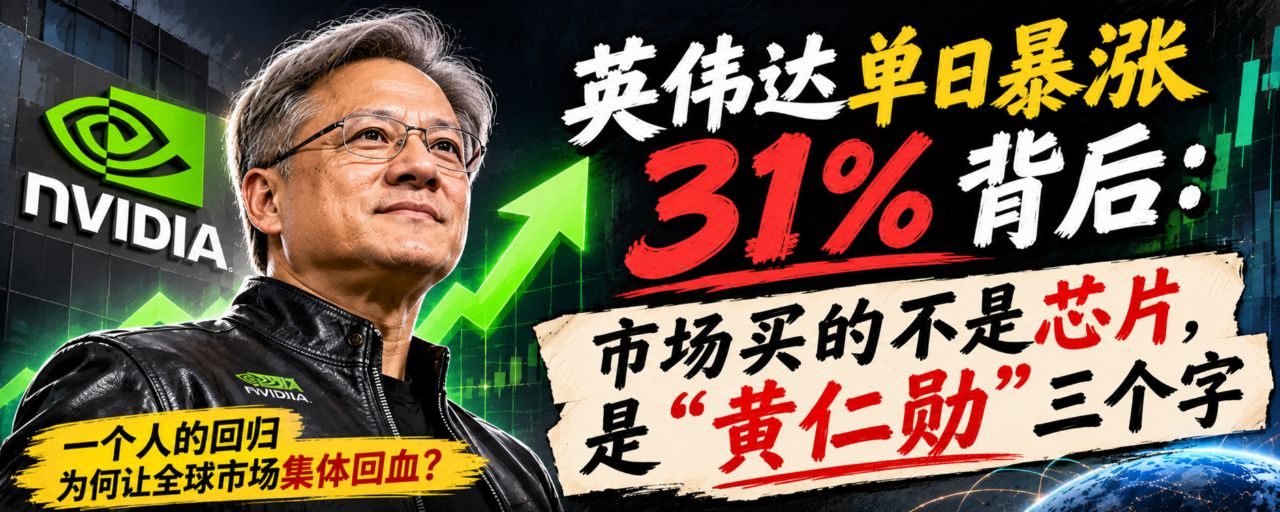

35 minutes before the U.S. stock market opened on November 23,#英伟达 announced something that caught Wall Street off guard: reinstating him as#黄仁勋 president, CEO, and director. Only 11 days had passed since he resigned.
Calling the market’s reaction “epic” would be no exaggeration.
Nvidia closed up 31.48% that day at $165.05, its biggest one-day gain since May 2003. Its market value rose by about $952 billion in a single day, setting a record for the largest one-day increase in market capitalization by any publicly listed company. The Nasdaq Composite closed up 6.51%, and the Philadelphia Semiconductor Index jumped 14%—both their biggest one-day gains since April 2025. Nvidia alone accounted for about a third of the S&P 500’s gain that day.
Asia-Pacific markets all rose in tandem the following day. The Nikkei 225 gained nearly 5% at one point, while South Korea’s KOSPI rose more than 7%. The exchange even activated its “sidecar” mechanism to suspend program trading. A-share computing hardware and semiconductor chip stocks also strengthened, with more than 3,100 stocks rising across the market.
Why can one person’s return bring global markets back to life?
What kind of figure is Jensen Huang, really?
On the surface, Nvidia’s “moat” is its CUDA software ecosystem and GPU hardware. But what has truly kept competitors a step behind over the past few years is Huang’s ability to bring together technical judgment, supply chain instincts, and personal credibility.
The AI chip supply chain is not simply a matter of “order—delivery.” TSMC needs to schedule wafer manufacturing and CoWoS advanced packaging capacity several quarters in advance. SK Hynix and Micron need to plan high-bandwidth memory output based on expected orders. These decisions involve billions of dollars in upfront investment, and whether suppliers dare to expand capacity in advance depends largely on their judgment of whether Nvidia “will proceed as planned.”
For years, Jensen Huang himself has been the anchor for that judgment. He has built relationships of mutual trust with core partners such as TSMC, SK Hynix, and Micron that go beyond the terms of their contracts. His personal visits to manufacturing partners and discussions with senior Korean executives about next-generation chip partnerships are actions that could not be replaced during a leadership vacuum.
In other words, Jensen Huang is not just “one of Nvidia’s CEOs”; he is the trust hub for the entire AI hardware supply chain. When that hub temporarily disappears, suppliers begin preparing contingency plans, cloud providers start worrying about whether GPUs will arrive on time, and the market quickly turns pessimistic in its assessment of whether “AI buildout can continue.”
This return was, in essence, a repair of the “trust chain”
Huang’s reinstatement addressed expectations first, not technology.
UBS analysts explicitly noted that the return helped ease investor concerns over financing arrangements, talent retention, and supply chain strategy. The Bernstein team, meanwhile, upgraded Nvidia back to “Outperform,” citing the fact that “the return removes the primary reason for our previous downgrade.” TSMC, SK Hynix, and Micron no longer need to reassess their existing expansion plans; for downstream cloud service providers, certainty has returned that GPUs will be delivered on schedule and Nvidia will continue to provide financing support.
A more fundamental change took place in the structure of trading. Nomura Securities’ analysis showed that news of Nvidia’s reinstatement lowered market volatility. The near-month VIX index plunged, triggering large-scale mechanical buying: market makers were forced to adjust their hedging positions, CTA trend signals switched from short to long, and S&P futures were forcibly pushed higher. Nvidia’s weighting of more than 6% in the S&P 500 and nearly 7% in the Nasdaq 100 means that its share-price swings are mathematically transmitted to the entire market through the rebalancing mechanisms of index funds and passive ETFs.
That is the transmission chain behind “one person moving trillions”: confidence recovers → volatility falls → mechanical buying is triggered → index weighting magnifies gains → global risk appetite rebounds in tandem.
After the return, what is the real test?
It is important to keep a clear head: Jensen Huang’s return has repaired the “uncertainty discount”; it has not created new incremental growth for the industry. Nvidia’s fundamentals are not bad to begin with. In the third quarter of FY27, revenue was $115.8 billion, up 103% year over year. Data center revenue was $107.6 billion, up 110%, accounting for about 93% of total revenue. The revenue guidance for the fourth fiscal quarter is $130 billion, plus or minus 3%. These figures show that real demand for AI infrastructure is still generating substantial revenue for upstream chipmakers.
But the pricing logic ahead will shift from “sentiment recovery” back to “earnings validation.” The first quarter of volume shipments for the Rubin platform contributed nearly $20 billion in revenue, about 17% of that quarter’s total. The market will next be watching to see whether customers continue purchasing as planned after the new prices take effect, and whether gross margins rebound as expected from their fourth-quarter low. The reminder from Allianz Chief Investment Officer Ludovic Subran is also worth keeping in mind: the return cannot make all previous concerns disappear, and the risk of a bubble in AI assets may even be greater than previously thought.
For the market, the greatest significance of Jensen Huang’s return is that, after a deep adjustment across the global AI industry chain, it provides a landmark moment at which pessimistic expectations have begun to ease at the margin. As of November 20, the Philadelphia Semiconductor Index had fallen about 42.5% from its year-to-date high, close to the scale of the 2022 correction, while earnings reports and capital expenditure guidance from major tech companies still pointed to strong AI demand. Once one of the most concentrated sources of uncertainty is removed, investors become willing to reassess the long-term outlook.
But a recovery is not a reversal. The underlying factors that will determine how far this rally can go are whether liquidity conditions genuinely improve, whether AI application revenues materialize, and whether data center projects are delivered as planned. Jensen Huang has brought “trust” back; next, the data need to deliver on “earnings.”
(Disclaimer: This article reflects only the author’s personal views on the market and does not constitute investment advice. Markets involve risk; invest with caution.)