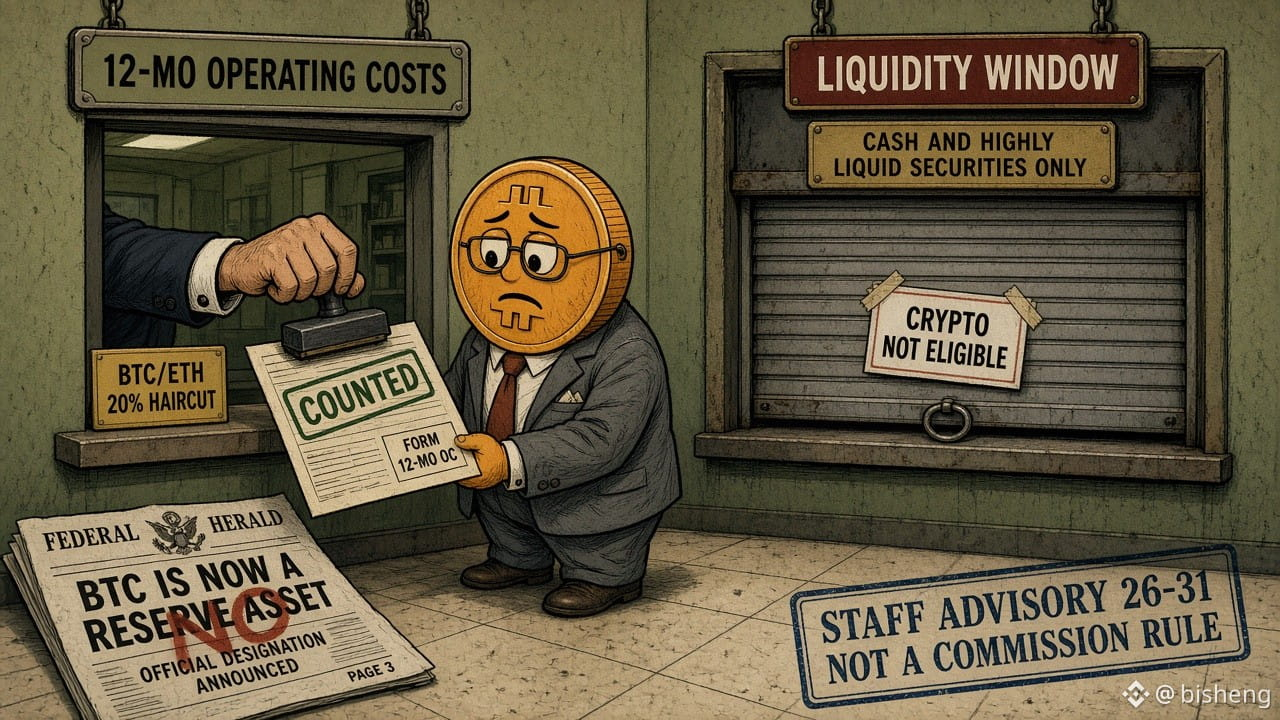
People in crypto circles have already spun yesterday’s CFTC staff guidance into: U.S. regulators have recognized Bitcoin as a reserve asset, institutions can use BTC to meet operating capital requirements, and buying is about to begin. That logic doesn’t hold up. A staff opinion is not a Commission rule, nor is it a no-action letter.
Yesterday was Monday, November 23. The CFTC’s Division of Market Oversight and Division of Clearing and Risk issued Staff Letter 26-31, press release No. 9331-26. Its scope is narrowly defined: swap execution facilities (SEFs), designated contract markets (DCMs), and derivatives clearing organizations (DCOs). The only thing Bitcoin, Ethereum, and qualifying payment stablecoins can be used to cover is the portion of financial resources that covers at least 12 months of operating costs. And those assets are subject to haircuts. The staff’s position is that, consistent with its previous approach to futures commission merchants’ proprietary positions, it would not object to a haircut of at least 20% for Bitcoin and Ethereum, and 2% for payment stablecoins. Crypto assets that are difficult to liquidate and are not payment stablecoins are generally subject to a 100% haircut—in effect, they cannot be used. Nor does just any payment stablecoin qualify: the letter sets out restrictions on issuers and reserves, so not every stablecoin on the market counts.
The liquidity portion is explicitly excluded. The official press release says crypto assets are neither cash nor highly liquid securities under U.S. GAAP, and therefore cannot meet the separate liquidity requirement. The letter breaks this down further: SEFs must hold at least three months of operating costs in unencumbered cash or highly liquid securities; for DCMs and DCOs, that figure is at least six months. The required cash still has to be there.
They also made a point of drawing another distinction. The letter does not address customer margin, nor does it explain whether crypto assets can be used to meet a DCO’s default-resource requirements under 39.11(a)(1). It is only about the operating-cost buffer. Chair Michael Selig said on X that he was glad to see staff continuing to provide clarity on crypto assets in U.S. derivatives markets. The Block also quoted him this morning. The wording is measured; it is not an announcement of a new reserve status.
The document makes its own status crystal clear. It represents only the views of the two divisions, creates no new rules or enforceable rights, is not a no-action position, and does not necessarily represent the Commission. The next administration can change it—but what it would be changing is a staff opinion, not formal rulemaking.
What is most likely to happen next: if exchanges and clearinghouses already have Bitcoin or Ethereum on their books, they’ll have a little more flexibility when filling out the form for 12 months of operating costs. But this guidance won’t make them go buy a bunch of coins on the spot market to hold as reserves. The cash requirement is still in place, and it has to stay in place. My take: this loosens the rules for filling out a form a little; it is not a purchase order.
#比特币 #CFTC