Brussels just put crypto in the same sentence as SWIFT, and I don't think people have fully registered that.
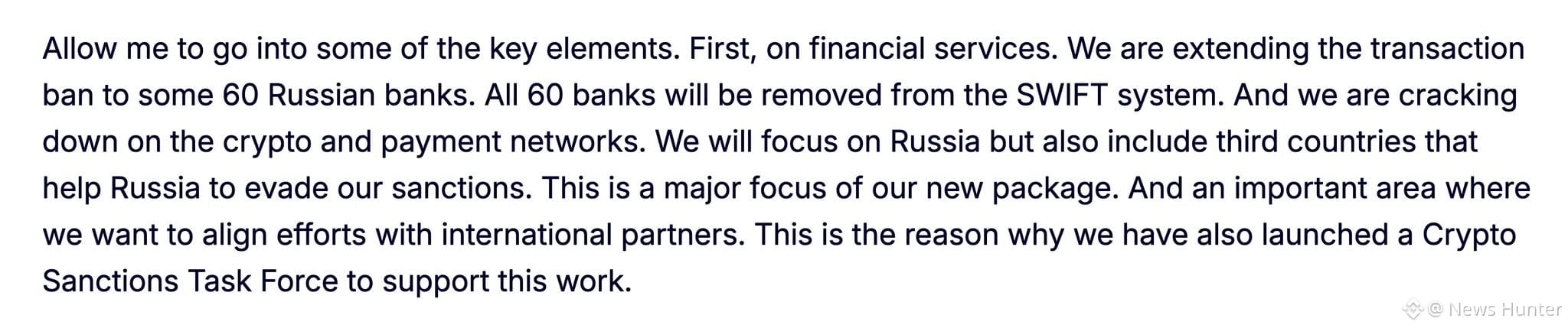
Ursula von der Leyen presented the EU's proposed 22nd Russia sanctions package yesterday. Roughly 60 more Russian banks get a transaction ban and removal from SWIFT. Then comes the part we care about: a crackdown on "crypto and payment networks", including third countries that help Russia dodge sanctions. The Commission also launched a dedicated Crypto Sanctions Task Force.
It's still a proposal. It needs unanimity from all member states, and that has never been a formality in Brussels.
Here's what I keep coming back to. Every time a door closes in traditional banking, flow looks for another door. Regulators know it, which is why the target keeps shifting from the banks to whatever sits next to them. Stablecoins like $USDT are the obvious pipe, and I've seen this cat-and-mouse game play out since the early days of capital controls. Enforcement tends to move slower than the workaround, then suddenly it doesn't.
For regular users the practical effect is boring but real: more screening, more compliance friction at exchanges and on-ramps, and more attention on who touches what. That's not a reason to panic. It's a reason to stay on the clean side of every rule.
Does a dedicated task force change how fast enforcement moves, or is this mostly headline policy?
#Sanctions #russia #CryptoRegulation #Eu #Stablecoins
Not financial advice. DYOR.