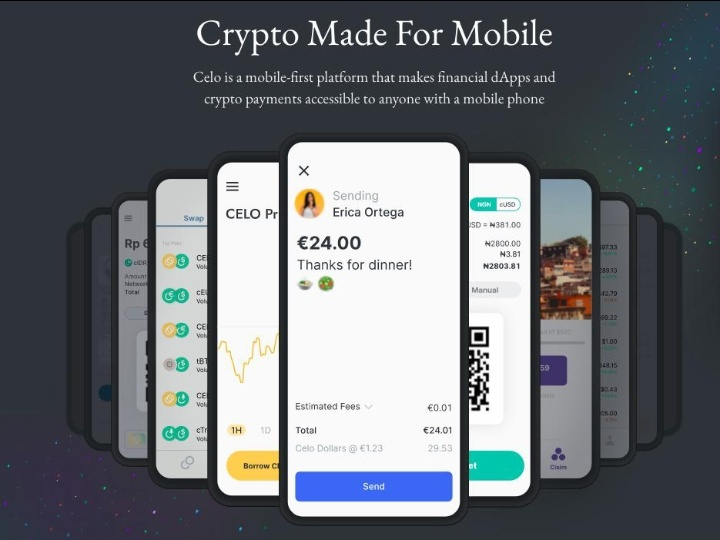


Crypto adoption has a problem. The technology is powerful, but the experience is still too complicated for many ordinary users. Celo wants to change that.
Imagine opening your phone, sending digital dollars to someone in another country, and completing the transaction without worrying about complicated wallet settings or expensive fees.
That is the kind of experience Celo is working to make possible.
Rather than competing only on blockchain speed or speculation, Celo has built its identity around mobile accessibility, stablecoin payments, and financial inclusion.
Let's explore what makes this ecosystem different and why its evolution deserves attention.
1. A Different Vision for Blockchain
Celo started in 2017 with a mission to make financial services accessible to anyone with a smartphone.
Its mainnet launched in April 2020 as an independent Proof-of-Stake blockchain.
The idea was straightforward: financial technology should not require expensive hardware, advanced technical knowledge, or access to traditional banking.
Celo focused on:
- Mobile-friendly blockchain applications
- Affordable transactions
- Stablecoin-based payments
- Ethereum-compatible smart contracts
- Financial services for underserved communities
This approach positioned Celo as a blockchain designed around practical use rather than trading alone.
2. From Independent Blockchain to Ethereum Layer 2
One of the most important chapters in Celo's development came on March 26, 2025.
Celo officially migrated from an independent Layer 1 blockchain to an Ethereum Layer 2 built using the OP Stack.
Why was this important?
Ethereum provides a major settlement and security ecosystem. Becoming an L2 gives Celo a closer connection to that ecosystem while allowing it to continue focusing on affordable payments and mobile applications.
The transition also preserved the existing network state and history.
The key changes include:
- Closer integration with Ethereum
- An Ethereum-based settlement architecture
- Improved interoperability opportunities
- Continued EVM compatibility
- A foundation for further scaling
This was not simply a branding change. It was a major architectural transformation.
3. Understanding the Gas Fee Migration
This is one detail users should not overlook.
On the original Celo Layer 1, CELO served as the native gas token.
After the Layer 2 migration, the fee system evolved. Celo L2 supports ETH-based gas infrastructure as well as fee abstraction, which allows eligible transactions to pay fees using approved ERC-20 tokens.
That means users should not assume every transaction requires CELO or that every supported stablecoin can automatically be used for fees.
The supported fee currencies and wallet experience depend on the current network configuration and application.
Always check the latest Celo documentation before making transactions.
4. What Makes Celo Special?
Mobile-First Technology
Celo is designed around smartphone accessibility. Its ecosystem includes applications that aim to make sending and receiving digital assets easier for everyday users.
Stablecoin Payments
Stablecoins are central to Celo's vision.
Instead of relying entirely on volatile cryptocurrencies, users can access digital assets designed to maintain a relatively stable value.
The ecosystem supports multiple stablecoins, including dollar-linked and local-currency options.
Affordable Transactions
Celo aims to make small payments practical by keeping transaction costs low.
Actual fees depend on network conditions and the transaction being performed.
Ethereum Compatibility
Developers can use familiar Ethereum technologies, including Solidity and established development tools.
This makes it easier for developers to bring existing applications and ideas into the Celo ecosystem.
5. MiniPay and Real-World Adoption
One of the most interesting examples of Celo's mobile-first approach is MiniPay.
Built within the Opera ecosystem, MiniPay is designed to simplify digital payments through mobile phones.
Its focus on stablecoin transfers demonstrates how blockchain technology can move beyond trading and become part of everyday financial activity.
Celo's March 2026 ecosystem update reported more than 14 million MiniPay users globally.
These figures are worth watching, although wallet numbers alone do not prove consistent active usage or long-term adoption.
The important question is whether people continue using these applications for real payments.
6. Understanding the CELO Token
CELO is an important part of the ecosystem.
Its major roles include:
Governance: CELO holders can participate in on-chain decisions affecting the protocol and its development.
Staking: CELO can be used in validator-related participation and governance mechanisms.
Ecosystem economics: Network activity, fee mechanisms, and community decisions can influence how the ecosystem's economic model develops.
However, token utility and token price are two different things.
A growing network does not automatically mean its token price will increase.
Investors should evaluate token supply, demand, governance decisions, liquidity, and market conditions independently.
7. Risks Worth Understanding
Celo has an interesting vision, but it is not risk-free.
Some important considerations include:
- Migration and protocol changes can affect how the network operates.
- Smart contracts can contain vulnerabilities.
- Stablecoins can lose their intended peg.
- Wallet recovery systems can introduce additional security assumptions.
- Staking carries risks depending on the mechanism and validator.
- CELO remains exposed to broader crypto market volatility.
- Adoption must be measured through genuine and sustained activity.
Never invest simply because a project has an attractive mission.
8. What to Watch Next
For anyone following Celo, these are important indicators:
1. Growth in stablecoin transaction volume.
2. Active users across mobile applications.
3. Developer activity and new ecosystem projects.
4. Adoption of local-currency stablecoins.
5. Network revenue and fee activity.
6. CELO governance and tokenomics developments.
7. Continued integration with Ethereum.
These indicators can provide a more meaningful picture of progress than social media excitement alone.
Final Thoughts: More Than Another Blockchain?
Celo's biggest opportunity is not simply becoming another Ethereum Layer 2.
Its ambition is to make blockchain useful for people who may never want to learn complicated crypto terminology.
A smartphone, an accessible wallet, and a simple stablecoin payment could be enough to introduce someone to digital finance.
That is an important vision.
But the long-term success of Celo will depend on real adoption, reliable infrastructure, developer activity, and sustainable economics.
The future of crypto may not be about making everyone a trader. It may be about making digital payments easier for everyone.
Celo is one project worth watching in that direction.
Always verify current network information through official documentation and a block explorer before making financial decisions.
DYOR. NFA.
#CeloFestival $CELO @celo @Binance Square Official