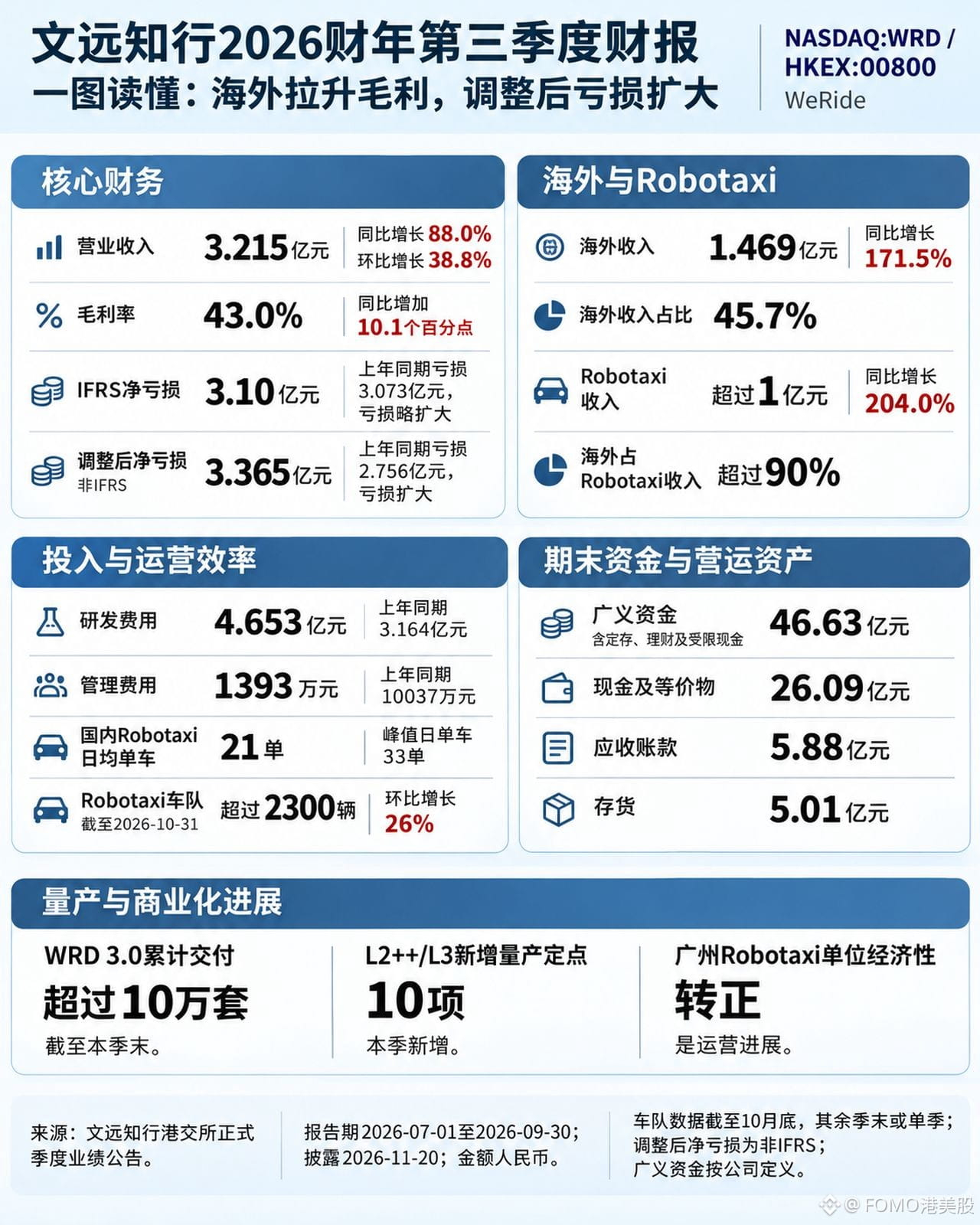
WeRide $WRD.US reported third-quarter revenue of RMB 321.5 million, up 88%. Overseas revenue was RMB 146.9 million, up 171.5%, accounting for 45.7% of the total. High-margin overseas and L2++ businesses lifted gross margin to 43%, up 10.1 percentage points, with gross profit rising from RMB 56.3 million to RMB 138.1 million.
Robotaxi revenue topped RMB 100 million for the first time, up 204%, with more than 90% coming from overseas. Local partners provide the fleets and operations, while WeRide supplies only the technology, keeping its capital burden light. In China, vehicles averaged 21 trips a day, and unit economics turned positive in Guangzhou. The global fleet exceeds 2,300 vehicles. Cumulative deliveries of L2++ solutions topped 100,000 units, and revenue at the AI infrastructure subsidiary nearly doubled.
Gross profit hasn’t kept pace with R&D.
R&D spending rose from RMB 316.4 million to RMB 465.3 million, an increase of RMB 149 million, while gross profit grew by only RMB 81.8 million. The adjusted net loss widened from RMB 275.6 million to RMB 336.5 million. The sharp drop in administrative expenses was mainly due to a reversal of share-based compensation—not operational improvements from cost savings. Broadly defined funds of RMB 4.663 billion at quarter-end are enough for four years, but the fact remains: incremental gross profit still doesn’t cover the increase in R&D spending.
The market is pricing the company as if commercialization has failed. The stock closed at $2.99 on November 20, down 8.58% that day. It has fallen nearly 70% from its 52-week high of $9.82 and is only 6% above its year-to-date low of $2.82. At this level, it has fallen too far: revenue is still growing 88%, overseas gross profit is ramping up, and there is enough cash for four years. The bet is that losses will never be caught up by revenue. If overseas gross profit scales enough to cover the increase in R&D spending, this price won’t hold. If it can’t, the low will be broken.
#文远知行 #BStocks #自动驾驶