


 There’s been a fascinating trend in the markets lately:
U.S. stocks are falling, gold is falling, and Bitcoin is falling too.
In theory, these asset classes don’t have exactly the same characteristics.
U.S. stocks reflect businesses and economic expectations. Gold is generally seen as a safe-haven asset, while Bitcoin is influenced more by liquidity and market risk appetite.
But why do they sometimes all fall at the same time?
If we focus only on news specific to each market, it may be hard to find a common cause.
That’s when we need to understand a very important concept: the ebb and flow of the U.S. dollar.
Put simply, the ebb and flow of the U.S. dollar refers to how dollar funds move between countries and asset classes around the world as U.S. monetary policy changes.
It’s like the ebb and flow of the sea.
When the tide comes in, many assets can receive capital support; when it goes out, some assets may come under pressure.
To truly understand global markets, you can’t just watch prices—you also need to see where dollar-denominated capital is flowing.
Why can the U.S. dollar affect the whole world?
First, consider this question:
Why does a single U.S. interest-rate hike affect investors far away in Asia and Europe, and even those in the cryptocurrency market?
The reason is that the U.S. dollar has long been more than just America’s own currency.
From the establishment of the Bretton Woods system, to the dollar’s later decoupling from gold, and then the gradual formation of the petrodollar system, the dollar steadily became a highly important currency in global trade, financial transactions, and foreign-exchange reserves.
Today, international trade, cross-border investment, commodities trading, and a large amount of international debt all rely on the U.S. dollar.
What does this mean?
Businesses in many countries need dollars to do business, many financial institutions hold dollar-denominated assets, and many investors also consider dollar assets an important investment option.
The U.S. dollar is like an important tap in the global financial system.
Whenever U.S. monetary policy changes, the cost and direction of global capital flows may change along with it.

Why can the Federal Reserve influence global capital?
Let’s use a simple example to understand.
Suppose you have $1 million and are now facing two choices:
One is to invest the money in dollar-denominated assets such as U.S. Treasury bonds and deposits; the other is to invest in stocks or bonds in other countries, or in risky assets such as Bitcoin.
If U.S. interest rates are relatively low and dollar-denominated assets offer modest returns, you may be more willing to take on some risk in search of higher-yielding investment opportunities.
But if the Federal Reserve continues raising interest rates and returns on dollar-denominated assets such as U.S. Treasury bonds become more attractive, you may reconsider:
If holding dollar-denominated assets can earn a decent return, why take on so much risk?
As a result, some capital may leave other markets and shift into dollar-denominated assets.
Here’s a key point:
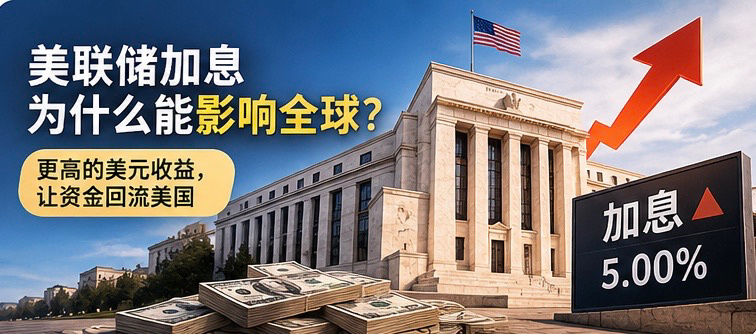
When the Federal Reserve raises interest rates, it does not directly order global capital to return to the U.S. Instead, it influences investors’ choices by changing the cost of capital and investment returns.
This is an important channel through which U.S. monetary policy affects global markets.
What is the dollar tide?
Once you understand why capital flows, it’s much easier to understand the dollar tide.
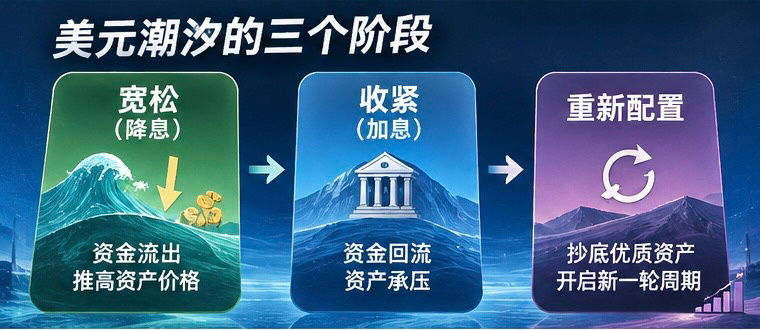
It can be divided into three stages.
Dollar easing: The tide comes in
When the Federal Reserve cuts interest rates or provides more liquidity to the market through other policies, borrowing costs may fall.
It may become easier for businesses to borrow, and the cost of capital for investors may also decrease.
When low-risk dollar-denominated assets become less attractive, some capital will look for other investment opportunities.
Stocks, real estate, emerging-market assets, and cryptocurrencies may all receive an influx of capital as a result.
Of course, capital doesn’t flow evenly into every asset. Ultimately, it depends on the economic environment, valuations, and market expectations.
Dollar tightening: The tide goes out
When the Federal Reserve raises interest rates, or markets begin to expect rates to stay high, the situation may reverse.
Borrowing becomes more expensive, financing pressures increase, and investors may become less willing to take risks.
Some capital may reduce its exposure to risky assets and shift into relatively stable assets such as dollar cash and Treasury bonds.
This change is especially pronounced in markets that rely on financing and use high levels of leverage.
Market repricing: Capital looks for a new direction
After the tide goes out, it doesn’t mean that all assets will keep falling.
Markets reassess corporate earnings, debt burdens, asset valuations, and future interest rates.
Some assets may remain under pressure, some may stabilize first, and others may find opportunities in a new wave of capital flows.
So the dollar tide isn’t a simple pattern of rises and falls, but an ongoing process of global capital reallocation.
Why are U.S. stocks, gold, and Bitcoin falling together?
Now we can return to the question at the beginning of the article.
Why do assets that seem so different sometimes fall at the same time?
Because at certain times, they face similar capital pressures, although the specific reasons are not exactly the same.
Let’s look at U.S. stocks first.
When markets worry that interest rates will remain high, the discounted value of companies’ future earnings may be affected—especially for high-valuation tech stocks that depend on future growth.
If this coincides with factors such as lower earnings expectations and concerns about returns on AI investment, U.S. stocks may come under greater pressure.
Now let’s look at gold.
Although gold is considered a safe haven, it does not generate interest.
When U.S. real interest rates rise, the opportunity cost of holding gold may increase, and a stronger dollar may also put pressure on gold prices.
However, interest rates aren’t the only thing that affects gold. Geopolitical risks, central-bank gold purchases, and safe-haven demand are also important.
Finally, let’s look at Bitcoin.
Bitcoin is relatively sensitive to changes in market liquidity and risk appetite.
When investors start reducing their risk exposure, cutting leverage, or withdrawing capital from highly volatile assets, Bitcoin may also come under pressure.
In futures markets in particular, a price decline can trigger liquidations, further amplifying short-term volatility.
So, when U.S. stocks, gold, and Bitcoin fall together, it doesn’t mean their underlying dynamics are exactly the same.
More precisely, at certain times they may all be affected by changing interest-rate expectations, dollar liquidity, and risk appetite.
The dollar is an important factor, but it is not the only reason prices fall.

What indicators should ordinary investors watch?
Understanding the dollar tide isn’t about guessing what the Federal Reserve will do next every day. It’s about learning to watch for changes in the capital environment.
There are several indicators worth keeping an eye on over the long term.
U.S. Dollar Index (DXY)
It reflects the strength of the dollar against a basket of major currencies.
A sustained rise in the dollar often means other currencies are facing some pressure, and may also affect global capital allocation.
But a rise in the Dollar Index doesn’t necessarily mean all risky assets will fall.
U.S. Treasury yields
Especially the yields on 2-year and 10-year U.S. Treasury bonds.
The 2-year yield is usually more sensitive to market expectations for interest rates, while the 10-year yield is also affected by factors such as long-term economic growth, inflation, and the term premium.
These yields can help us understand how markets view future interest rates and the economic environment.
Real interest rates
Real interest rates can be understood simply as nominal interest rates minus inflation expectations.
They are especially important for assets that don’t generate interest, such as gold.
When real interest rates rise, gold may face pressure from a higher opportunity cost; when real interest rates fall, gold may become relatively more attractive.
The Federal Reserve’s balance sheet
It can help us track changes in the size of the Federal Reserve’s balance sheet and its liquidity policies.
But note that the size of the balance sheet is not the same as the amount of dollar liquidity actually available in the market. You can’t judge the capital environment by looking at just one number.
Looking at these indicators together is more meaningful than looking at any one of them on its own.

A final thought
Many people study the market by focusing only on how much prices have risen or fallen.
But if you want to take a longer-term view, you should ask a few more questions:
Where is the capital behind this market move coming from?
What is happening to the Federal Reserve’s policy direction?
Is the dollar strengthening or weakening?
Is global capital seeking risk or reducing it?
These questions are often more valuable than simply guessing whether prices will rise or fall tomorrow.
The dollar tide won’t determine the fate of every stock or cryptocurrency, but it will affect the cost and direction of global capital flows, as well as risk appetite.
Understanding the dollar tide isn’t about predicting every rise and fall. It’s about knowing where global capital is moving and where the next opportunities may emerge.