


Ethereum privacy wallet Fluidkey recently announced the findings of its investigation into a security incident, confirming that hackers exploited a vulnerability in a third-party log management tool to steal users’ login credentials and create unauthorized transfer requests in advance on the platform’s servers. The attackers then triggered notifications through small transfers. When victims opened and unlocked their wallets, the app automatically signed the pre-prepared transactions.
The incident occurred on November 19. Within approximately 37 minutes, 52 accounts were affected, resulting in losses of about $1.6 million. Fluidkey emphasized that users’ private keys were not exposed; the vulnerability primarily involved security flaws in the backend authorization and device-signing processes.
Fluidkey hacked for $1.6 million; attack affected 6 blockchains
According to Fluidkey’s official investigation report, the attacker began transferring user assets at 5:28 p.m. UTC on November 19. Unauthorized transactions continued until the platform halted transaction processing entirely at 6:05 p.m., preventing further transfers.
The incident affected six blockchains—Ethereum, Base, BNB Chain, Polygon, Optimism, and Arbitrum—and 52 accounts were victimized.
Blockchain analytics firm Bitquery traced at least $1.58 million flowing into wallets associated with the attacker. Losses amounted to approximately $837,000 on Base and $660,000 on Ethereum.
After obtaining the assets, the attacker converted most of the funds to ether ($ETH), then moved them to the Ethereum mainnet through a cross-chain bridge. Fluidkey said approximately 887 ETH was subsequently sent to a cryptocurrency mixer, making it harder to trace the funds.
Hacking method revealed: credentials stolen through a logging vulnerability, transactions forged in advance
Fluidkey’s investigation found that the attack originated with SigNoz, a third-party open-source logging and monitoring tool deployed on the company’s own servers. The attack unfolded in multiple stages, from stealing login credentials to creating unauthorized transfer requests, all within the platform’s backend systems.
First, the attacker exploited two known security vulnerabilities in SigNoz to gain access to internal logs and read records from November 12 to 19. The platform was running version 0.121.1 at the time; the vulnerabilities had been fixed in versions 0.141.1 and 0.142.1, respectively.
Because some backend services recorded users’ login session tokens in logs, the attacker was able to impersonate logged-in users and send requests to Fluidkey’s servers after obtaining these credentials.
Next, the attacker used these credentials to create unauthorized transfer requests, mark the transactions as approved, and raise the spending limit for two-factor authentication, bypassing the original backend authorization controls.
However, Fluidkey uses a self-custodial wallet architecture, with the private keys that control funds remaining on users’ devices. So although the attacker could forge transaction approvals on the server side, they could not directly complete on-chain transfers; the wallet app still had to sign them.
Opening the wallet could trigger a transfer, without users actively confirming the malicious transaction
To obtain valid signatures for the transactions prepared in advance, the attacker sent small amounts of money to target accounts. This triggered wallet notifications, increasing the chances that users would reopen the app.
For victims, the process may have begun with a notification about a small incoming payment. When users opened Fluidkey and unlocked their wallets, the app processed transfer requests that the server had marked as approved.
The key issue was that these requests were actually transactions forged by the attacker using stolen login credentials. But the app followed its usual process and used the private keys on users’ devices to sign them, resulting in the transfer of assets.
As a result, victims did not need to enter a recipient address or confirm a transfer amount, and may not have clicked a suspicious link or disclosed their seed phrases. Simply opening and unlocking the wallet as usual could cause transactions prepared in advance by the attacker to be signed.
The key flaw in the incident was that Fluidkey’s original design allowed the server to create and approve transactions using only login credentials, leaving users’ devices to sign them. Once the backend approval status was forged, assets could be transferred without users’ consent, even though their private keys never left their devices.
Fluidkey patches authorization mechanism, requiring transfer requests to be verified with users’ keys
In addition to the asset losses, Fluidkey confirmed that the attacker accessed personal information associated with 70 accounts, including email addresses, names, International Bank Account Numbers (IBANs), and mailing addresses.
The viewing keys for 54 newly registered accounts were also accessed. These keys can be used to view account addresses, balances, and transaction histories, but cannot be used to transfer assets directly.
Following the incident, Fluidkey released version 1.79.22 on November 20, restoring services on the web, iOS, and Android apps and preventing older versions from sending transactions.
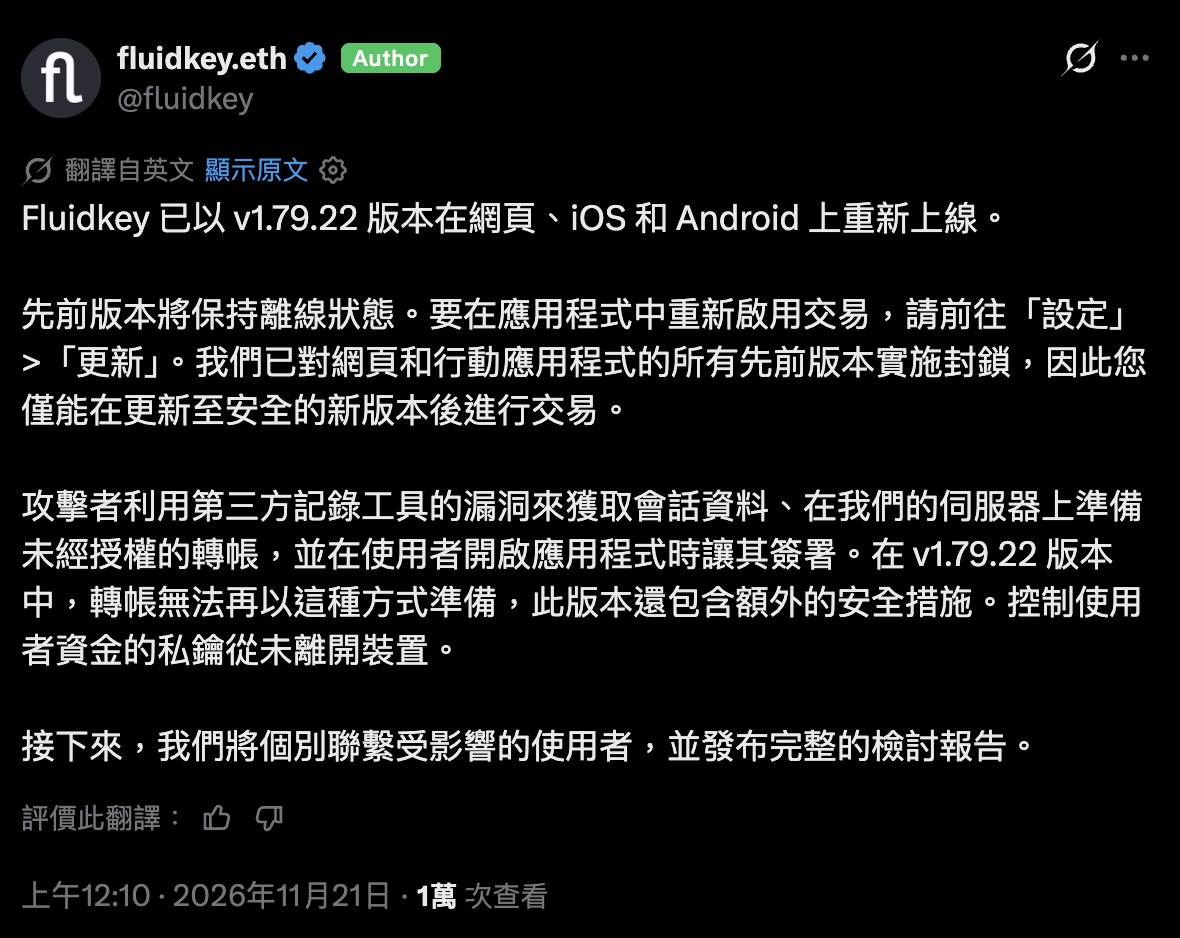 Image source: X/@fluidkey. On November 20, Fluidkey released version 1.79.22, restoring services on the web, iOS, and Android apps
Fluidkey has updated SigNoz, revoked existing login sessions, restricted external access to the log query interface, and stopped recording sensitive information such as login credentials in logs.
To address the core flaw behind the attack, Fluidkey also changed its transfer authorization mechanism, requiring transfer requests received by the server to be authorized with users’ own keys. This prevents an attacker from creating and approving transactions using login credentials alone. Changes to the two-factor authentication spending limit now also require server-side verification.
Fluidkey has contacted affected users and is working with security incident response organization SEAL 911 and blockchain investigation firm zeroShadow to trace the flow of funds. It has also notified the U.S. Federal Bureau of Investigation (FBI) and the Swiss National Cyber Security Centre.
“Fluidkey privacy wallet hack revealed: Logging tool security flaw leads to $1.6 million in losses” was originally published on “Crypto City”.