

Weekend liquidity in crypto: why Saturday and Sunday moves are often misleading and what to confirm at the weekly close
Unlike traditional stock markets, the crypto market never closes. This 24/7 trading often gives the false impression that a Sunday candle is worth exactly the same as a Tuesday or Wednesday candle. In practice, market depth changes dramatically when Saturday and Sunday arrive, and understanding this change helps you avoid falling for false breakouts and liquidity sweeps.
1. What the numbers say: almost half the volume disappears
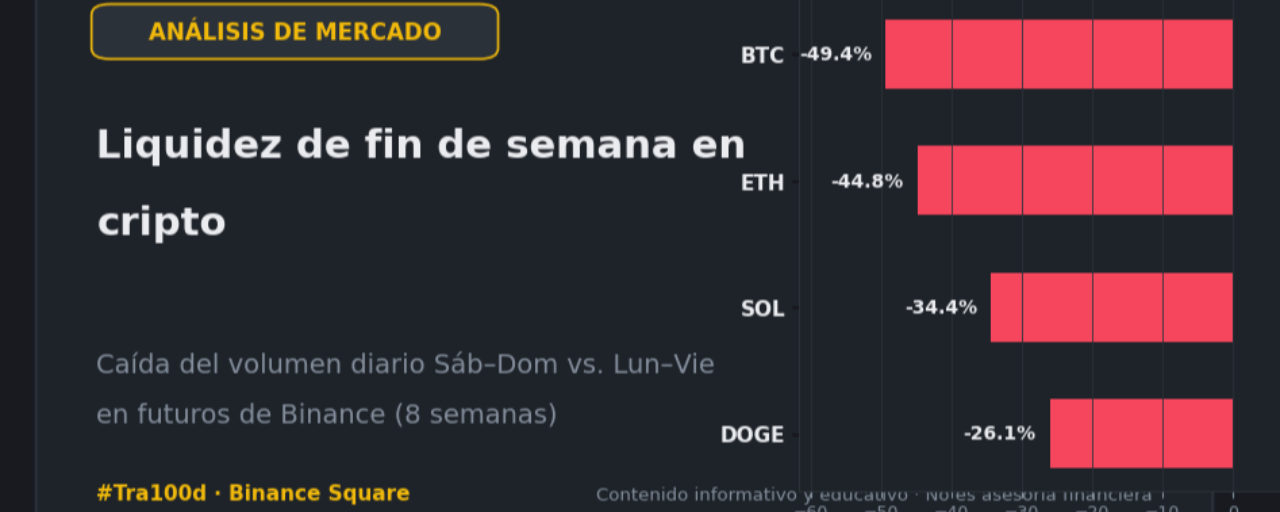
Comparing average daily volume in Binance perpetual futures over the past eight weeks (40 Monday-to-Friday trading sessions versus 15 Saturday and Sunday sessions, UTC), the drop in activity is striking:
$BTC: drops from $13.416M daily on weekdays to $6.783M on weekends (−49.4%).
$ETH: drops from $9.102M to $5.024M (−44.8%).
$SOL: drops from $1.815M to $1.190M (−34.4%).
DOGE: drops from $377M to $278M (−26.1%).
The pattern offers a clear clue about who's moving each asset: the greater the role of institutional desks, ETFs, and hedging tied to traditional markets—as is the case with $BTC and $ETH—the more volume dries up between Saturday and Sunday. By contrast, in cryptocurrencies with greater retail participation, such as memecoins, the decline is notably smaller.
2. Why a thinner order book creates traps
When volume is cut almost in half, far less capital is needed to push the price several percentage points in a few hours. This leads to three common effects on Saturday and Sunday:
Breakouts with no follow-through: an asset can break above an intraday resistance level on low volume, then give back the entire move as Asian and European liquidity returns on Monday.
Liquidation wicks: with fewer limit orders absorbing order flow, a burst of market selling or buying sweeps up accumulated stops above recent highs or below recent lows, then reverses almost immediately.
False sense of calm: the opposite can also happen; a range-bound market with depressed volume often compresses volatility just before the weekly close on Sunday (00:00 UTC), when sharp moves tend to cluster.
3. What to confirm before validating a weekend reversal
Instead of chasing the first move on Saturday or Sunday, run the chart through a three-step filter:
Relative volume above average: a technical breakout that occurs on volume below 1.0x its recent average should be treated with skepticism until participation increases.
Clean weekly close: intraday weekend wicks often get reversed; what matters is where the daily and weekly candles close at the end of Sunday UTC, and whether the price holds that level during the first sessions on Monday.
Open interest (OI) behavior: if a Sunday bounce occurs while OI is falling, it usually reflects short position closures rather than fresh institutional demand entering the market. When Monday brings a sustained increase in both volume and OI, the signal carries more weight.
4. How to adapt your risk management on Saturday and Sunday
You don't need to trade every day of the week. Many traders reduce their position size over the weekend, widen their buffers around obvious levels where stops accumulate, or set aside Saturday and Sunday to calmly review daily and weekly charts and plan scenarios for Monday's open.
Conclusion
Binance data shows that $BTC and $ETH liquidity drops by almost half on weekends (−49.4% and −44.8%). That void makes Saturdays and Sundays fertile ground for false breakouts and quick sweeps. Reading relative volume, respecting the weekly close, and waiting for confirmation when liquidity is back to full strength usually helps you avoid more mistakes than trying to guess the first move.
Do you usually trade on weekends, or do you prefer to wait for Sunday's weekly close and Monday's open? Let me know in the comments 👇
#TechnicalAnalysis #CryptoEducation #BTC #ETH #SOL #Tra100d
⚠️ For informational and educational purposes only; this is not financial advice. Cryptocurrencies are volatile: do your own research and trade with caution.