
#SolanaSets2027RoadmapToDoubleComputeCapacity
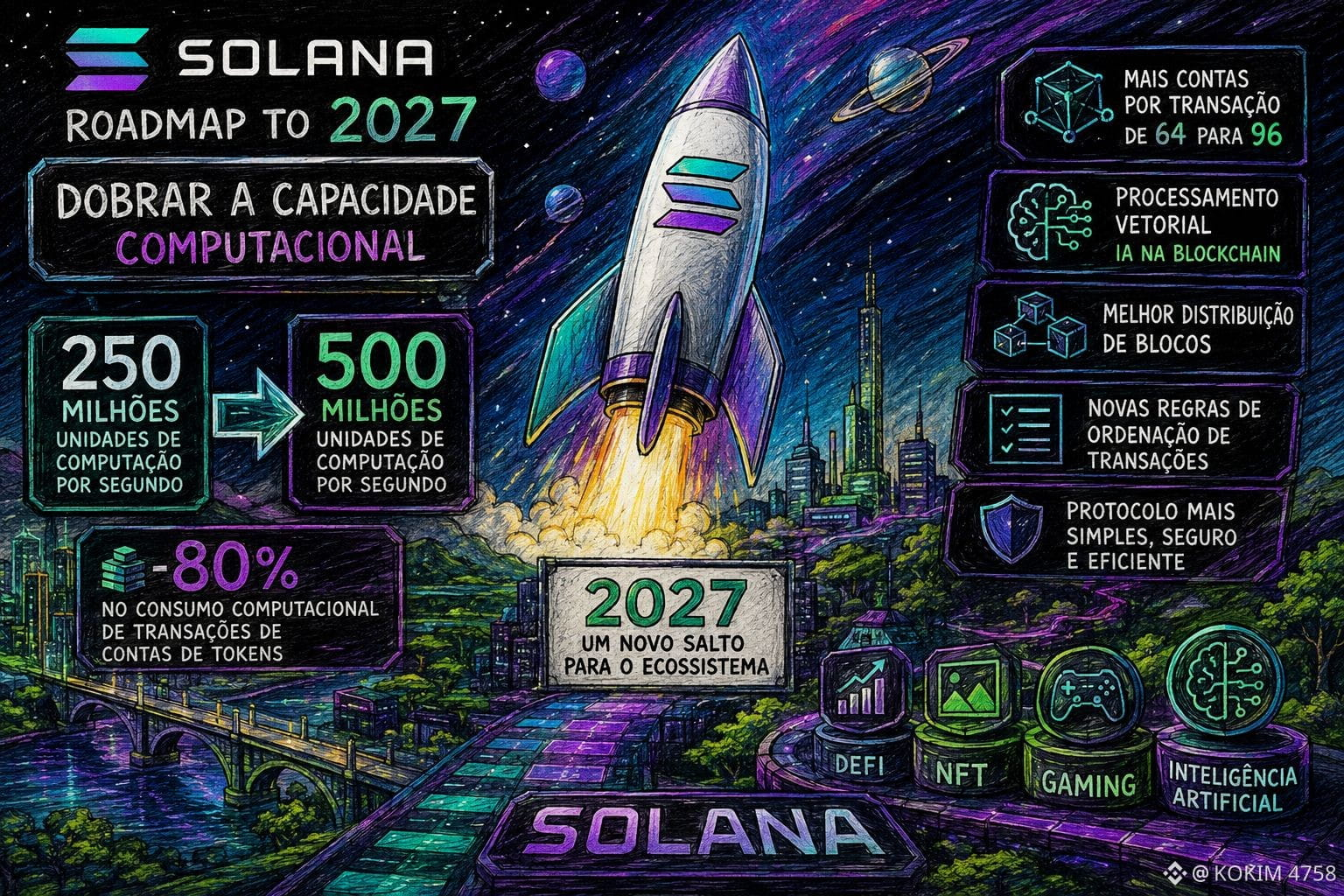
🚀 SOLANA WANTS TO DOUBLE ITS COMPUTATIONAL CAPACITY BY 2027!
Solana has just taken its ambitions to another level. Anza, the team responsible for developing a fundamental part of the network’s infrastructure, has unveiled a technology roadmap for 2027 that could further transform the ecosystem’s potential.
The goal is impressive: increase computational capacity from approximately 250 million to 500 million compute units per second. And that’s not all! The project also aims to reduce the computational cost of transactions involving token accounts by up to 80%.
Another important advancement will be increasing the number of accounts accessible per transaction in version 1 from 64 to 96, as well as introducing vector processing, paving the way for artificial intelligence models running directly on the blockchain.
The strategy also includes improvements to block distribution, new transaction ordering rules, and protocol simplification to strengthen the network’s security and efficiency.
My take: Solana doesn’t just want to be fast. It wants to build infrastructure capable of supporting a new generation of financial applications, DeFi, and artificial intelligence. If these goals are achieved, 2027 could mark a significant leap forward for the entire ecosystem.
But there’s one key detail: a roadmap isn’t a result. The real test will be turning these promises into real-world performance, adoption, and growing usage.
$SOL $NIGHT $PIEVERSE
#Solana #DeFi #CryptoInnovation