
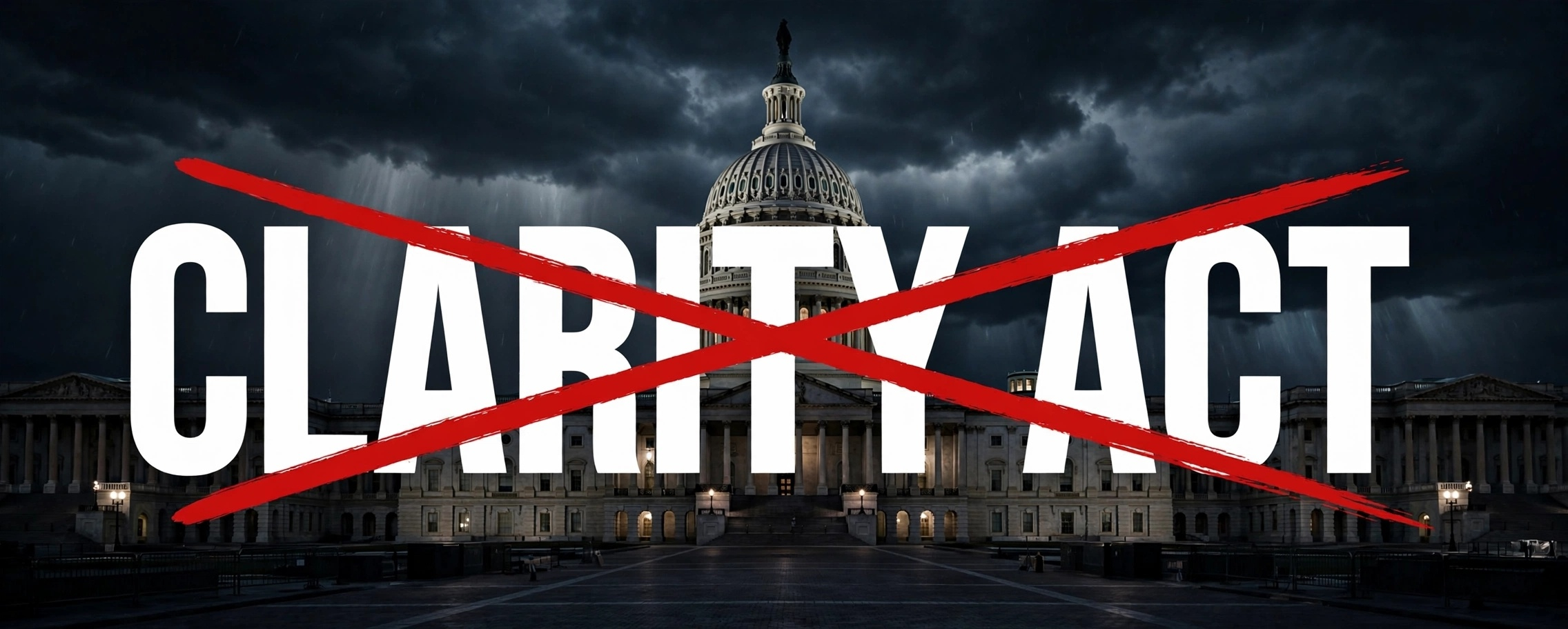

There’s a bill that had been debated for over a year, passed the House by a wide margin, and had nearly all its technical provisions finalized—but ultimately died, not because the technology was flawed.
It died because of politics.
It’s called the CLARITY Act—the Digital Asset Market Clarity Act. It’s the most important crypto market structure bill in the U.S.
And as of November 22, 2026, it can pretty much be considered dead.
What Is the CLARITY Act? Why Does It Matter So Much?
For those who haven’t been following along, the CLARITY Act is a bill that aims to establish clear rules for crypto in the U.S.
Until now, crypto in the U.S. has been regulated piecemeal. The SEC says this is a security, the CFTC says that is a commodity, and the states all have different takes. The result: exchanges are confused, developers are confused, and investors are confused.
The CLARITY Act was intended to address four main issues:
1. Division of authority between the SEC and CFTC: Which assets are regulated by the SEC, which by the CFTC, and which fall under both.
2. Stablecoin rules: How payment stablecoins are regulated, who can issue them, and what reserves they must hold.
3. DeFi rules: Who is responsible when a protocol is decentralized, and whether developers can be sued over the code they write.
4. Consumer protection + AML: Minimum standards for platforms, disclosures, and anti-money laundering.
This isn't a minor bill. It's the legal foundation for the U.S. crypto industry for the next 10 years.
And the bill had already passed the House by a vote of 294-134. That's a huge margin. It means it wasn't just one party that supported it—both parties did.
So Why Did It Fail in the Senate?
In the Senate, the CLARITY Act needed 60 votes to advance to a final vote. The result on September 15, 2026: 49-50.
Short by 11 votes. It failed.
What's frustrating is that it didn't fail because of its technical provisions.
According to Patrick Witt, the White House's former top crypto adviser, the technical negotiations were nearly complete. Almost all disagreements over stablecoins, DeFi, and the division of authority between the SEC and CFTC had been resolved after more than a year of negotiations.
It failed because of two non-technical issues:
1. Ethics Provisions Concerning Officials' Families
This was at the heart of the final debate.
The latest draft required federal officials with significant interests in token-issuing entities to divest or place those interests in a blind trust. It also gave state attorneys general a role in pursuing certain violations.
Democrats said that wasn't enough. Their reasons:
- It didn't clearly require divestment from the Trump family's crypto holdings
- Enforcement could be controlled by an attorney general appointed by the president, making it non-independent
- Stronger safeguards were needed
Republicans said they had already made concessions. Trump had even agreed on July 20 to include ethics language in the bill, including a role for state attorneys general. But Democrats said those concessions could still be circumvented.
The result: deadlock.
2. Midterm Election Timing
This is the second factor, and one people often forget.
As negotiations grew intense, the midterm elections were just around the corner. Politicians from both parties became more cautious. Supporting a bill that carried the whiff of a conflict of interest involving the president's family was politically risky.
Witt himself said, "election timing consumed the bill's remaining political window."
In other words: the election ate up its political window.
And sure enough, on November 3, 2026, Democrats won control of both chambers of Congress. With the new makeup, the chances of the old version of the CLARITY Act passing became almost zero. The new chair of the House Financial Services Committee, Maxine Waters, is now drafting a new version that is reportedly more SEC-led, gives the CFTC a smaller role, and includes stricter consumer protections.
The Industry Has Spent $170.5 Million. What Did It Get?
This is the figure that's making a lot of people even more frustrated.
The crypto industry spent $170.5 million on PACs in the 2026 election, mostly supporting Republican candidates. The goal: a pro-crypto Congress, passage of CLARITY, and clear regulations.
The result: Democrats won both chambers, and CLARITY failed.
That doesn't mean the money was completely wasted. Lobbying still made crypto a national issue. But in terms of legislative results, its main goal was not achieved.
This is an expensive lesson for the industry: lobbying money can't overcome the political dynamics of ethics and elections.
So Who Regulates Crypto Now?
This is the most important question after CLARITY's demise.
The answer: not Congress, but the agencies.
With no law in place, what's happening now is that agencies are issuing rules through the Federal Register:
- OCC: Has granted final approval for Coinbase National Trust to open on November 9 as a fiduciary custodian, and for Ripple National Trust Bank for RLUSD. The OCC is also processing GENIUS licensing applications; the comment period closes on November 23.
- The Fed: Published a proposed stablecoin rule on September 24, 2026.
- SEC + CFTC: Both are working on overhauls through rulemaking. The SEC is discussing tokenization, while the CFTC is battling states over prediction markets.
- FinCEN + OFAC: Enforcement continues. FinCEN cut MEXC off from U.S. banks on November 7. OFAC sanctioned facilitators of a North Korean IT worker scheme.
The problem: agency rules are fragile. They can be frozen or repealed if the president changes in 2028. That's different from a law, which requires Congress to change it.
Witt called this a "failure of US leadership" because the U.S. has become a country where crypto rules are set by agencies, rather than by stable laws.
Two Perspectives You Need to Understand
To be fair, we need to look at both sides:
The Case for the Old Version of CLARITY:
According to its supporters, the old version of CLARITY was good enough. It already included ethics provisions; they just needed to be refined. The important thing was to establish clear rules first; ethics could be tightened through amendments. If the bill dies completely, consumers are the ones who lose, because the market is left without legal certainty. Developers become afraid to build in the U.S. and move to other countries with clearer rules.
The Case for Stricter Ethics Rules:
According to its opponents, you can't create a market structure law in an era when the president and his family have major token businesses without truly independent safeguards. If enforcement is controlled by an attorney general appointed by the president, that's not independent enforcement. If divestment requirements are unclear, that's not divestment. It's better to delay the bill than pass one that's ethically flawed.
Both sides have valid arguments. The problem is that they couldn't find common ground before the election.
What Happens Next? As of November 22, 2026
This is the status as of November 22, 2026—not a prediction:
1. Old version of the CLARITY Act: Politically dead. It will not move forward in the new Congress.
2. New version: Democrats are drafting a new bill, with a greater role for the SEC. There is no vote date yet.
3. Four SEC + CFTC nominees: Steven Levine + Kristin Johnson (SEC), Nathan Anonick + Matthew Rowland (CFTC). Senate hearings took place on November 19; they have not yet been confirmed.
4. Agency rules: Still moving forward. The OCC, Fed, SEC, CFTC, and FinCEN continue to issue rules through the Federal Register.
5. Prediction markets: The new battleground. The CFTC is suing 11 states, 9 Democratic senators want the CFTC to withdraw its order, and the deadline to respond is November 23.
So for the next two years, until at least 2029 according to some analysts, the U.S. will not have a comprehensive crypto market structure law. Instead, it will have agency rules that can change over time.
Conclusion
The CLARITY Act didn't die because the technology couldn't be regulated.
The CLARITY Act died because of two things unrelated to technology: an ethics debate over conflicts of interest and election timing that used up its political window.
This isn't a story about one party winning and another losing. It's a story about how the political process can kill a bill that was technically almost finished.
For the crypto industry, the lesson is clear: legal certainty can't rely solely on lobbying and a single bill. If its political foundations are fragile, even the best bill can die at the last second.
For traders and investors, the lesson is just as clear: don't wait for a law to arrive. What you should be watching now is no longer "When will CLARITY pass?" but "What rules will the SEC, CFTC, OCC, and Fed issue this week?" Because for now, they are the ones actually regulating the market.
And most importantly: don't hate the process—understand it. If we don't, we'll keep being surprised every time a bill that's almost finished suddenly dies again.
Sources: CoinPost, Insight News, Senate Banking Committee hearing, November 19, 2026, Federal Register, OCC, FinCEN, CoinMarketCap.
Disclaimer: This article is for educational purposes only and is based on public data as of November 22, 2026. It is not a political endorsement or financial advice. Always DYOR. $EVAA